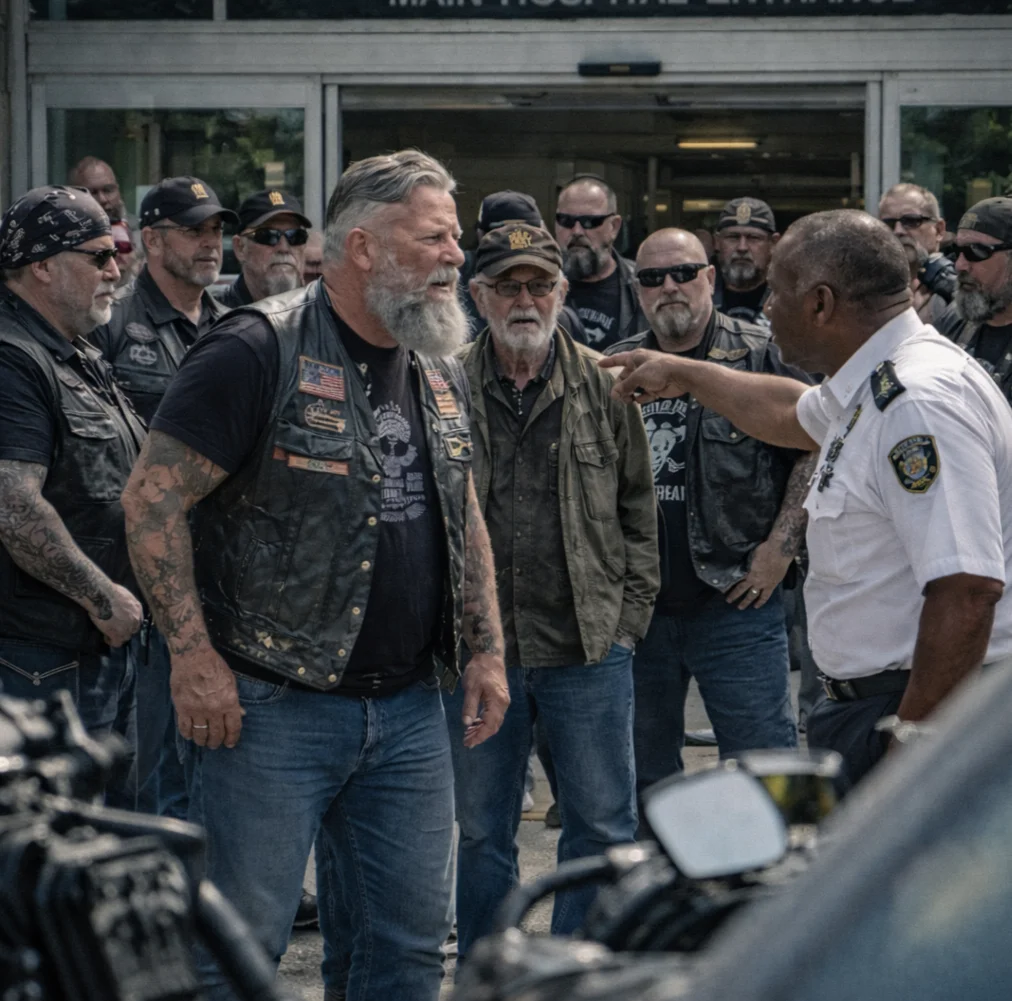
Thirty-two bikers shut down a hospital entrance because security wouldn’t let a veteran say goodbye to his dying wife.
I was one of them.
And I would do it again tomorrow.
At the time, I didn’t even know his name.
All I knew was what a nurse told us over the phone: a man had just been thrown out of the hospital by security. His wife was upstairs on the fourth floor, dying of terminal pancreatic cancer. She had only hours left.
They had dragged him out because he was homeless.
Because he smelled.
Because he didn’t have an ID card.
Because he didn’t look like the kind of man who deserved to sit beside the woman he had loved for thirty-one years and say goodbye.
I called Danny.
Danny called the club.
The club called every rider within thirty miles.
We were at that hospital in less than an hour.
When we pulled into the parking lot, I saw him immediately.
He was sitting on the sidewalk near the emergency entrance, wearing dirty jeans and a torn jacket, his hands trembling in his lap. He kept staring up at the fourth floor, counting windows, trying to guess which one belonged to his wife.
I parked my bike and walked over to him.
“You Earl?” I asked.
He flinched like he thought I might hit him.
“Yeah.”
“What room is your wife in?”
“Four-twelve. Her name’s Linda.”
“How long have you been married?”
“Thirty-one years in April.”
I looked at him for a second.
“How’d you end up out here?”
His jaw tightened.
“Medical bills,” he said. “When Linda got sick. Lost the house. Lost everything trying to pay for treatment that didn’t work.”
That hit me hard.
The man had gone broke trying to save his wife. He had lost his home, his stability, and whatever life he once had. And now, when her final hours had come, the hospital wouldn’t even let him hold her hand.
“Stay here,” I told him. “We’re going to fix this.”
By the time I walked back to the parking lot, there were thirty-two bikes lined up across the main entrance.
Thirty-two brothers standing shoulder to shoulder, arms crossed, silent.
Danny was already at the front doors, talking to a hospital administrator who looked like he might throw up.
The man kept repeating words like policy, liability, and proper identification.
Danny kept repeating one sentence.
“Let him see his wife.”
The police were on their way.
So were the news cameras.
So was every biker within fifty miles who had seen the text chain.
And up on the fourth floor, Linda Walker was dying alone, asking the nurses where her husband was.
We were not leaving.
Not for the police.
Not for hospital security.
Not for anyone.
Not until Earl got to Room 412.
The administrator’s name was Geoffrey—some last name I never cared enough to remember.
He couldn’t have been older than forty. Expensive suit. Soft hands. The kind of face that looked like life had never truly challenged him.
He stood behind the glass doors as if they would protect him.
“This is a medical facility,” he said through the intercom. “You are disrupting patient care and violating multiple regulations. If you do not disperse immediately, you will be arrested.”
Danny didn’t move.
“There’s a veteran sitting on your sidewalk,” he said. “He served two tours in Iraq. He’s been homeless for three years. His wife is dying upstairs. And your people threw him out like trash.”
“He had no identification,” Geoffrey replied. “He was creating a disturbance. We have policies—”
“Your policies are making that woman die alone.”
Geoffrey blinked.
“I’m sorry?”
Danny’s voice turned colder.
“She is upstairs dying by herself while the only person she wants to see is sitting outside on the concrete because your security guards decided he didn’t look clean enough to say goodbye to his own wife.”
By then, a crowd had started to form.
People stood near the entrance with their phones out, recording everything. One woman was already streaming live on Facebook.
Geoffrey noticed the cameras.
His jaw tightened.
“I’ve called the police,” he said. “They’ll be here shortly.”
“Good,” Danny replied. “Bring the mayor too. We’ll explain it to everyone.”
More bikes were arriving now.
The message had spread far beyond our club. Other clubs came. Independent riders came. Men who had never met Earl came because they heard what happened and couldn’t stomach it.
By the time the first police cruiser rolled in, there were almost fifty motorcycles in that parking lot.
Two officers stepped out. One was older, one younger. The older one took one look at the bikes, looked at the hospital entrance, and sighed.
“All right,” he said. “Who’s in charge here?”
Danny stepped forward.
“That would be me.”
The officer introduced himself as Officer Martinez.
“What’s going on?”
Danny told him everything. About Earl. About Linda. About Room 412. About security dragging a husband out while his wife lay dying upstairs.
Martinez listened carefully. He didn’t interrupt once.
Then he turned to the younger officer.
“Stay here.”
And he went inside the hospital.
We waited.
Earl was still sitting on the sidewalk. I went back to him.
“What’s happening?” he asked.
“We’re working on it.”
“She doesn’t have much time,” he said. “The nurse who called you guys—she texted me. Linda keeps asking for me. She’s scared.”
His voice cracked on that last word.
Scared.
That one word nearly broke me.
“We’re going to get you in there, Earl.”
“What if you can’t?” he asked. “What if she dies while I’m still sitting out here on the sidewalk?”
I didn’t have an honest answer for that.
So instead, I sat down beside him.
This man smelled like the street. Like cold nights and too many days without comfort. He had sacrificed everything for the woman he loved, and now the system was treating him like he was disposable.
“Tell me about Linda,” I said.
He looked at me like I was crazy.
“We might be here a minute,” I told him. “Tell me about her.”
He was quiet for a while.
Then he started talking.
“She was a third-grade teacher,” he said. “Twenty-two years. Kids loved her. She used to spend her own money on school supplies because the district never gave them enough. She came home every day talking about ‘her kids.’ Not her students. Her kids.”
“How did you meet?”
“County fair. Nineteen ninety-three. She was running the ring toss booth for a school fundraiser. I told her I’d play every game she had if she’d let me buy her a corn dog afterward.”
He almost smiled.
“She said she was vegetarian.”
“Was she?”
“No,” he said. “She just wanted to see what I’d say.”
I laughed.
“What did you say?”
“I told her I’d buy her whatever she wanted for the rest of her life.”
He shook his head.
“She said it was the worst pickup line she’d ever heard. We got married seven months later.”
“Sounds like a hell of a woman.”
“The best,” he said softly. “She didn’t care that I was just a mechanic. Didn’t care about money. Didn’t care about things. She always said as long as we had each other, we had everything.”
Then his eyes drifted back up to the fourth floor.
“When she got sick, I sold the truck first. Then my tools. Then the house. Insurance covered some of it, but never enough. She kept telling me to stop. Said she’d rather die than watch me destroy myself trying to save her.”
“But you kept going.”
He looked at me like the answer was obvious.
“What was I supposed to do? Just let her die?”
“No,” I said. “You did what a husband does.”
His face crumpled.
“And now I can’t even get into the building to hold her hand.”
Officer Martinez came back out about fifteen minutes later.
He walked right past Danny and straight toward me and Earl.
“Mr. Walker?”
Earl looked up quickly.
“Yeah?”
“I’ve spoken with the hospital administration,” Martinez said. “They’ve agreed to let you see your wife.”
Earl folded forward like all the strength had gone out of him at once.
“But,” Martinez added carefully, “there are conditions. They want you checked in properly. A nurse on the fourth floor has agreed to verify who you are. And they would like you to…”
He paused, searching for the least humiliating words.
“Clean up?” Earl said quietly.
Martinez looked uncomfortable.
“They have a shower room in the ER wing. They’ve got fresh clothes from the donation bin. If you’re willing to do that, they’ll take you straight to Room 412.”
Earl stood up so fast he nearly fell.
I caught him by the arm.
“I’ll do whatever they want,” he said. “Just get me to her.”
Martinez nodded.
“Come with me.”
At the entrance, Geoffrey was gone.
Instead, an older woman with kind eyes met us inside. Her badge identified her as Margaret, the Chief Nursing Officer.
“Mr. Walker,” she said gently, “I’m sorry for what happened. We’re going to take care of you now.”
She said it like she meant it.
Like she was ashamed of what had been done in that building.
They led Earl to a shower room in the ER wing. They gave him towels, soap, a razor, and a clean set of clothes—nothing fancy, just a flannel shirt and clean jeans.
He was done in twelve minutes.
I have never seen anyone shower that fast.
When he came back out, he didn’t look like a different man.
He just looked like the same man, stripped of the dust and humiliation of the street.
His face was gaunt. His eyes were hollow with grief.
But he was clean.
And his wedding ring shone on his finger.
Margaret escorted him to the elevator.
I followed.
No one stopped me.
The fourth floor hallway was long and quiet. Room 412 sat near the end. A nurse named Denise—the one who had called us—was standing outside the room waiting.
“She’s still here,” Denise said softly. “She’s been asking for you all day.”
Earl put his hand on the door but didn’t move.
“How bad is it?” he asked.
Denise hesitated.
“She’s comfortable. But she’s very tired, Mr. Walker.”
He nodded once.
Then he opened the door.
I stayed in the hallway.
That moment belonged to them.
But through the window, I could see Linda Walker lying in the hospital bed.
She looked impossibly small.
The cancer had taken almost everything from her except her eyes.
And when Earl walked into that room, her eyes lit up.
“Earl,” she whispered.
She said his name like it was a prayer.
“I’m here, baby,” he said, his voice breaking. “I’m here.”
He crossed the room in three quick steps and took her hand, pressing it against his face.
“Where were you?” she asked. “I kept asking for you. They said you weren’t here.”
“I tried to come,” he said. “They wouldn’t let me in.”
“Why?”
He didn’t answer.
He just held her hand tighter.
Then she looked at him and said, “You shaved.”
He gave a broken little laugh.
“Yeah. Wanted to look nice for you.”
“You always look nice to me.”
That was when he completely fell apart.
He bent over her, sobbing, his forehead against her chest.
And with all the strength she had left, Linda lifted her hand and ran her fingers through his hair.
“It’s okay,” she said. “You’re here now. That’s all that matters.”
I couldn’t stay there after that.
I went back downstairs and told Danny that Earl was with Linda.
The news spread across the parking lot like a wave.
Someone started clapping.
Then another person joined in.
Then the whole lot.
Not for us.
For Earl.
The police allowed us to remain as long as we didn’t block the ambulance entrance. Officer Martinez said we could stay as long as necessary.
So we stayed.
Hours passed.
The sun went down.
Somebody ordered pizza.
Someone else brought coffee.
We sat with our bikes and waited.
At 9:47 that night, Denise came outside and found me in the lot.
Her eyes were red.
“She’s gone,” she said quietly. “About ten minutes ago. He was holding her hand.”
I closed my eyes.
“He sang to her at the end,” Denise added. “Some song she loved. She smiled. Then she just… slipped away.”
“Was it peaceful?” I asked.
Denise nodded.
“It was beautiful. She wasn’t alone. She wasn’t afraid. He was right there.”
I told Danny.
Danny told the others.
Fifty riders stood in that parking lot with their heads bowed.
No one spoke.
No engines.
No noise.
Just silence for Linda Walker.
Then Danny lifted his head and said, “Start them up.”
Fifty motorcycles roared to life all at once.
The sound shook the windows of that hospital from one end to the other. Every floor heard it.
Every patient heard it.
Every doctor, every nurse, every administrator heard it.
We revved our engines for thirty seconds.
A final salute.
For Linda.
For Earl.
For thirty-one years of love that no hospital policy had the right to interrupt.
Then we cut the engines.
And the silence afterward felt sacred.
Earl came downstairs about an hour later.
Margaret walked beside him, carrying a small bag with Linda’s things—her wedding ring, a necklace, a photograph from her wallet.
He stepped out into the parking lot and saw fifty bikers standing there looking at him.
He didn’t know what to say.
Truthfully, neither did we.
Danny walked over, took off his leather vest, and draped it around Earl’s shoulders.
“You need somewhere to stay tonight, brother?” he asked.
Earl looked at him and said, “I’m not a biker.”
Danny shook his head.
“You’re a veteran. You’re a husband. You stayed with your wife until her last breath. That makes you our brother.”
Earl’s mouth trembled.
“I don’t have anywhere to go.”
“Yeah, you do,” Danny said. “You’re coming with us.”
And he did.
We took him home that night—to Danny’s house. We gave him a bed, a warm meal, and a place where he didn’t have to keep surviving for a few hours.
He stayed there three days.
After that, we got him into a veteran’s housing facility through one of our members. We helped him connect with VA benefits he had never applied for, mostly because no one had ever helped him understand what was available.
We also paid for Linda’s cremation.
No fundraising campaign. No speeches. No pressure.
The club just passed the word around, and the brothers showed up with cash.
When the time came, Earl scattered Linda’s ashes at the county fairgrounds—where they had first met, where he had offered to buy her a corn dog, and where she had pretended to be vegetarian just to mess with him.
Six of us rode with him that day.
We stood in a circle while he said goodbye.
“I’ll see you soon, baby,” he whispered. “Save me a seat.”
That was eight months ago.
Earl is doing better now.
He has a roof over his head. He has a job at an auto shop. Turns out he’s still one hell of a mechanic when he isn’t trying to live under a bridge.
He comes by the clubhouse on Saturdays now. Drinks coffee. Talks about Linda. We listen.
He still isn’t a biker.
He doesn’t ride.
He doesn’t wear leather.
But he is family.
The hospital changed its visitor policy two months after the standoff. Margaret pushed for it.
Now, when a patient wants to see a family member who cannot provide traditional ID, there is a process to verify them through nursing staff and patient confirmation.
They call it the Walker Policy.
Geoffrey the administrator got reassigned.
I have no idea where he went.
I don’t care.
Officer Martinez rides with us sometimes on his days off now. Good man. Owns a Sportster. Not a very smooth rider yet, but he’s learning.
Denise sends us Christmas cards every year.
She signs them:
From Room 412
And every Tuesday night, Earl calls Danny.
They talk for an hour.
About nothing.
About everything.
About Linda.
Danny never misses the call.
People ask me why we did what we did that day.
Why thirty-two bikers showed up for a man none of us had ever met.
I always tell them the same thing.
Because he was one of us.
Because he served this country, lost everything trying to save his wife, and was thrown onto a sidewalk by the very system that should have treated him with dignity.
Because no veteran should be invisible.
Because no husband should miss his wife’s final breath.
Because sometimes doing the right thing is not polite, or quiet, or convenient.
Sometimes it is loud.
Sometimes it is stubborn.
Sometimes it means blocking the front entrance of a hospital until somebody finally does their job.
We’re bikers.
This is what we do.
We show up.
We don’t leave.
We take care of our own.
And Earl Walker is one of our own.
He always will be.