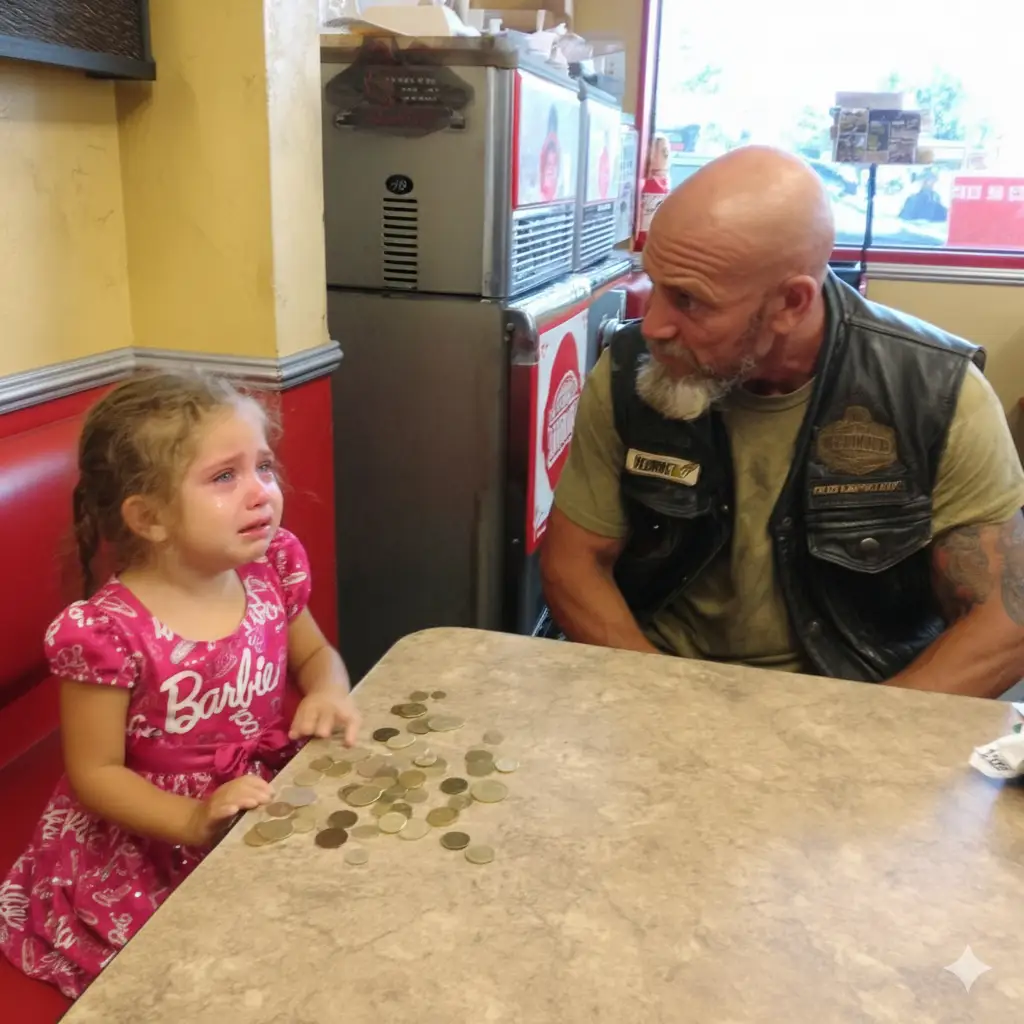
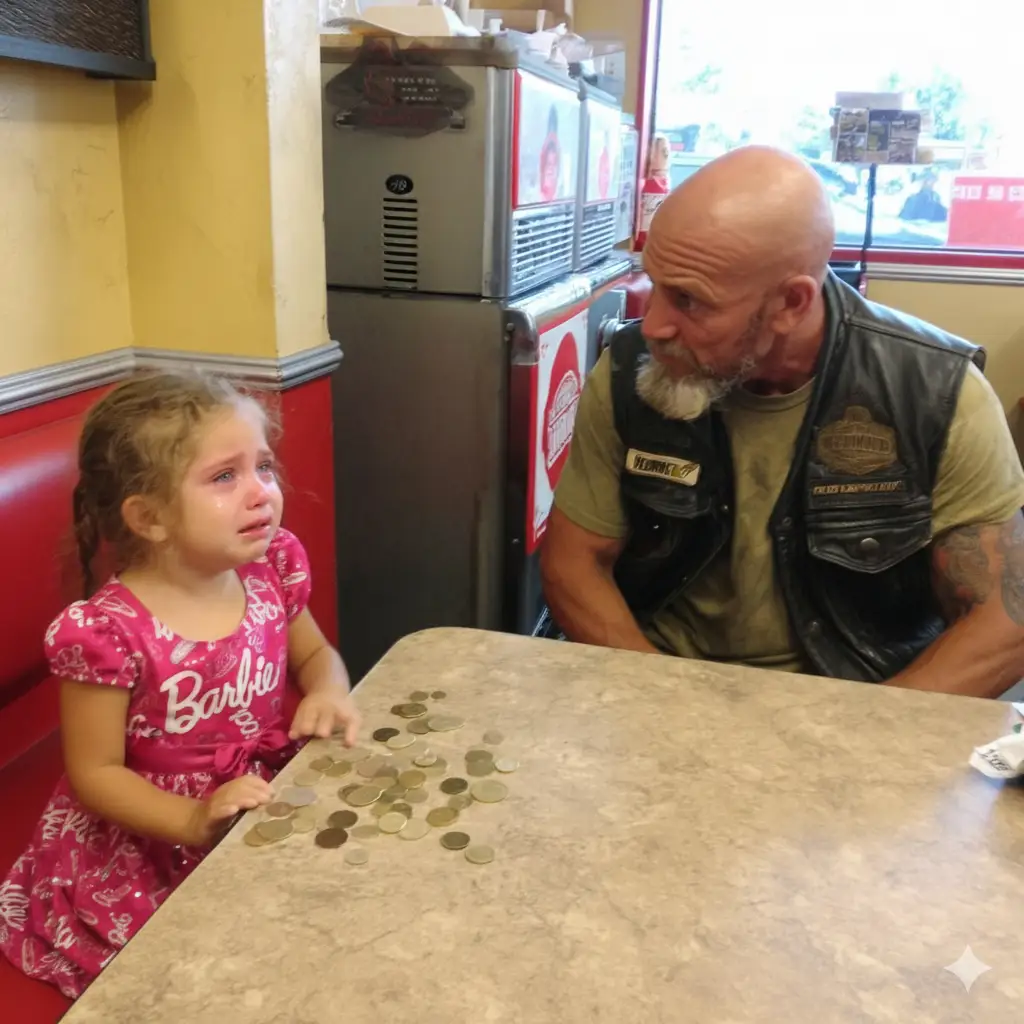
A little girl walked up to my table in a diner and begged me to teach her father how to ride a motorcycle again.
“He cries every night since the accident took his legs,” she said.
Then she dumped the contents of her piggy bank onto my table — $4.73 in pennies and nickels — carefully counting each coin on the sticky diner surface.
“But he used to race bikes before I was born,” she continued quietly. “And I thought maybe…”
Her voice broke. Tears dropped onto the table.
Outside the diner window, her father sat in a wheelchair in the parking lot, staring at my Harley with the kind of longing that could break your heart. He looked about thirty-five, military haircut, prosthetic legs visible below his shorts.
He hadn’t come inside.
Too proud to let anyone see his daughter begging for help he couldn’t afford.
I watched him for a moment.
Then I looked back at the girl.
“What’s your name, sweetheart?” I asked, gently pushing the coins back toward her.
“Emma,” she said. “That’s my dad, Marcus. He won’t talk about motorcycles anymore. Says that life is over.”
She leaned closer, lowering her voice like she was sharing a secret.
“But I saw him looking at motorcycle magazines at the store. He touched the pictures like they were treasure.”
What Emma didn’t know was that I ran a custom motorcycle shop that specialized in adaptive bikes for wounded veterans.
I stood up from my booth and left a twenty on the table for my coffee.
“Keep your money, Emma,” I said. “But I need you to do something for me.”
Her eyes lit up instantly.
“Anything!”
“Go tell your dad that Jack Morrison from Morrison Custom Cycles wants to talk to him about his old racing days.”
I paused.
“And tell him I knew Tommy Valdez.”
Tommy Valdez had been Marcus’s best friend.
Killed in the same explosion that took Marcus’s legs.
I’d built Tommy’s memorial bike the year before for his widow.
Emma ran outside clutching her coins. I watched through the window as she tugged on her father’s sleeve and pointed toward the diner.
Marcus looked confused.
Then shocked.
Then afraid.
He wheeled himself inside slowly, Emma pushing from behind even though the chair was electric.
Up close, I saw the look I’d seen in too many veterans.
The hollow look.
The giving-up look.
“You knew Tommy?” he asked.
His voice sounded rough, like he hadn’t spoken much lately.
“I built his memorial bike,” I said. “His wife commissioned it.”
I pulled out my phone and showed him pictures.
A beautiful Softail with Tommy’s unit insignia etched into chrome.
Marcus reached out and touched the screen gently.
“He always said he’d teach me to ride a cruiser after we got home,” Marcus said quietly. “I was more of a sport bike guy.”
“Emma told me you used to race.”
“That was before,” he said quickly.
“Before you lost your legs,” I asked, “or before you lost hope?”
Marcus’s hands tightened on the wheelchair arms.
“What the hell do you know about it?”
“I know you wake up at three in the morning dreaming about the ride,” I said calmly.
“I know you miss leaning into curves and feeling the engine beneath you.”
“How would you know that?”
“Because I’ve built bikes for thirty-seven veterans who thought their riding days were over.”
I pulled out my phone and showed him videos.
Veterans with prosthetics.
Veterans in wheelchairs.
Triple amputees riding custom trikes.
A paralyzed woman riding a modified Spyder.
Marcus watched silently.
“This is just inspiration nonsense,” he muttered.
But he didn’t look away.
“Dad!” Emma protested. “Bad word!”
I continued scrolling.
“This is Staff Sergeant James Williams. Triple amputee. Rode across the country last year.”
Marcus whispered, “Stop.”
But Emma grabbed the phone.
“Daddy, look! They’re riding!”
“With what money?” Marcus snapped.
“You think the VA pays for custom motorcycles?”
Emma quietly placed her $4.73 back on the table.
“Then I’ll save more,” she said. “I’ll skip lunch.”
Marcus froze.
“You’ve been skipping lunch?”
Emma shrugged.
“You need your motorcycle more.”
Marcus broke.
Right there in the diner.
This Marine who survived an IED.
Who endured surgeries and learned to walk again on prosthetics.
He broke.
He pulled Emma into his lap.
“Oh baby… what have I done to you?”
I gave them a moment.
Then I said quietly, “Marcus, I need you to listen.”
He looked up.
“Every motorcycle I build for wounded veterans is free.”
He blinked.
“Funded by donations and charity rides. And your bike has been sitting in my shop for six months.”
Marcus stared at me.
“What?”
“Tommy’s widow commissioned two bikes,” I said.
“One for Tommy’s memory.”
“And one for his brother who survived.”
“You.”
Marcus shook his head.
“I can’t ride anymore.”
“You can’t ride the same way,” I corrected.
“But you can ride.”
Hand controls.
Custom seat.
Stabilization system.
Everything already built.
Emma bounced in excitement.
“Daddy please!”
Marcus whispered, “It’s been three years…”
“Your soul still remembers,” I said.
I slid my business card across the table.
“Come by Saturday.”
“Just sit on the bike.”
Saturday morning at exactly 10:00 AM, Marcus rolled into my shop.
Emma stood beside him wearing a glitter-covered helmet.
The shop was full of veterans working on their bikes.
Marcus froze in the doorway.
But the other vets nodded at him.
They understood.
They’d all stood in that doorway once.
Then Marcus saw it.
A black Harley Street Glide.
Custom modifications hidden neatly in the frame.
“That’s mine?” he whispered.
“If you want it.”
He reached out and touched the tank.
Something woke up in his eyes.
“It’s beautiful.”
“Sit on it!” Emma shouted.
Other veterans gathered around.
Helping him mount.
Adjusting controls.
Showing him how it worked.
Emma stood beside me crying.
“He’s smiling,” she whispered.
Two months later Marcus took his first ride.
Ten miles.
When he returned he was crying again.
“I felt Tommy riding beside me,” he said.
Two years later Marcus now works at my shop.
Helping wounded veterans ride again.
Emma framed her $4.73 and hung it on the wall.
Under a sign that says:
“The Best Investment Ever Made.”
Marcus has helped forty-three veterans get back on bikes.
This summer he’s riding cross-country.
Emma on the back.
Chasing the sunrise they once thought they’d lost.
One day Emma asked why I helped them.
Why I didn’t just take her money.
I told her the truth.
“Forty years ago, I was your dad. Broken. Hopeless.”
“And my little daughter sold her bicycle to buy motorcycle parts for me.”
Emma smiled.
“Did it work?”
I looked around the shop.
At the veterans rebuilding their lives.
At Marcus teaching another amputee how to ride.
At the wall full of photos.
“You tell me, kiddo.”
Emma grinned.
“Yeah.”
“It worked.”
And it all started with $4.73 in pennies and nickels.
Sometimes that’s all a miracle costs.