A biker grabbed my son’s arm so hard it left a bruise at a rest stop off I-40, and I already had 911 on my screen before he let go.
My son, Lucas, is seven years old.
We were driving from Memphis to Little Rock to visit my mother. Just the two of us. It was a simple three-hour trip, and we stopped at a rest area about halfway through because Lucas needed to use the bathroom.
I let him go into the men’s room by himself.
He’s seven. He’s been doing that for over a year. The restroom was only about twenty feet away from where I stood. I could see the entrance the whole time.
He was inside for maybe four minutes.
Normal.
Then he came out.
And he wasn’t alone.
A man walked out behind him. He looked ordinary—khaki pants, blue polo shirt, clean-cut hair, friendly face. He was talking to Lucas, and Lucas was smiling back.
At first, I didn’t think much of it. Adults talk to children sometimes. That happens.
But then I saw the man place a hand on Lucas’s shoulder.
Not guiding him toward me.
Guiding him toward the parking lot.
Toward a white van parked at the far end.
I started walking faster.
That was when the biker appeared.
He came out of nowhere.
Big man. Leather vest. Bandana. Tattoos running up both arms. The kind of man most people would instantly label dangerous.
He stepped right in front of Lucas and the man in the polo shirt, cutting them off.
Then he grabbed Lucas by the arm and yanked him backward.
Hard.
Hard enough that Lucas cried out.
I screamed.
The clean-cut man froze.
The biker turned toward him and said something I couldn’t hear. The man’s face drained of color. Then he spun around and hurried toward the white van.
By then, I was already running. Already dialing 911.
A stranger had just put his hands on my child.
“Let go of my son!” I shouted.
The biker released him immediately.
He raised both hands and stepped back.
“Ma’am,” he said calmly, “you need to listen to me.”
“Don’t touch my son!”
Lucas was crying. I could already see the red mark on his arm darkening.
The 911 operator answered.
“What’s your emergency?”
The biker spoke again, still calm, still steady.
“Tell them about the white van,” he said. “Not about me. The white van. That man was taking your son.”
I froze.
Then I looked toward the parking lot.
The white van was pulling out fast.
Too fast.
Its tires squealed as it shot toward the exit.
And that was the moment I understood what had almost happened.
My legs gave out beneath me. I sat down hard on the concrete curb with Lucas in my arms. The phone was still in my hand. The 911 operator kept asking if I was still there.
“I need police at the rest area on I-40 westbound, mile marker 74,” I said. My voice sounded distant, like it belonged to someone else. “A man just tried to take my son. White van heading east. I couldn’t see the full plate.”
The operator began firing questions at me.
What kind of van?
Description of the man?
How many people inside?
I could barely think.
My brain had stopped working.
The biker crouched down nearby—not too close, just close enough to help.
“White Ford Transit van,” he said. “Probably a 2019 or 2020. White male, around forty years old, five-foot-ten, about one-eighty, brown hair, khakis, blue polo shirt. Arkansas plates. Partial plate was 4-7-Charlie.”
He had memorized everything.
I repeated his words to the operator exactly.
“Stay where you are,” she told me. “Units are on the way.”
When I hung up, I looked at him properly for the first time.
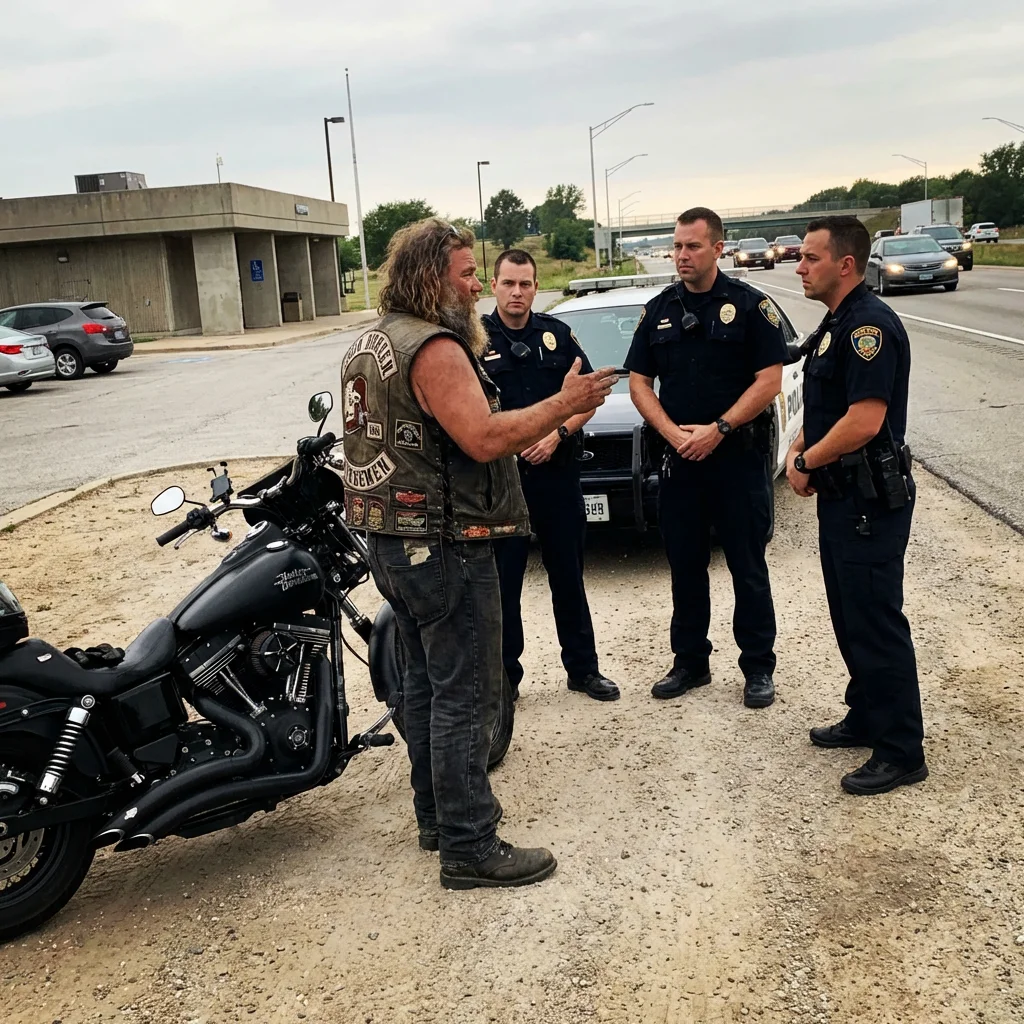
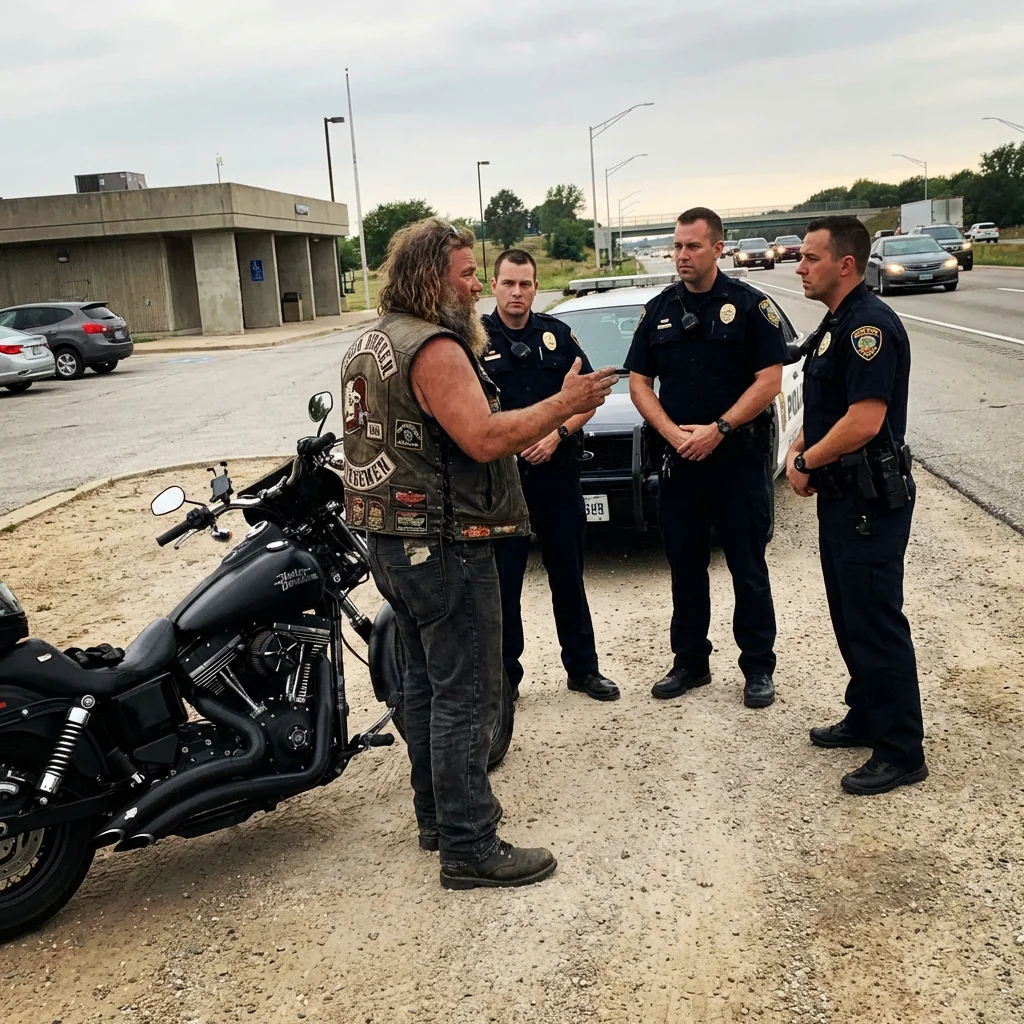
He was sitting on the curb a few feet away. Up close, he seemed even larger. His arms were covered in tattoos—an eagle on one forearm, military insignia on the other. His leather vest had patches.
One read USMC.
Another read BACA.
He wasn’t looking at me.
He was staring out toward the highway in the direction the van had gone. His jaw was tight. His hands were clenched.
He was furious.
Not at me.
Not at Lucas.
At the man in the polo shirt.
“How did you know?” I asked.
He didn’t answer right away.
Then, quietly, he said, “I’ve seen it before.”
“Seen what?”
“The pattern,” he said. “The approach. The grooming. The redirect. They find a child alone, start a conversation, build trust fast, make physical contact, then guide them away from their parent and toward a vehicle. It usually happens in under five minutes.”
He said it like someone who had repeated those words many times before.
“Who are you?” I asked.
“Name’s Dean. I’m with BACA.”
“What’s BACA?”
“Bikers Against Child Abuse. We work with law enforcement and child services. We protect kids.”
I looked again at the patch on his vest.
I had never heard of them.
“You were just here by chance?”
“I was taking a break,” he said. “But when I pulled in, I noticed the van. No rear windows. Out-of-state plates. Engine left running while nobody got out. That’s a red flag.”
“So you were watching it.”
“Yes, ma’am. Then I saw the man go into the restroom. A minute later, your son went in after him. Then they came out together.”
My stomach twisted.
“He was in the bathroom with my son?”
“Yes, ma’am.”
“Did he—”
“I don’t think so,” Dean said quickly. “I think he just started talking to him in there. These guys move fast. They’re practiced.”
Lucas was still in my lap, his face buried in my shirt. He had stopped crying, but he was shaking.
I looked down at him.
“Baby,” I said gently, “what did that man say to you?”
His voice was muffled.
“He said he had a puppy in his van. He said I could pet it. He said it was a secret surprise.”
I thought I was going to be sick.
“A puppy?” I whispered.
“He said his name was Mike,” Lucas said. “He was nice, Mama. He seemed nice.”
Dean looked directly at me.
“That’s how they work,” he said. “They don’t look scary. They don’t act creepy. They look friendly. Normal. Safe. They know exactly what to say.”
“And if you hadn’t been here?”
Dean didn’t answer.
He didn’t need to.
Two state police cruisers arrived within minutes. One officer took my statement. Another spoke to Dean. A third searched the restroom and parking area.
They found something in the men’s room.
A stuffed puppy sitting on the sink.
Bait.
Deliberately left there.
The officer taking my statement was calm, but I could see the tension in his face.
“This matches patterns we’ve been tracking,” he told me. “Rest stops along I-40 have been flagged. We’ve had multiple reports in the last six months.”
“Multiple?”
“This corridor is known,” he said. “They target rest areas. Especially ones with isolated restrooms and distracted parents.”
The world seemed to tilt.
I had sent Lucas into that bathroom alone.
Twenty feet away.
While I stood there checking my phone.
The officer seemed to read the guilt on my face.
“This is not your fault,” he said. “These people are professionals. They study behavior. They wait for tiny openings.”
“But I was right there.”
“And they chose that moment because you were right there but distracted. That’s how they work.”
Dean walked back over after finishing his statement.
“They’re running the plates now,” the officer said to him. “Units are already looking for the van.”
Dean nodded.
“Check registration history,” he said. “Guys like that switch plates.”
The officer looked at him carefully.
“You’ve done this before.”
“Yes, sir.”
“How many times?”
Dean was quiet for a moment.
“Enough.”
The officer shook his hand.
Then he turned to me and said, “You should thank him. Five more seconds, and your son would have been in that van.”
Five seconds.
I looked at the bruise forming on Lucas’s arm.
Dark purple already.
Five seconds.
The police eventually left after giving me a case number and a card. They told me there was a good chance they would find the van because of Dean’s description.
Lucas and I sat there for a while after they were gone. Dean sat nearby on his motorcycle, drinking from a water bottle and giving us space.
I should have gotten back on the road.
My mother was expecting us.
But I couldn’t move.
My hands would not stop shaking.
Then Lucas looked up at me.
“Mama?”
“Yes, baby?”
“That big man hurt my arm.”
I looked at the bruise. Then at Dean. Then back at Lucas.
“I know,” I said softly. “But he was helping you.”
Lucas frowned.
“How was he helping me? He grabbed me.”
How do you explain something like that to a seven-year-old?
How do you explain that the man who looked kind was dangerous, and the man who looked dangerous was the one who saved him?
I took a breath.
“Sometimes people who look nice are not nice,” I said. “And sometimes people who look scary are actually very good.”
“Like the man in the bathroom?”
“Yes.”
“He lied about the puppy.”
“Yes, baby. He lied.”
Lucas thought about that for a moment.
Then he asked, “And the big man with tattoos? He was good?”
“He was very good,” I said. “He saved you.”
Lucas turned and studied Dean from across the lot.
Then, with the total honesty only children have, he said, “His tattoos are cool.”
Despite everything, I nearly laughed.
I carried Lucas over to where Dean was sitting beside his bike.
Dean looked up.
“I owe you an apology,” I said. “And I owe you a thank you. I don’t even know which should come first.”
“You don’t owe me either one,” he said. “I was just doing what I do.”
“You bruised my son’s arm.”
He nodded immediately.
“I know. I’m sorry for that. I grabbed harder than I meant to. But he was three steps from that van door, and I had maybe two seconds to act.”
“I was ready to have you arrested.”
He gave a small, tired smile.
“I know. Happens more than you’d think.”
“What?”
“People see a biker put hands on a kid, they don’t think rescue. They think assault. I’ve had guns pulled on me twice. Been pepper-sprayed once. Had cops called more times than I can count.”
“And you still keep doing it?”
“Every time.”
“Why?”
Dean looked out toward the highway again.
Then he said, “I have a daughter. She’s twenty-three now. But when she was nine, a man tried to take her from a park.”
I felt my breath catch.
“What happened?”
“He told her her mother had been in an accident and that he was there to take her to the hospital,” Dean said. “She got into his car because he seemed nice and because she was scared.”
“Oh my God.”
“She was in that car for forty-five seconds before a woman in the parking lot started screaming. That woman blocked the car with her shopping cart. Made enough noise that the guy panicked and pushed my daughter out.”
His voice never rose, but his eyes changed.
“Forty-five seconds,” he said. “That’s how close I came to losing her.”
“I’m so sorry.”
“After that, I found BACA. Started volunteering. Then it turned into everything. I ride rest stops, parks, schools—places where kids are vulnerable. I watch for the patterns.”
“How often do you see it?”
“More often than anyone wants to believe.”
Lucas shifted in my arms and looked at the motorcycle.
“Can I see it?”
Dean looked at me first.
I nodded.
He showed Lucas the bike—a black Harley-Davidson Road King. Lucas climbed up on it, fascinated by the handlebars, the mirrors, the weight of it.
“You ride this every day?” he asked.
“Every day.”
“Is it fast?”
“Fast enough.”
Lucas smiled.
Then he glanced at the bruise on his arm.
“Sorry I cried when you grabbed me,” he said.
Something softened in Dean’s face immediately.
“Don’t be sorry, buddy,” he said. “You had every right to cry. I’m sorry I had to grab you that hard.”
“It’s okay,” Lucas said. “You were saving me from the lying man.”
Dean nodded once.
“Yeah. I was.”
Lucas touched the eagle tattoo on his arm.
“Cool,” he said.
Dean smiled for real that time.
“Thanks, brother.”
We exchanged numbers before I left. Dean told me to call if I remembered any new details. He also suggested getting Lucas into a child advocacy program.
“He seems fine right now,” Dean said, “but sometimes kids process things later.”
“Thank you,” I told him.
“Just doing my job.”
“It’s not a job,” I said. “You don’t get paid for this.”
“No, ma’am,” he said. “But some things matter more than money.”
Then he swung onto his bike, started the engine, and headed east on I-40.
Toward the next rest stop.
The next parking lot.
The next child someone might be watching.
They found the white van three days later near Texarkana.
There were two men inside.
The man in the polo shirt and another man driving.
Because of Dean’s description, because of the partial license plate, because he had paid attention when no one else was, the police were able to stop them.
What they found in that van turned the case into a multistate investigation.
Evidence.
Items linked to previous victims.
Connections to missing children.
The van was eventually tied to nine cases across four states.
Nine children.
Lucas would have been number ten.
I tell this story because I need people to understand something.
When I saw Dean grab my son, I saw danger.
I saw a huge man in leather putting his hands on my child, and every instinct in me screamed that he was the threat.
But the real threat was the man in khakis and a polo shirt.
The monster was smiling.
The monster had a calm voice and a story about a puppy.
The hero had tattoos, a leather vest, and hands strong enough to leave bruises.
I almost had the hero arrested while the monster drove away.
That thought still haunts me.
Dean still rides I-40.
He still watches rest stops.
He still looks for white vans, friendly strangers, and children walking the wrong direction.
He once told me he does not do it for recognition.
He does not do it for praise.
He does it because forty-five seconds almost took his daughter from him, and he made himself a promise that he would never stand by and let it happen to someone else’s child if he could stop it.
Lucas’s bruise faded.
But the lesson never will.
Do not trust appearances.
The person who looks dangerous may be the only one paying attention.
The person who looks safe may be the one you should fear.
And if you ever see a biker at a rest stop scanning the parking lot with hard eyes and clenched fists, do not assume he is looking for trouble.
He may be watching for your child.
Because someone has to.