The bikers in our town caught the man who had been poisoning dogs in our neighborhood.
The police couldn’t catch him. Security cameras couldn’t catch him.
But fifteen bikers did.
It all started in May.
First, a golden retriever died. Then a beagle. Then three more dogs within six weeks. Every one of them had been poisoned.
Someone was walking through our neighborhood at night, tossing poisoned meat into people’s yards as if killing beloved pets meant nothing.
The police investigated, but they found nothing. All they told us was to keep our dogs inside and stay alert.
By August, seven dogs were dead.
Seven families had buried pets they loved like family. Children were waking up from nightmares. An elderly woman named Ruth had not stopped crying since she found her little terrier dead on her kitchen floor.
Pepper was twelve years old.
After Ruth’s husband died, Pepper had become her only companion. Her comfort. Her reason to keep going.
And now Pepper was gone too.
What the police didn’t know was that Ruth had a son named Dale.
And Dale was a member of the Iron Horses Motorcycle Club.
Dale was a huge man—six foot three, heavily tattooed, broad-shouldered, and intimidating to anyone who didn’t know him.
But when his mother called and told him about Pepper, he cried like a child.
The next morning, Dale called his club president.
The president didn’t hesitate.
“We ride tonight,” he said.
That evening, fifteen bikers arrived in our neighborhood just before sunset.
They parked their motorcycles along the street, unfolded lawn chairs, poured coffee into metal cups, and took their places.
Then they sat.
They came back every night.
For twelve straight nights, they watched every yard, every fence, every shadow, and every movement.
At first, some neighbors felt uneasy seeing so many bikers gathered in one place.
But by the third night, people were bringing them food.
By the sixth night, children were sitting near them listening to stories.
For the first time in months, the neighborhood felt safe again.
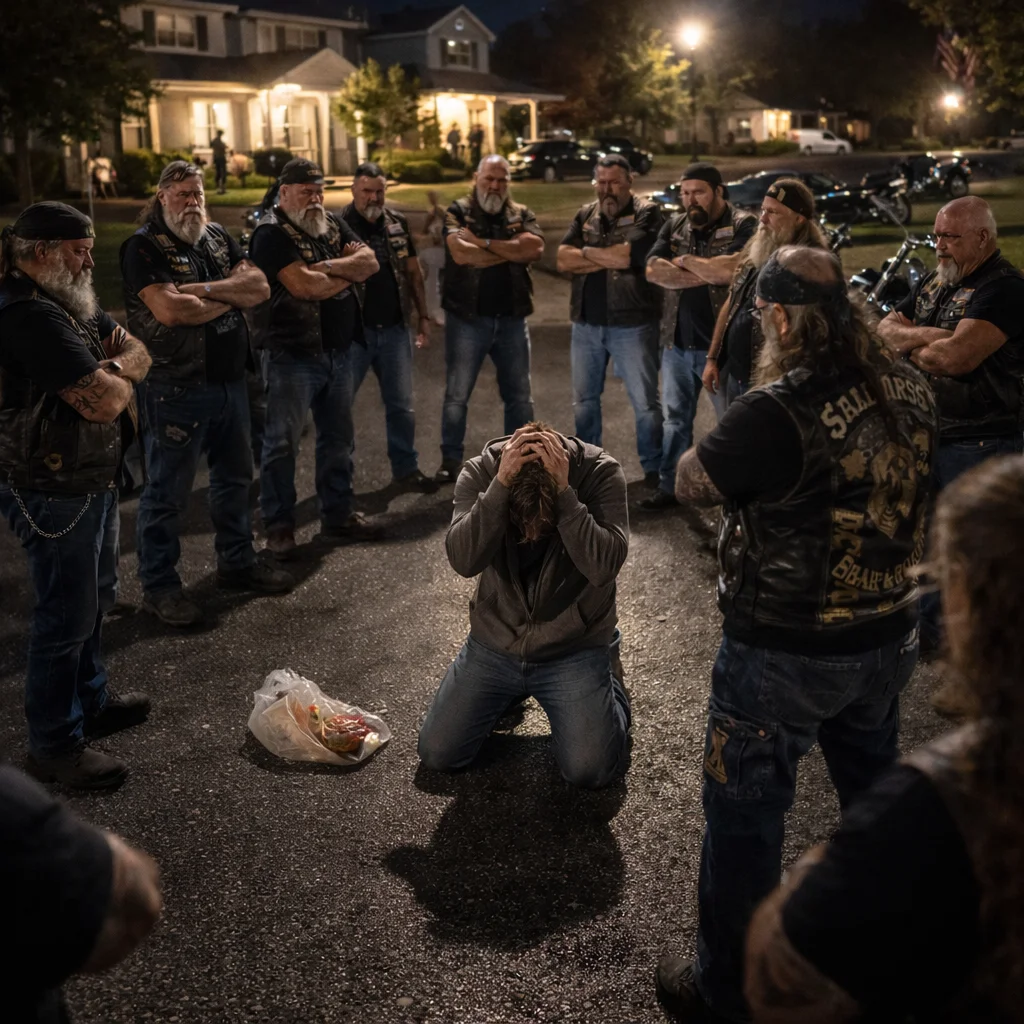
Then, on the twelfth night, at exactly 2:47 in the morning, a man appeared on the sidewalk carrying a plastic bag.
Dale spotted him first.
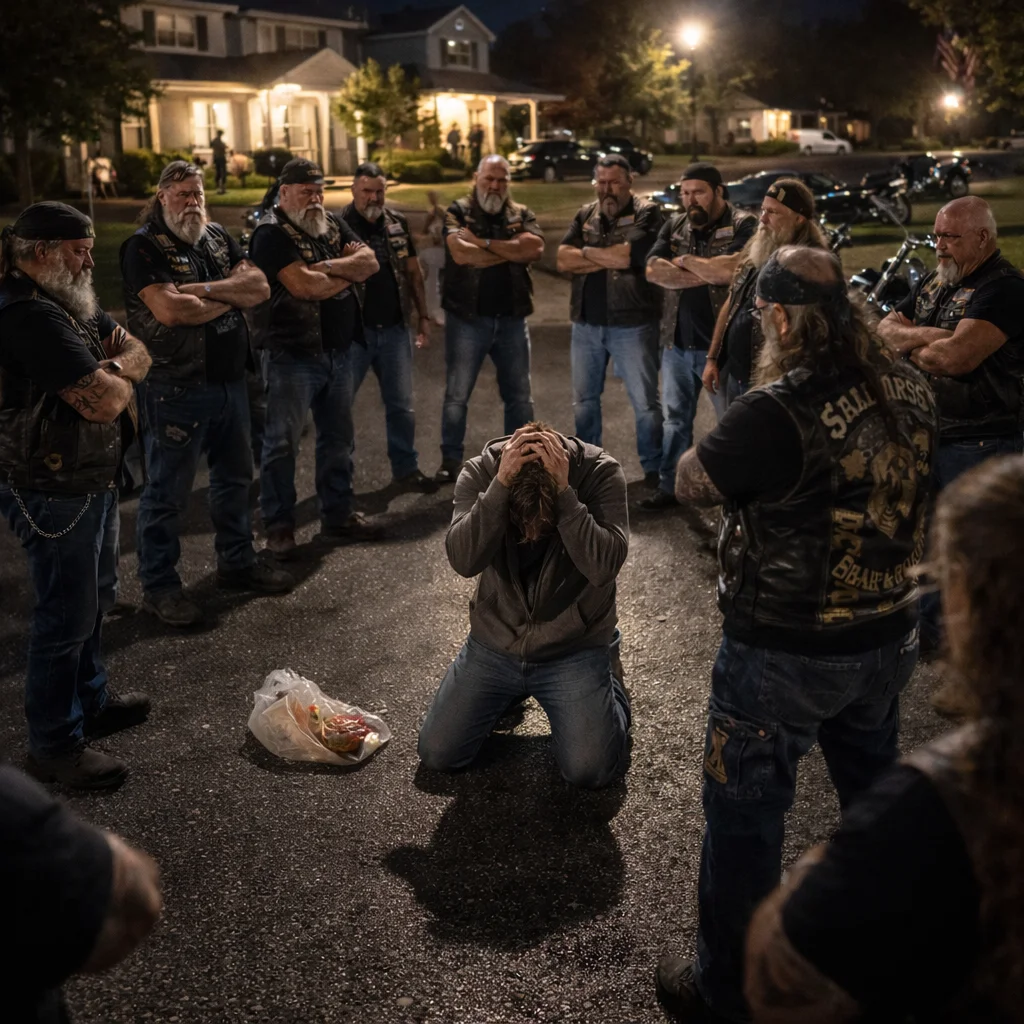
The bikers moved quietly and surrounded him before he even realized what was happening.
Fifteen large men formed a silent circle around one small man holding a bag full of meat soaked in rat poison.
His name was Gerald.
He lived only three streets away.
He looked completely ordinary.
The police were called, but they were still twenty minutes out.
The bikers never touched him.
Not once.
But what they did make him do was something he would never forget.
And neither would anyone else who witnessed it.
The moment Gerald saw he was trapped, he dropped the bag.
He tried to run, but he barely made it two steps before leather and denim blocked every direction.
“Going somewhere?” Dale asked.
Gerald was trembling. Sweat ran down his face. His eyes searched desperately for an escape, but there was none.
“I wasn’t doing anything,” he stammered. “I was just walking.”
“At three in the morning?” Dale asked.
“I couldn’t sleep.”
“With a bag of meat?”
Gerald glanced at the bag lying on the pavement.
“That’s not mine,” he muttered.
Dale didn’t blink.
“We watched you carry it down the street. We watched you stop at two fences. We watched you reach into the bag.”
“You’re mistaken. I didn’t—”
“We’ve been out here for twelve nights, Gerald,” Dale said coldly. “Do you really think we’re mistaken?”
The other bikers said nothing.
They just stood there in silence—fifteen unmoving figures made of muscle, restraint, and fury.
Gerald’s mouth opened, then closed. No words came.
“You’ve been poisoning dogs,” Dale said.
It wasn’t a question.
“No… I…”
“Seven dogs. Seven families. My mother’s dog too. A twelve-year-old terrier named Pepper. Does that sound familiar?”
Something in Gerald’s face changed.
The act was over.
“Look, it’s not what you think,” he whispered.
“Then explain,” Dale said.
Gerald swallowed hard.
“There was a dog across from my house. A shepherd. It barked every night. I complained to the owner, but he told me to mind my own business. I complained to the city. Nobody did anything. I just wanted it to stop.”
“So you poisoned it.”
“I just wanted one night of peace.”
“And the other six dogs?” Dale asked. “Did they keep you awake too?”
Gerald said nothing.
“Did a twelve-year-old terrier named Pepper bark all night outside your house?”
Silence.
“Did the beagle four streets away bother you?”
Still nothing.
Dale looked at him with disgust.
“You liked it,” he said. “You killed one dog, and you liked the feeling. The control. The power. So you kept going.”
Gerald lowered his head.
By then, lights were flicking on across the neighborhood.
Front doors opened. People stepped outside in robes, slippers, and pajamas.
Word spread quickly.
They caught him.
They finally caught him.
Within minutes, a crowd gathered.
The Hendersons came out, the family who had lost their golden retriever, Biscuit.
Mrs. Martinez came with her children, whose beagle had been buried in the backyard.
Tom and Lisa Park came too. Their German shepherd had been a therapy dog for their autistic son.
Then came the elderly couple from Elm Street whose rescue dog had been killed.
And finally, Ruth arrived.
Someone had called her.
She shuffled slowly down the sidewalk wearing her housecoat, moving with the careful steps of an old woman carrying too much pain.
When she saw Gerald standing in the middle of that circle, she stopped.
Gerald saw her too.
And he immediately looked away.
Dale turned toward him.
“Here’s what’s going to happen,” he said. “The police are coming. When they get here, you’re going to confess. But first, you’re going to face every person you hurt.”
Gerald stared at him.
“What?”
“You’re going to walk to every family here who lost a dog. You’re going to look them in the eye. You’re going to tell them what you did. And then you’re going to listen.”
Gerald shook his head.
“No. I’ll wait for the police.”
“That wasn’t a request.”
The bikers tightened the circle.
Not violently.
Not aggressively.
Just enough to make it clear there would be no escape from what he had done.
“Start walking,” Dale said.
Gerald’s legs were weak, but he moved.
Dale walked just behind him—not touching him, just there.
A shadow of justice.
The first stop was the Henderson family.
Sarah Henderson stood on the porch holding a framed photo of Biscuit.
“Tell them,” Dale said.
Gerald’s voice was barely audible.
“I poisoned your dog.”
Sarah held up the picture.
“His name was Biscuit,” she said. “He was seven years old. My daughter taught him how to shake hands when she was four. She’s nine now, and she still puts food in his bowl every morning because she doesn’t understand he’s never coming back.”
Gerald tried to look down.
“No,” Dale said. “Look at her.”
He looked.
“She cries every night,” Sarah continued. “Every single night. She asks me why someone would hurt Biscuit. She asks me if he was scared when he died. And I don’t know what to say.”
“Next,” Dale said.
Then came Mrs. Martinez and her children.
“Tell them.”
“I poisoned your dog.”
Her voice shook with anger.
“My children found him in the yard. They thought he was sleeping. My son kept trying to wake him up. He still has nightmares.”
One of the children started crying.
The other stared at Gerald with a hatred no child should ever carry.
“Next.”
Then came Tom Park.
“Tell him.”
“I poisoned your dog.”
Tom spoke through clenched teeth.
“That dog was trained for my autistic son. He was more than a pet. He was his comfort, his security, his best friend. My son still sits by the door waiting for him to come back. He doesn’t understand death. He only understands that someone he loved disappeared.”
Gerald was crying by then.
Tom took a step forward.
“I don’t care if you cry,” he said. “My son doesn’t even know how to cry properly. But he feels this loss every single day.”
“Next.”
Then the elderly couple from Elm Street.
“I poisoned your dog.”
Betty Wallace answered.
“We drove twelve hours to rescue Duke because nobody wanted him. The shelter said he was days away from being put down. We brought him home so he would finally know love and safety. And then you killed him in the one place where he should have been safe.”
Three more families followed.
Three more confessions.
Three more stories of beloved animals lost to cruelty.
A pit bull rescued from abuse. A tiny Chihuahua mix that slept beside its owner every night. A stray mutt who wandered into the neighborhood and became everyone’s dog.
Each time, Gerald had to say the words.
Each time, he had to hear what those dogs meant to the people who loved them.
By the time they reached the seventh family, Gerald could barely stand.
Then they stopped in front of Ruth.
Dale’s mother stood quietly at the edge of the sidewalk.
Small. Frail. Wrapped in an old housecoat.
She didn’t look angry.
She looked shattered.
Dale guided Gerald a few steps closer.
“Tell her,” he said, his own voice breaking.
Gerald looked at Ruth.
“I poisoned your dog.”
Ruth nodded slowly, as if she had always known the truth would eventually have a face.
“Pepper was twelve years old,” she said softly. “I got her the same year my husband died. The doctor told me I needed something to care for. Something that needed me.”
She pulled a small photo from her pocket.
Pepper had one crooked ear and bright, happy eyes.
“She slept on my husband’s pillow every night,” Ruth said. “As if she were saving his place for him. She followed me everywhere. The kitchen, the garden, the bathroom. Everywhere.”
Gerald was sobbing now.
“The morning I found her, I sat on the kitchen floor beside her for three hours before I could call anyone. I just kept petting her and apologizing to her.”
Her voice stayed calm.
That was the worst part.
No screaming. No anger. Just deep, final heartbreak.
“I’m an old woman,” Ruth continued. “I’ve buried my husband. I’ve lost friends. I’ve lost my health. Pepper was the last thing in my life that made me feel needed. When I woke up, she was happy to see me. When I came home, she was waiting at the door. You may think that sounds small. But when you are old and alone, it is everything.”
She looked directly into Gerald’s face.
“Why?”
He couldn’t answer.
“I didn’t do anything to you,” Ruth said. “Pepper didn’t do anything to you. She was tiny. Harmless. She couldn’t have hurt anyone.”
“I’m sorry,” Gerald whispered.
“Sorry doesn’t bring her back,” Ruth said. “Sorry doesn’t fill my empty house. Sorry doesn’t give me a reason to get out of bed tomorrow.”
Then she stepped closer.
“I forgive you,” she said quietly. “Because that is what my husband would have wanted. But I need you to understand something.”
Gerald looked at her through tears.
“You didn’t just kill a dog,” she said. “You killed the last piece of joy I had left. And you did it for nothing.”
At that, Gerald’s legs gave out.
He collapsed onto the sidewalk and cried like a child.
No one helped him.
And no one pitied him.
Twelve minutes later, the police arrived.
By then, Gerald had already confessed to everything—not to the officers, but to the people whose lives he had damaged.
The bikers stepped aside and let the police do their job.
Gerald didn’t resist. He didn’t deny anything. He simply held out his wrists.
As the officers placed him in the back of the cruiser, one of them approached Dale.
“You all did this?” the officer asked, looking around at the crowd, the lawn chairs, the long nights of watchfulness.
“Yes, sir,” Dale replied.
“You touch him?”
“No sir. Not once.”
“What exactly did you do?”
Dale looked at Gerald sitting in the police car.
“We made him say it,” he said. “We made him face every person he hurt. We made him hear what he took from them.”
The officer glanced at Gerald, then back at Dale.
“That’s worse than anything we could’ve done,” he said.
“That was the point,” Dale answered.
Gerald was charged with seven counts of animal cruelty, seven counts of property destruction, and one count of criminal poisoning.
He pleaded guilty to all of it.
The judge sentenced him to eighteen months in prison.
Some people said it wasn’t enough.
But when Gerald stood in that courtroom, his face showed the truth.
He was already living inside a punishment no court could ever create—the knowledge of exactly what he had done, and exactly who he had done it to.
Hurting something in the dark is easy when you never have to face the people who loved it.
But once you have to stand there and say, “I killed what you loved,” that truth never leaves you.
Three weeks after Gerald was arrested, Dale showed up at Ruth’s house carrying a cardboard box.
Ruth opened the door.
“What’s this?” she asked.
“Open it,” Dale said.
She lifted the lid.
Inside was a tiny terrier-mix puppy—tan and white, with one crooked ear.
Ruth covered her mouth.
“She came from a rescue,” Dale said. “Nobody wanted her. She has a bad leg. The vet says she’ll always limp.”
Ruth picked the puppy up, and it immediately licked her chin.
“She’s not Pepper,” Dale said gently. “Nothing could replace Pepper. But she needs someone. And I think you need someone too.”
Ruth began to cry.
Not the heavy tears of grief.
The softer kind.
The kind that begin healing.
“What’s her name?” Dale asked.
Ruth looked at the puppy’s crooked ear, her weak little leg, and her trusting brown eyes.
Then she smiled through her tears.
“Hope,” she said. “Her name is Hope.”
For the first time in weeks, Dale smiled too.
The puppy fell asleep in Ruth’s arms before they even went inside.
The Iron Horses still ride through our neighborhood now and then.
Not every night anymore.
Just often enough to remind us they’re there.
They wave at us.
We wave back.
The children run to the sidewalks to watch the motorcycles roll past.
We no longer have a dog poisoner in our neighborhood.
Instead, we have something better.
We have fifteen bikers who taught us what it really means to protect people.
Not with violence.
Not with fear.
But with patience, loyalty, and presence.
They sat in the dark for twelve nights because one old woman lost her dog, and that mattered enough for them to act.
That’s what people misunderstand about bikers.
They see the leather, the tattoos, and the loud engines, and they make assumptions.
They don’t see Dale crying on the phone with his mother.
They don’t see fifteen exhausted men giving up their sleep night after night.
They don’t see a cardboard box with a puppy inside being carried to an old woman’s front door.
They don’t see the love.
But we do.
Because we lived it.
Gerald took seven dogs from this neighborhood.
But the bikers gave us something back.
They gave us safety.
They gave us unity.
They gave us proof that there are still people in this world who show up when it matters most.
And they gave Ruth a puppy named Hope—with a crooked ear, a weak leg, and a heart full of love.
That is real justice.
Not just the kind written in legal documents.
The kind people feel.