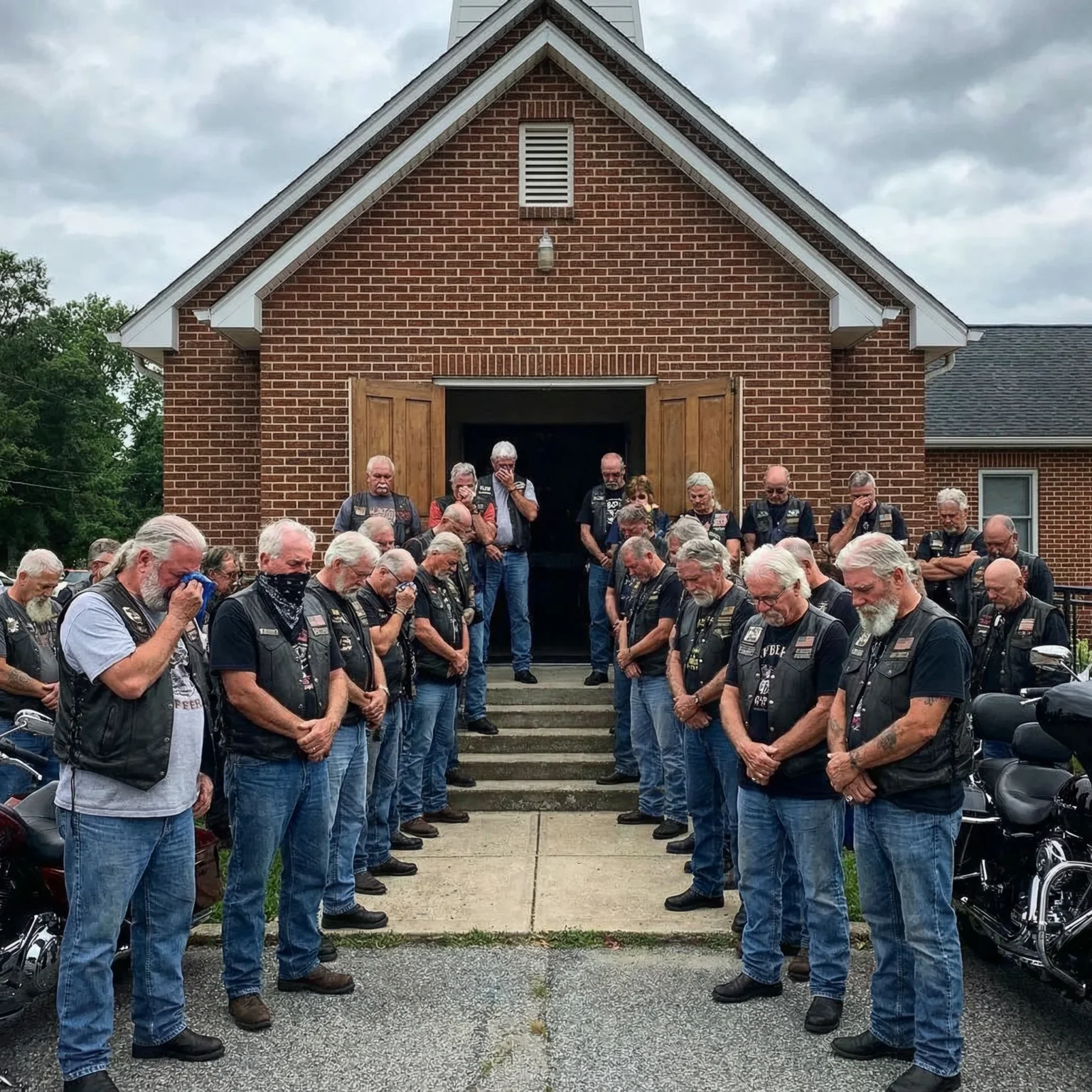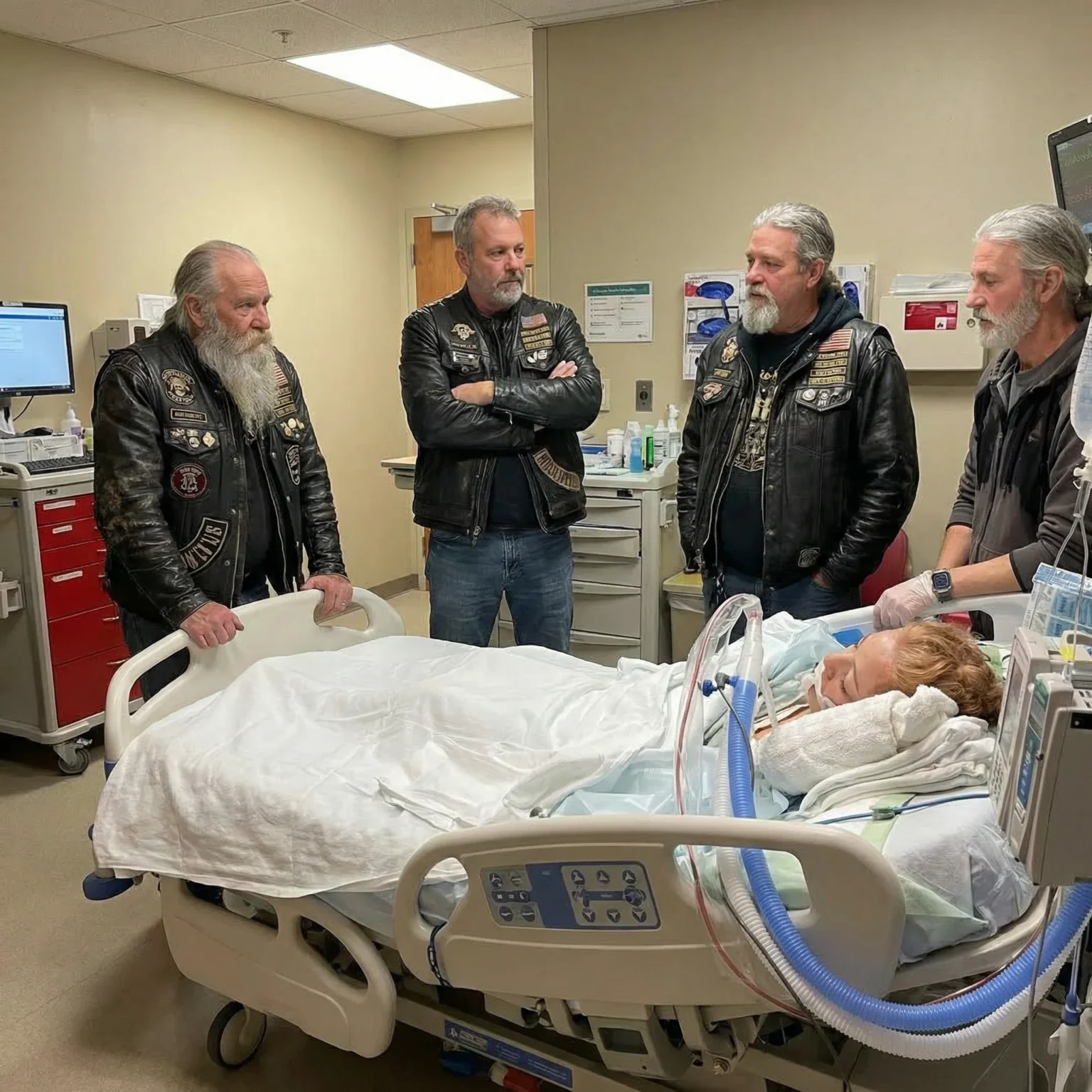
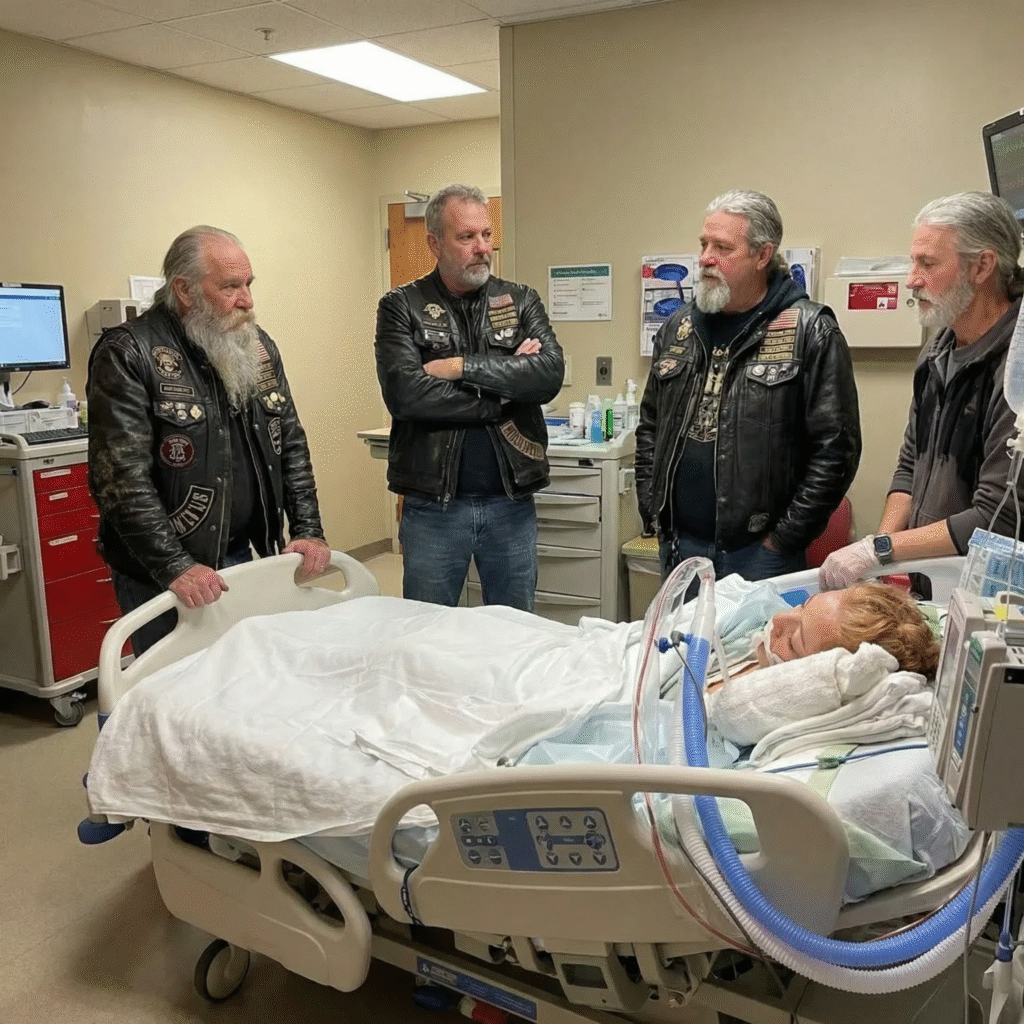
For six straight days, bikers sat outside my daughter’s hospital room.
My daughter didn’t know them.
I didn’t know them.
And for the first two days, I was afraid of them.
My daughter, Lily, is fourteen years old. Last Tuesday, she was hit by a car while riding her bike home from school. The injuries were catastrophic: a fractured skull, a broken pelvis, internal bleeding. The doctors told me the first seventy-two hours would determine everything.
I spent that first night alone in the waiting room.
My husband died three years ago. My family lives in another state. There was no one there but me and the sound of hospital machines keeping my daughter alive.
Then the first biker showed up.
He was a large man with tattoos covering both arms, wearing a leather vest and heavy boots. He walked to the nurses’ station and said he was there for the girl in Room 412.
The nurse asked if he was family.
He said no.
She asked if he knew Lily.
He said he didn’t.
She told him he couldn’t stay.
He sat down in the hallway anyway.
By morning, there were four of them.
By Wednesday, there were seven.
They brought folding chairs, thermoses of coffee, and sat in shifts—two at a time, always outside Lily’s door. They never entered her room, never got in anyone’s way, never raised their voices, never caused a single problem.
But they also never left.
On the third day, I finally walked up to the big one—the first one who had shown up.
“Why are you here?” I asked. “You don’t even know my daughter.”
He looked exhausted. His eyes were red, like he had not slept.
“Ma’am,” he said quietly, “I know this doesn’t make sense yet. But we need to be here.”
“Why?”
He glanced toward Lily’s room. Then back at me.
“Because the man who hit your daughter was our brother,” he said. “And he died at the scene.”
My knees nearly gave out.
“He was riding drunk,” the biker continued. “Crossed the center line. Hit your girl. We found out that same night.”
I could barely breathe.
“We’re not here to make excuses,” he said. “We’re not here to defend him. We’re here because our brother did this. And where we come from, a debt like that doesn’t go unpaid.”
I still didn’t understand.
Not until he explained what they intended to do.
His name was Wade. He was the president of their club. He had hands the size of shovels and a voice like gravel. He stood there in the hallway, beneath fluorescent lights, while my daughter lay unconscious behind a hospital door, and he told me the truth.
The man who hit Lily was named Kevin Mallory. He was thirty-eight. A mechanic. He had been riding motorcycles since he was sixteen and had been part of their club for twelve years.
Kevin had been struggling for a long time—divorce, losing custody of his children, depression, drinking more than anyone wanted to admit. Wade said the club had tried to help him. Meetings, support, warnings, tough love. But Kevin was sinking, and he refused to grab the rope.
On Tuesday evening, Kevin left a bar on Route 9 and got on his bike.
His blood alcohol level was twice the legal limit.
He crossed the center line at fifty miles an hour and hit my daughter.
“Kevin died on impact,” Wade said. “Your daughter survived because of her helmet. And because Kevin swerved at the last second.”
I stared at him.
“He swerved?”
Wade nodded. “Accident reconstruction says he turned hard left right before impact. Took most of it on his side instead of hitting her straight on. If he’d hit her dead center, she wouldn’t have lived.”
I didn’t know what to do with that information.
The man who nearly killed my daughter had also saved her life, in the very same moment.
The same reckless act had almost destroyed her and somehow spared her too.
“That doesn’t make it okay,” I said.
“No ma’am,” Wade replied. “It doesn’t.”
“My daughter might never wake up,” I whispered. “She might have brain damage. She might never walk again.”
“We know.”
“And you think sitting out in the hallway changes that?”
Wade didn’t look away.
“No. Nothing changes it. But we can help. And we’re going to.”
“How?”
“However you need,” he said. “Medical bills. Therapy. Equipment. Modifications to your house if she needs a wheelchair. Whatever it takes. However long it takes.”
“Why would you do that?”
“Because Kevin was our brother. His debt is our debt.”
I wanted to scream at him.
I wanted to tell him to take his guilt, his leather vest, and his club brothers and get out of my daughter’s hospital.
But I was exhausted.
Terrified.
Alone.
And these strangers were the only people who had shown up.
My own sister hadn’t come. My mother said she might visit the following month. My coworkers had sent flowers. These bikers brought chairs.
“You can stay,” I said finally. “But I’m not ready to forgive anything.”
“We’re not asking you to,” Wade said.
Days four and five were the hardest.
Lily’s brain swelling wasn’t going down the way the doctors wanted. More scans. More consultations. More explanations I couldn’t fully understand. I sat beside her bed and held her hand and talked to her. I told her about school. About her cat, Mango, who was staying with our neighbor. About the spring dance she had been excited for.
She didn’t respond.
She just lay there beneath bandages and tubes and monitors.
Outside the room, the bikers kept their quiet watch.
I learned their names despite myself.
Wade.
Hector.
Dusty, a wiry man who always carried a book.
Tommy, no older than twenty-five, who looked like he might cry every time he glanced toward Lily’s room.
Frank, an older man who barely spoke but somehow made sure I had coffee every morning.
And then, on the fourth day, a woman arrived.
Her name was Beth.
I didn’t know who she was at first. She walked down the hallway, looked at the bikers, and sat with them like she belonged there.
Wade introduced us.
“This is Beth,” he said. “Kevin’s ex-wife.”
I stared at her. She looked younger than me. Tired, nervous, hollow-eyed.
“I’m sorry,” she said. “I’m so sorry about your daughter.”
“Did you know he was drinking?” I asked.
“I knew he had a problem. That’s why I left. But I didn’t know he’d get on his bike like that. If I had known…”
“You couldn’t have stopped it,” Wade said softly.
Beth and I ended up sitting together in the cafeteria that evening.
At first, we talked about anything except Kevin. She told me about her children—Owen, ten, and Grace, seven.
“They don’t understand,” she said. “They know their father died. They know he hurt someone. They’re confused.”
“I’m confused too,” I admitted.
She looked down at her hands.
“Kevin wasn’t evil,” she said. “He was broken. The drinking. The depression. He needed help he never truly accepted.”
“He got drunk and nearly killed my daughter.”
“I know,” she said immediately. “I’m not excusing him. There is no excuse.”
We sat in silence for a while.
Then I asked, “Why are you here?”
Beth took a breath.
“Because I need to look at your daughter’s face,” she said. “I need to see what Kevin did. I need to carry that with me so I never make the mistake of pretending it wasn’t real.”
That was the most honest thing anyone had said to me in days.
On day six, Dr. Reeves came into the room looking different than usual.
Not cautious.
Not neutral.
Hopeful.
“The swelling is coming down,” she said. “Faster than we expected. We’d like to begin reducing sedation this afternoon.”
I stood up so fast I almost knocked over the chair.
“She’s going to wake up?”
“We’re going to try,” she said. “It may take hours. It may take a full day. And we still won’t know the extent of any cognitive impact until she’s fully conscious.”
“But she’s improving?”
“Yes. She’s improving.”
I put my hands over my face and cried.
Not the quiet kind.
The kind that comes from terror finally cracking open.
The nurse stepped into the hallway and told the bikers.
I heard Wade say, “Thank God.”
I heard someone else whisper, “Come on, Lily.”
They started reducing the sedation at 2:00 p.m.
At 4:00, Lily’s fingers twitched.
At 5:30, her eyelids fluttered.
At 6:15, she opened her eyes.
“Mom?” she whispered.
I grabbed her hand so tightly I was afraid I might hurt her.
“I’m here, baby. I’m right here.”
She looked around the room, confused, frightened. She tried to move and winced immediately.
“Don’t move,” I told her. “You were in an accident. You’re in the hospital. But you’re safe. You’re going to be okay.”
Then her eyes drifted toward the window.
Wade and Hector were sitting outside in the hallway, exactly where they had been every day.
“Who are they?” Lily asked.
I looked at them—at Wade with his hand pressed against his mouth, at Hector with his eyes closed like he was praying.
“They’re friends,” I said.
The word surprised me.
But it was true.
The next several days were a blur of evaluations, scans, specialists, and cautious victories.
Lily could speak. She could think. She remembered her cat, her school, her best friend’s name. The brain damage the doctors had feared never appeared. Her fractures would heal. Her internal injuries were stabilizing.
She was going to be okay.
And still, the bikers stayed.
Not all of them at once anymore, but always two. Always outside the door. They waved whenever Lily glanced through the window.
On day eight, she asked me again.
“Mom, why are those motorcycle guys always here?”
I had been dreading the question.
I had rehearsed softer versions of the truth.
But Lily was fourteen, not four. She deserved honesty.
“The man who hit you was on a motorcycle,” I said carefully. “He died in the accident. Those men out there were his friends.”
She stared at me for a moment.
“He died?”
“Yes.”
“And they feel bad?”
“They feel responsible,” I said. “They’ve been here since the first night.”
“Every night?”
“Every single night.”
Lily was quiet for a while.
Then she said, “Can I meet them?”
“Are you sure?”
She looked toward the hallway.
“They’ve been sitting out there for over a week, Mom. Yeah. I want to meet them.”
So I stepped into the hallway, where Wade and Dusty were on shift.
“She wants to meet you,” I said.
Wade stood so slowly it looked like he was walking toward a place he wasn’t sure he deserved to enter.
They came to the doorway but didn’t step inside.
Lily looked at them—these rough, tattooed men who had been guarding her door for more than a week.
“Hi,” she said.
“Hi, Lily,” Wade said, and his voice cracked. “How are you feeling?”
“Everything hurts,” she said. “But I’m okay.”
“That’s good,” he replied. “That’s real good.”
“My mom said you’ve been here since the beginning.”
“Yes ma’am.”
Lily smiled a little at being called ma’am.
“You didn’t have to do that.”
“Yeah,” Wade said softly. “We did.”
“Because of the man who hit me?”
Wade nodded. “His name was Kevin. He was our brother.”
Lily thought for a moment.
“I’m sorry he died,” she said.
The hallway went completely still.
Wade blinked hard. Dusty stared at the floor.
“You’re sorry?” Wade asked.
“He was your friend,” Lily said. “That must be sad.”
Wade pressed a hand over his eyes. His shoulders trembled once before he pulled himself together.
“You’re something else, Lily,” he said.
“That’s what my mom says. Usually when I’m being annoying.”
For the first time, Wade laughed.
A real laugh.
Lily tilted her head. “Can I ask something?”
“Anything.”
“Was Kevin a good person? Before?”
Wade took a long breath.
“He was a good man who made the worst decision of his life,” he said. “Before that, yes. He was good. He’d give you the shirt off his back. He loved his kids. He fixed bikes for people who couldn’t have paid him back.”
Lily nodded.
“Then I forgive him,” she said.
Just like that.
Four words.
Like she was putting down something the rest of us had been dragging around for days.
Wade broke completely.
Tears ran down his face. Dusty cried too.
So did I.
“You don’t have to do that,” Wade said.
“I know,” Lily answered. “But he can’t undo it. And me being angry won’t make my pelvis heal faster. So I’d rather forgive him and move on.”
“You’re fourteen?”
“Unfortunately.”
Wade laughed through tears.
“Your mom raised a good one.”
“She knows,” Lily said.
And the bikers kept their promise.
Every single part of it.
When Lily was discharged three weeks later, our house had already been changed.
A ramp at the front door.
Grab bars in the bathroom.
A hospital bed set up downstairs so she would not have to manage the stairs.
Wade had organized everything.
The whole club had come out while Lily was still in the hospital. Tommy handled carpentry. Hector took care of plumbing. Frank, who turned out to be a retired contractor, supervised the work.
They refused to take a single dollar.
Then the bills started arriving.
The first one was for $47,000.
I stared at it until the numbers blurred.
Wade came by, took it from my hands, and said, “We have a fund. Kevin had life insurance through the club. It’s not enough for everything, but it covers part of it. And what it doesn’t cover, we do.”
“I can’t let you do that.”
“It’s not charity,” he said. “It’s a debt.”
Over the next six months, they paid every bill.
Therapy.
Follow-up surgeries.
Hip specialists.
All of it.
When Lily took her first steps in physical therapy, Wade was there, standing in the corner of the room with his arms crossed.
“Looking good, kiddo,” he said.
“Hurts like crazy,” Lily shot back.
“Tough girl.”
“Tough therapist,” she said, nodding at the physical therapist, who did not tolerate complaints.
By April, Lily could walk with a cane.
By June, she no longer needed it.
She still had a limp. She may always have one.
But she was alive.
And she was walking.
About a year later, Lily asked if she could visit Kevin’s grave.
I didn’t know how to feel about it.
But by then I had learned to trust her heart.
Wade drove us there in his truck.
The cemetery was quiet. Kevin’s headstone had a motorcycle carved into it. Fresh flowers lay at its base.
Lily stood there for a long time.
Then she placed a small card against the stone.
I didn’t read it until later.
When I finally asked what it said, she told me.
“Dear Kevin. I forgive you. I hope wherever you are, you forgive yourself too. Thank you for swerving. Your friend, Lily.”
Thank you for swerving.
At fourteen years old, my daughter understood something I was still trying to make peace with: that in the last second of Kevin’s life, drunk and reckless and full of terrible choices, he still turned the bike.
It didn’t erase what he had done.
It didn’t make it acceptable.
But it meant something.
It has been two years now.
Lily is sixteen.
She is back in school.
She plays volleyball, though she can’t jump quite as high as she used to.
She is learning to drive, which terrifies me for perfectly ordinary reasons.
And the bikers still come around.
Not every day.
Not in shifts anymore.
But they come.
Wade brings birthday gifts, always something motorcycle-related. Last year it was a leather jacket, and Lily wore it to school the very next day.
Dusty drops off books because they both love science fiction.
Tommy built Lily a bookshelf with a motorcycle carved into one side.
Beth still visits, bringing Kevin’s children—Owen and Grace. Lily babysits them sometimes now. Kevin’s kids laughing in my living room with the girl their father almost killed.
If that isn’t grace, I don’t know what is.
Frank still brings me coffee every Saturday morning. He sits on my porch without saying much and watches the street.
I think he is lonely.
I think they all are, in their own ways.
Kevin’s death left a hole in their club.
Being part of Lily’s life fills some of that empty space.
People ask me how I can let them into our lives.
How I can welcome the dead man’s brothers into my home.
Into my daughter’s future.
I tell them the truth.
Anger is heavy.
Forgiveness is heavier.
But anger bends you until you break.
Forgiveness straightens your spine so you can keep walking.
Kevin Mallory made a terrible choice that nearly destroyed my family.
But his brothers showed up the next day, and for two years they helped us rebuild.
They never asked for forgiveness.
They asked only for the chance to make things right.
And my daughter, with a wisdom I still don’t fully understand, gave them that chance with four simple words:
I forgive him.
Some people think forgiveness means saying what happened was acceptable.
It does not.
It means choosing not to let the pain own the rest of your life.
Lily moves forward every day.
With a limp.
With a leather jacket.
With a family that is louder, stranger, and bigger than the one she started with.
Kevin’s debt has long since been paid.
But the bikers still come around.
Not because they owe us anything anymore.
Because now, somehow, we belong to each other.
And family does not leave.