I called the cops on a biker who was beating a child behind a gas station at 9 PM on a Tuesday. I was certain I was saving that kid’s life.
I’d stopped for gas on Route 23. A small station in the middle of nowhere. The kind of place that still has a payphone and a flickering neon sign.
I was pumping gas when I heard it.
A child screaming.
High-pitched. Terrified. Coming from behind the building.
Then I heard a man’s voice. Deep. Angry.
“I told you what would happen.”
More screaming.
I ran toward the sound. My phone was already out, dialing 911.
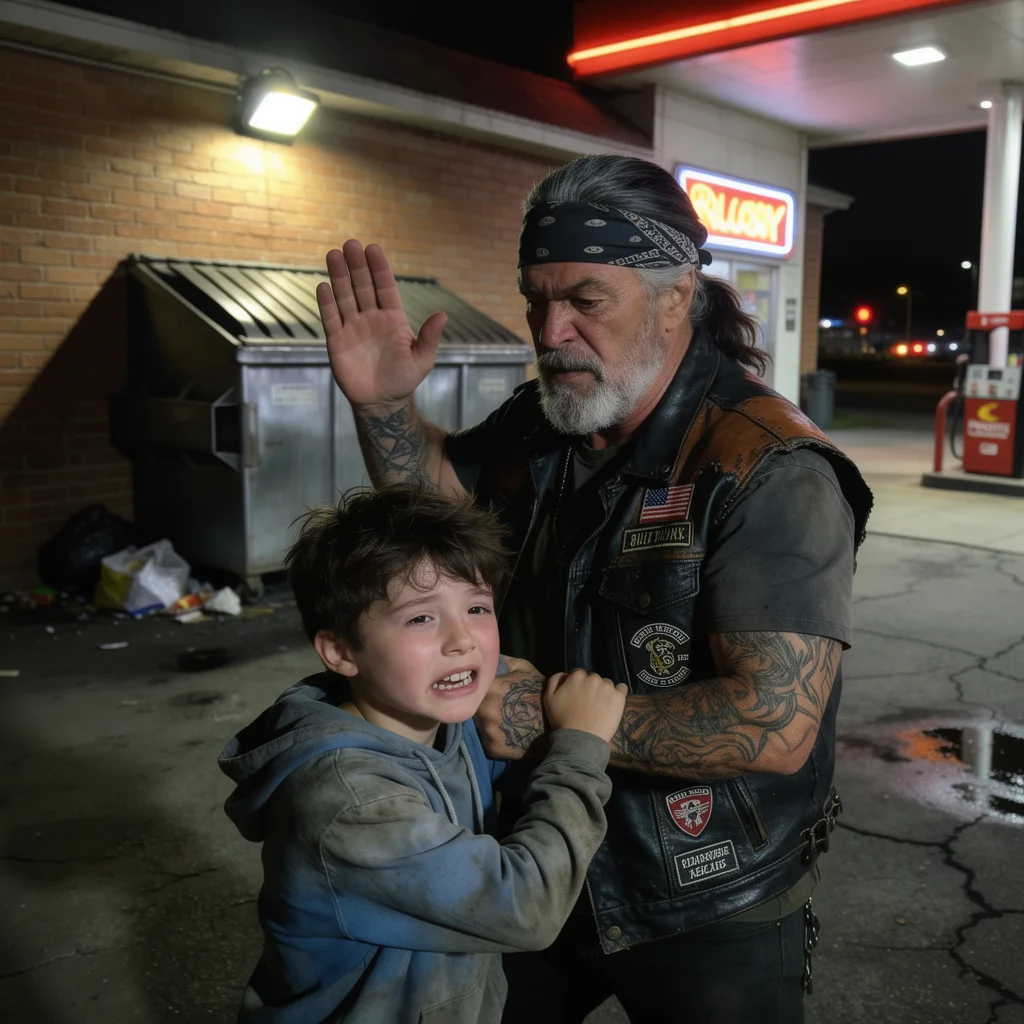
Behind the gas station, next to the dumpsters, I saw them.
A big man in a leather vest. Biker patches on his back. Maybe six-two, 250 pounds. Gray beard. Looked like he could break someone in half.
And a boy. Maybe twelve years old. Thin. Dirty clothes.
The biker had him by the arm.
The boy was crying. Struggling. Trying to pull away.
The biker raised his hand.
“Stop!” I yelled.
They both turned to look at me.
“Let him go,” I said. My voice was shaking but I stood my ground. “I called the police. They’re on their way.”
The biker’s expression changed. Surprise. Then something else I couldn’t read.
“Ma’am,” he started.
“Let him go right now.”
The boy was staring at me. His face streaked with tears. But his expression wasn’t relief.
It was fear.
The biker released the boy’s arm and raised both hands.
“This isn’t what you think.”
“I know exactly what this is. I saw you.”
“You saw part of it.”
Police sirens were already getting closer.
The boy looked at the biker. Then at me. Then back at the biker.
“Marcus,” the biker said gently. “Go wait by my bike.”
The boy ran.
Not away from the biker.
Toward the front of the station. Toward a motorcycle.
Two police cars pulled in.
Four officers stepped out.
“He’s the one,” I said, pointing at the biker. “He was hitting that child.”
The officers separated us and took statements. I told them everything I’d seen.
But twenty minutes later, they let the biker go.
They said the situation was being handled.
They wouldn’t explain anything else.
I drove away angry and confused, convinced something wasn’t right.
Two days later I called the police station.
A detective said someone wanted to talk to me.
I went that afternoon. They brought me into a small conference room.
The biker was there.
Ray Mitchell.
And next to him sat the boy.
Marcus.
Marcus looked different now. Clean. Fed. Calm.
“Ms. Patterson,” Ray said. “Thank you for coming. I owe you an explanation.”
Marcus looked up at me.
“You saved me,” he said.
“Just not the way you thought.”
Ray leaned forward.
“Marcus has been missing for two years,” he explained. “He was taken from a group home in Nevada when he was ten. Trafficked across several states. Forced to steal, scam, and shoplift for the people controlling him.”
I looked at Marcus. He kept his eyes on the table.
“Trafficked?” I whispered.
Ray nodded.
“He’s one of dozens of kids used by a trafficking ring operating across the Southwest. They move the kids constantly. Keep them scared. Keep them working.”
“And you are?” I asked.
“Former Army Ranger. Former police detective. Now I work with an organization that tracks these operations and helps recover kids.”
He showed credentials. They looked legitimate.
“We’ve been tracking Marcus’s handler for months,” Ray continued. “A man named Vincent Cross. He runs a network moving kids across several states. Our goal was to get the children out before building the case.”
“How many kids?” I asked.
“We believe seventeen. Marcus was the fourth we’ve recovered.”
Marcus spoke quietly.
“Vincent sent me to that gas station that night. Told me to steal money from cars or the store. Ray had been following Vincent’s van for two days.”
Ray nodded.
“When I saw Marcus breaking into a car behind the station, I stopped him before he could get arrested for real.”
Marcus added, “When he grabbed me I panicked. I thought Vincent would find out and punish the other kids.”
“And then I showed up,” I said.
Ray nodded again.
“And then you showed up.”
“And called the police.”
“Which actually helped us.”
I frowned. “How?”
Detective Hobbs entered the room.
“Vincent Cross was already heading to that gas station,” he said. “Marcus hadn’t called him yet like he was supposed to. When he showed up twenty minutes after your call, our officers were already there.”
“We arrested him immediately,” Hobbs continued.
My hand went to my mouth.
“And when we searched his van,” the detective added, “we found two other missing children inside.”
Ray looked directly at me.
“Your call forced everything to happen faster than planned. If we had waited, Vincent would have moved the kids again.”
I looked at Marcus.
“Are you okay now?”
He nodded slowly.
“I’m safe. That’s the first time in two years.”
Ray added, “He’s in protective care now. We’re also trying to locate his mother.”
Marcus looked up quickly.
“You found my mom?”
“We believe so,” Ray said softly. “A woman in Nevada has been searching for a missing son for two years. Same name. Same age.”
Marcus started crying.
Real, heavy tears.
“She never stopped looking,” Ray said gently.
I wiped tears from my own face.
Then Ray said something unexpected.
“Ms. Patterson… I’d like to ask you something.”
“What?”
“We need people who pay attention. People willing to act when something looks wrong. Would you consider helping us?”
“How?”
“You’d be trained. You’d learn signs of trafficking. You’d watch truck stops, gas stations, rest areas. If you saw something suspicious, you’d report it.”
Detective Hobbs handed me a card.
“It’s legal and coordinated,” he said. “And it saves kids.”
I looked at Marcus.
Then at the card.
“What are the signs?” I asked.
Over the next three months, I learned.
Children who looked afraid or malnourished.
Kids who avoided eye contact.
Adults controlling every movement or conversation.
Children working late at night.
Kids punished for not bringing money.
I reported two cases during those months.
One turned out to be nothing.
The other led to the rescue of three children.
Ray called me afterward.
“You’re getting good at this.”
“I’m just paying attention.”
“That’s exactly what most people refuse to do,” he said.
Six months later, I got a phone call.
“Ms. Patterson?”
It was Marcus.
“I’m living with my mom now,” he said excitedly. “The DNA test confirmed it.”
“That’s wonderful!”
“I’m in school now. Real school. Seventh grade.”
“I’m proud of you.”
“I wanted to thank you,” he said.
“You saved me.”
Three years have passed since that night.
Marcus is fifteen now.
He’s on the basketball team. He wants to be a teacher someday.
Ray’s organization has rescued more than forty children.
I’ve helped identify several cases myself.
Five of them led to rescues.
Five kids who went home.
All because someone paid attention.
I still stop at that same gas station sometimes.
Same flickering neon sign.
Same dumpsters out back.
But now when I pump gas, I’m watching.
Listening.
Because kids like Marcus are still out there.
And sometimes the thing that looks wrong is actually the first step toward making something right.
Sometimes help looks like a scary biker you want to call the cops on.
Sometimes the person who looks dangerous is actually the one saving a child.
And sometimes the best thing you can do is trust your instincts and ask for help.
Even when you don’t understand the whole story.
Especially then.