I laughed at a biker who was kneeling outside a hospital crying.
Five minutes later, I found out why he was there.
I have never felt smaller in my life.
It was a Tuesday afternoon. I had just finished my shift at the county courthouse and was cutting through the hospital parking lot on my way to my car.
That was when I saw him.
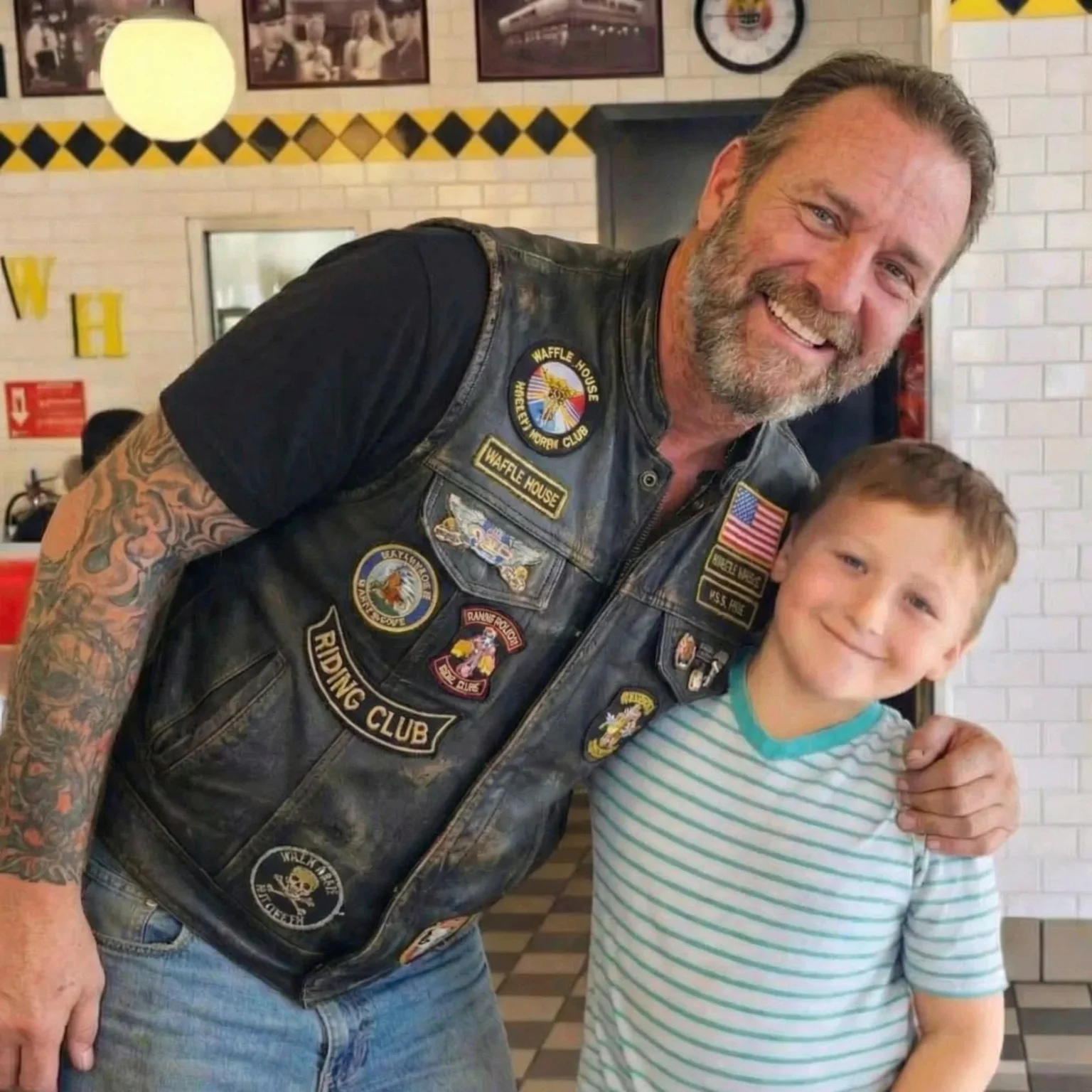
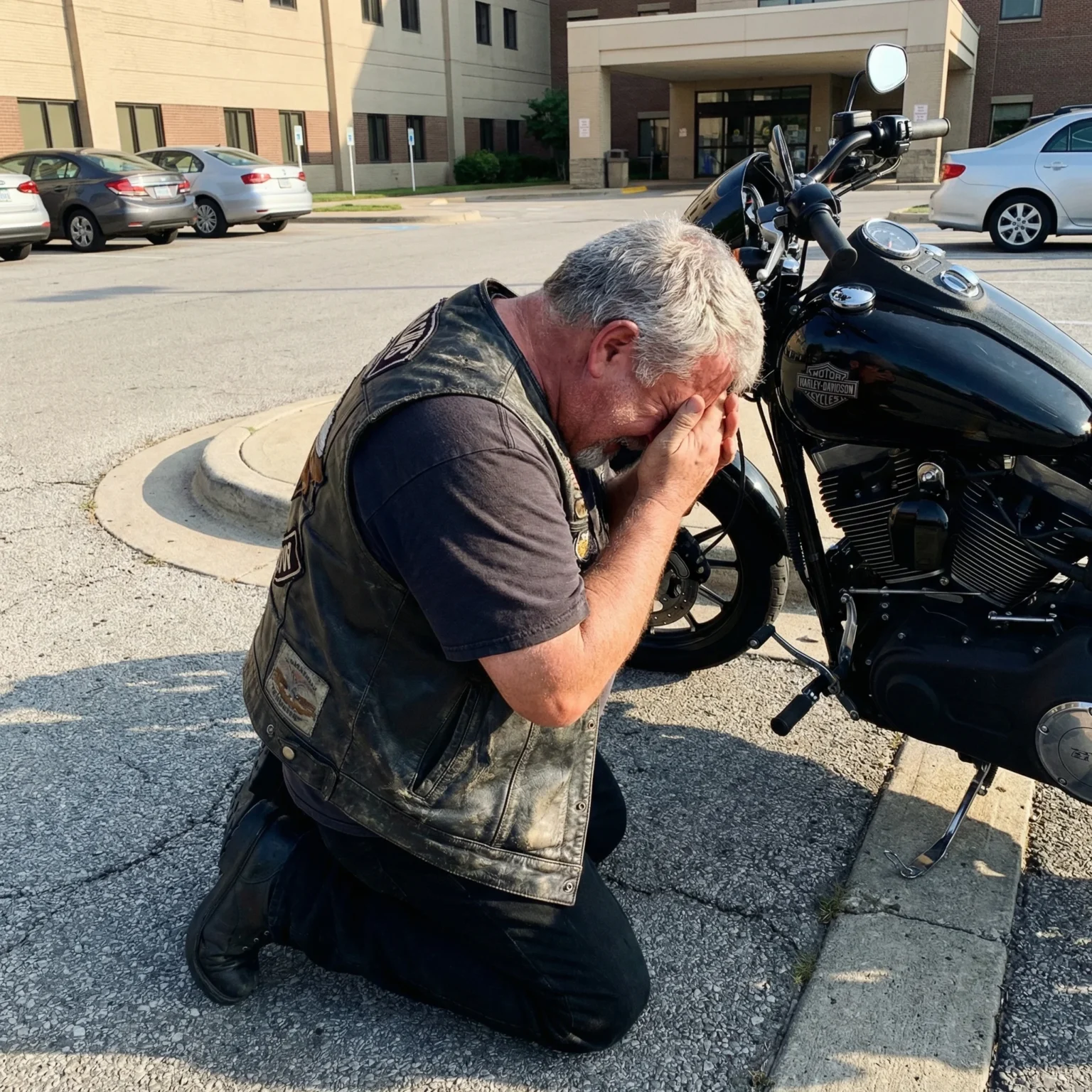
He was a big man—maybe six-foot-two, two hundred and fifty pounds. Gray beard. Tattoos down both arms. Leather vest covered in patches. The kind of man people notice and make assumptions about immediately.
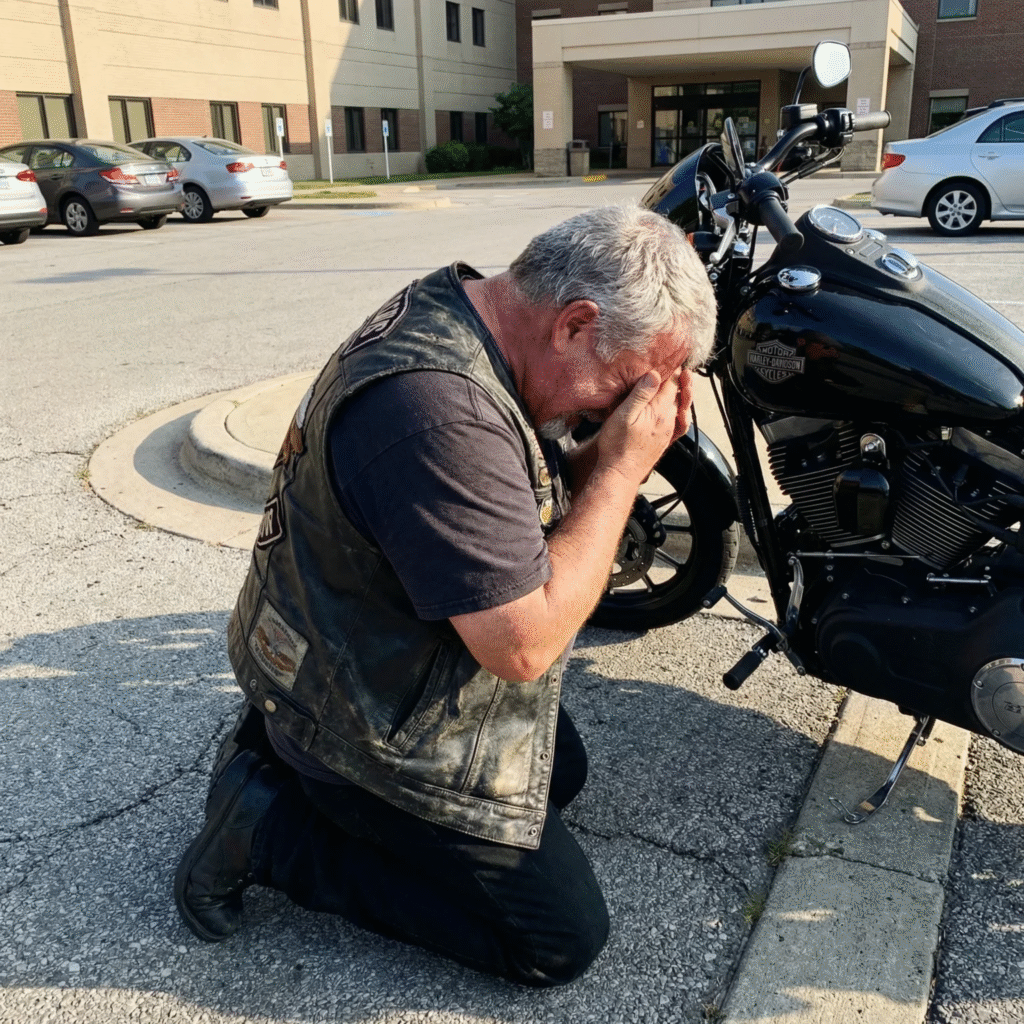
He was on his knees beside a Harley.
His face was buried in his hands. His shoulders were shaking.
He was crying.
Not wiping away a tear.
Not holding it together.
Crying.
And I laughed.
It wasn’t a loud laugh. Just a quiet little snicker. The kind people make when something feels absurd. When something doesn’t fit the image they have in their head.
My friend Sarah was walking with me. She heard me and looked over.
“What’s funny?” she asked.
I nodded toward him.
“That. Looks like somebody’s having a bad day.”
Sarah didn’t laugh.
She just looked at me for a long second.
“What?” I said.
Her expression hardened.
“It’s not funny.”
I shrugged, suddenly defensive.
“It’s just weird. Guys like that don’t usually cry in parking lots.”
“Guys like what?”
“You know,” I said. “Bikers. Tough guys.”
Sarah shook her head and walked toward her car without another word.
I got in my own car irritated, embarrassed, and more than a little self-righteous. I told myself I hadn’t said anything terrible. I had just noticed something unusual.
That’s all.
I pulled out and started toward the lot exit.
To get there, I had to drive right past him.
And as I got closer, I saw what I hadn’t noticed before.
There was a little girl’s bicycle lying on the pavement next to his Harley.
Pink.
Training wheels.
Streamers hanging from the handlebars.
A child’s helmet sat on the motorcycle seat.
My stomach dropped.
I slowed down and looked again.
He was holding something in his hands.
A stuffed bunny.
Pink.
One ear stained with blood.
And he wasn’t just crying.
He was falling apart.
The kind of sobbing that comes from somewhere so deep it doesn’t even sound human anymore.
I lifted my eyes and looked at the building beside him.
The pediatric emergency entrance.
And in one horrible second, I understood.
I pulled into a parking space and just sat there, gripping the steering wheel, staring at him through my rearview mirror.
The pink bike.
The little helmet.
The stuffed bunny.
The pediatric ER.
Something had happened to a child.
His child.
And I had laughed.
I should have driven away.
I should have minded my own business.
But I couldn’t.
Not after what I’d done.
I got out of the car and walked slowly toward him. I had no idea what I was going to say. I didn’t even know if I had the right to say anything at all.
When I was about ten feet away, he looked up.
His eyes were swollen and red. His face was wet. His expression was so broken it made my chest hurt.
“I’m sorry,” I said.
The words came out before I could think.
“I’m so sorry.”
He stared at me, confused.
“Do I know you?”
“No,” I said. “I just…”
I couldn’t do it. I couldn’t tell him I had laughed at him.
He swallowed hard.
“My daughter,” he said. His voice sounded shredded. “She’s inside. They’re trying to save her.”
My throat closed.
“What happened?”
“She was riding her bike in our neighborhood. I was following behind on my motorcycle, just keeping an eye on her. She just learned to ride without training wheels last week.” His voice broke. “A car ran a stop sign. Hit her. Then kept going.”
I covered my mouth.
“Oh my God.”
“She’s seven,” he whispered. “Seven years old.”
He looked down at the bike on the ground.
“She was so proud of this thing. Wanted to ride it everywhere. I bought her that bunny for her birthday.”
He lifted the stuffed toy in his hand.
“The paramedics gave it back to me. They cut her shirt off in the ambulance, but they saved her bunny.”
I sat down on the curb beside him.
I didn’t ask.
I just sat.
Because there was nothing else to do.
“The doctors said the next hour is critical,” he said. “Internal bleeding. Possible head trauma. They told me to prepare myself.”
He was talking like she was already gone.
Like saying her name out loud was the only way to keep her here.
“What’s her name?” I asked softly.
“Emma. Emma Louise.”
He laughed once, bitterly, through tears.
“She wants to be a veterinarian. Loves animals. Brings home every stray cat she sees. Tells everybody she’s going to save them all.”
He was telling me who she was in case the world lost her.
And I felt my own eyes fill.
“She sounds tough,” I said.
He looked at me.
“You don’t know that.”
“No,” I said. “I don’t. But I believe it.”
We sat there in silence after that.
Two strangers on a curb.
Him with his daughter’s bloodstained bunny in his hands.
Me with the weight of what I had done pressing down on me so hard I could barely breathe.
A few minutes later, a doctor came out through the emergency doors.
Mike shot to his feet so fast he nearly stumbled.
“Mr. Patterson?” the doctor asked.
“That’s me,” he said. “Is she—?”
The doctor held up a hand gently.
“She’s stable. We got the bleeding under control. She’s in surgery now, but the surgeon is optimistic.”
For a second, Mike just stared at him.
Then his knees buckled.
I jumped up and caught his arm before he hit the ground.
“She’s alive?” he said.
“She’s alive,” the doctor said. “She’s not out of danger yet, but she made it through the critical window.”
Mike started crying again.
But now it was different.
Relief. Shock. Gratitude. Fear still there, but pierced through with hope.
“Can I see her?”
“After surgery,” the doctor said. “A couple more hours. Go to the surgical family waiting room. Someone will come get you.”
Then he walked back inside.
Mike stood there breathing hard, clutching that little pink bunny like it was the only thing keeping him upright.
Then he turned to me.
“Thank you,” he said. “For sitting with me. I don’t even know your name.”
“Jennifer.”
“I’m Mike.”
He held out his hand.
I shook it.
His grip was still strong, even then.
I swallowed and forced myself to say the thing I owed him.
“I need to tell you something,” I said. “And you probably won’t want to hear it.”
He looked at me, tired and hollow-eyed.
“What?”
“When I first saw you out here…” I took a breath. “I laughed.”
He blinked.
“I saw this big biker kneeling in a parking lot crying, and I laughed. I judged you. I made you into a stereotype in my head. I thought it was ridiculous. And then I saw the bike and the bunny and I realized what was happening. I am so ashamed.”
He was quiet for a long moment.
Then he asked, “Why are you telling me this?”
“Because you deserve the truth. Because I needed to own it. Because the worst moment of your life is not something I should have turned into a joke.”
Mike looked down at Emma’s bike, then back at me.
“People do that all the time,” he said quietly. “They see the leather, the beard, the patches, and they already know who they think I am. Dangerous. Violent. Bad news. They pull their kids closer. Cross the street. Look at me like I’m a problem.”
“That’s horrible.”
“It’s reality.”
“That doesn’t make it okay.”
“No,” he said. “It doesn’t. But at least you came back. That counts.”
“It doesn’t erase it.”
“No,” he said. “But it’s a start.”
A nurse came out then and led him inside.
Before he followed her, he looked back at me.
“Will you pray for her?” he asked. “Even if you don’t believe in prayer. Just… do whatever it is you do.”
“Yes,” I said immediately. “I will.”
He nodded once and disappeared into the hospital.
I stood in that parking lot for a long time after he was gone.
Looking at his motorcycle.
Looking at Emma’s little pink bike with its streamers and training wheels.
Thinking about how fast a person can be wrong.
How easy it is to laugh when you don’t know the story.
How cruel ignorance can be when it hides behind something as small as a smirk.
The next day, I went back.
I told myself I just wanted to know if the little girl had made it.
But really, I think I went back because I needed to see that she was alive.
I found Mike in the family waiting room.
He looked like he hadn’t slept. Same clothes. Same heavy face.
But this time, he was smiling.
“She’s awake,” he said the second he saw me. “She woke up this morning and asked for her bunny.”
My whole body sagged with relief.
“Oh, thank God.”
“They say she’s going to make it,” he said. “Long recovery. Physical therapy. But she’s going to make it.”
I smiled so hard it hurt.
“That’s amazing.”
“You want to meet her?”
I hesitated.
“I don’t want to intrude.”
“You’re not intruding,” he said. “Come on.”
He took me down the hall to the pediatric ICU.
Emma was propped up in bed. Her head wrapped in bandages. Tubes and wires everywhere. But her eyes were open. Bright. Curious.
And in her arms was the pink bunny.
“Emma,” Mike said softly, “this is Jennifer. She’s a friend.”
Emma looked at me seriously.
“Did you pray for me?”
I glanced at Mike.
He shrugged a little.
“Yes,” I said. “I did.”
She nodded once.
“I think it worked.”
Then she smiled.
And despite the machines and bruises and everything she had just survived, she was still exactly what she was supposed to be.
A little girl.
Mike sat beside her and started telling her about all the flowers people had sent. The cards from school. The messages from neighbors.
I stayed only a few minutes.
Long enough to see her alive.
Long enough to feel my heart settle.
In the hallway, Mike stopped me.
“Thank you for coming back,” he said.
“I had to know she was okay.”
“Most people wouldn’t have.”
“I almost didn’t.”
“But you did.”
I looked down.
“It still doesn’t feel like enough.”
He studied me for a moment.
“You know what I think?” he said. “I think you’re a good person who had a bad blind spot. The question isn’t whether you got it wrong. The question is what you do after.”
“What do I do after?”
He gave me a tired half-smile.
“You’re here now. That’s a start.”
Emma spent three weeks in the hospital.
I visited a few more times.
Brought books. A stuffed animal. Sat with Mike while Emma slept. Helped pass the hours in those awful waiting rooms where time seems to stop.
Somewhere in those visits, we became friends.
Not close all at once.
Just slowly.
The kind of friendship that forms when people see each other without masks.
The police never found the driver who hit Emma.
That part never got easier for Mike. The not knowing. The injustice of it.
But Emma survived.
She had to relearn how to walk.
She had nightmares about cars.
She refused to look at her bike for months.
But she survived.
And that became everything.
Six months later, Mike invited me to Emma’s “I’m Alive” party.
That’s what she called it.
Not a recovery party.
Not a welcome-home party.
An “I’m Alive” party.
It was at a park.
Mike’s motorcycle club showed up in full force.
Big men in leather vests and tattoos everywhere.
And every single one of them treated Emma like she was royalty.
They had all chipped in to buy her a new bike.
Purple this time.
No training wheels.
Basket on the front. Bell on the handlebars.
Emma squealed when she saw it.
Then insisted on riding it immediately.
Mike walked beside her the whole time, hands hovering, ready to catch her if she fell.
She didn’t fall.
She rode in circles around the park, laughing and ringing the bell.
“Look at her,” Mike said, standing beside me. “Six months ago I didn’t know if she’d ever walk again.”
“She’s incredible.”
“She’s tougher than I am,” he said. “I’m the one who fell apart. She’s the one who keeps going.”
One of his club brothers came over then. A huge man named Bear who somehow made Mike look small.
“Your girl’s a warrior,” Bear said.
Mike grinned.
“She gets that from her mama.”
They all loved her.
And suddenly all those images I had once attached to bikers—dangerous, reckless, hard—seemed stupid and small and ugly.
What I saw instead were men who showed up.
Men who loved hard.
Men who cried when children were hurt and rallied when somebody needed help.
Mike caught me watching.
“What are you thinking?”
“That I was very, very wrong about you.”
He smiled a little.
“About me, or bikers?”
“Both.”
He laughed softly.
“Well. At least now you know better.”
“I do.”
Emma rode up then and stopped dramatically in front of us.
“Dad, can we do cake now?”
“In a little bit.”
“But I want cake now.”
“Emma.”
She crossed her arms.
“I almost died. I think I should get cake whenever I want.”
Mike laughed.
“You cannot use the ‘I almost died’ card forever.”
She tilted her head.
“How long do I get to use it?”
“Another month.”
“Deal.”
She rang her bell and rode off again.
Mike watched her go and shook his head.
“She’s going to use that for everything.”
“She earned it.”
We stood there in silence for a while.
Then Mike said, very quietly, “I think about that day in the parking lot a lot.”
“So do I.”
“I thought I was losing her. I thought my whole life was ending.” He paused. “You sitting down next to me mattered more than you know.”
I looked at him in surprise.
“I almost drove away.”
“But you didn’t.”
“That doesn’t erase the laugh.”
“No,” he said. “But it means the laugh wasn’t the end of the story.”
It’s been two years now.
Emma is nine.
Fully recovered.
Back on her bike.
Still carrying that pink bunny sometimes.
Mike and I are still friends.
I go to charity events with his club now—fundraisers for veterans, children’s hospitals, toy drives, all the things I never would have imagined before I knew them.
And I teach a diversity training course at the courthouse.
Every time I teach it, I tell Mike and Emma’s story.
Not their names.
Not the private details.
But the truth of it.
How easy it is to judge someone by the costume your mind puts on them.
How dangerous it is to believe your own assumptions without question.
How cruelty can hide inside something as small as a laugh.
And I always end the same way.
The toughest-looking person in the parking lot may be carrying the softest, most shattered heart.
The person you judge in one second may be living through the worst moment of their life.
And if you don’t know the story, your laughter may become someone else’s wound.
I learned that in a hospital parking lot.
On the worst day of a father’s life.
When I laughed at a man whose world was breaking apart—
and he still chose to show me grace.