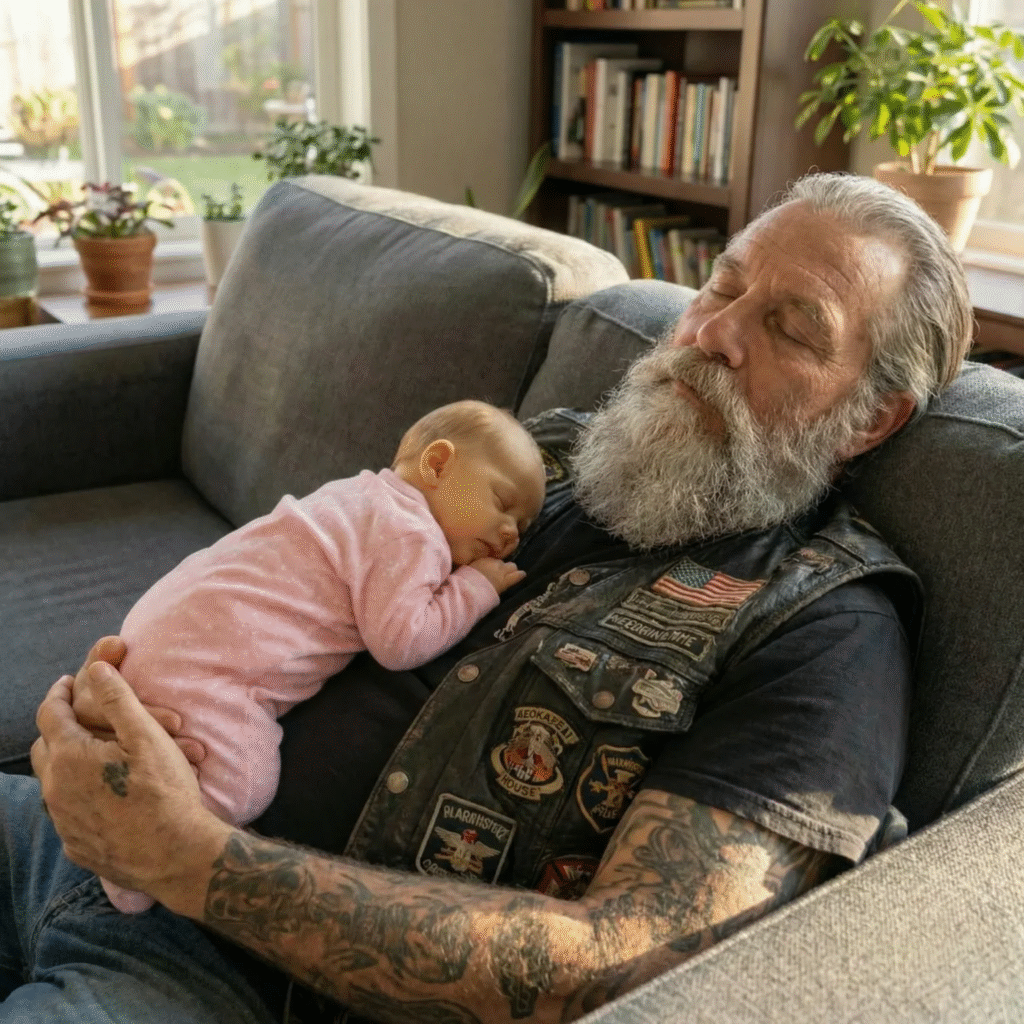
I’m sixty-eight years old. I ride a Harley. And three weeks ago, for the first time in my life, I became a father.
The baby nobody else wanted is asleep in a crib in my living room right now.
Her name is Maya.
She’s four months old. She has Down syndrome, a heart defect, and she was born addicted to methamphetamine.
The social worker told me she had been in the system for three months. Twelve families had looked at her file.
Not one of them said yes.
Too many medical issues. Too much risk. Too expensive. Too complicated.
Maya was on her way to institutional care. A group home for medically fragile children. She would have grown up there.
And maybe died there.
I met her by accident.
I was at the hospital visiting my buddy Carlos after his bypass surgery. I brought him magazines and spent twenty minutes giving him hell about the way he’d ignored every doctor’s warning about fried food and cigars.
When I left his room, I took a wrong turn.
I ended up on the NICU floor.
I was about to turn around and head back to the elevator when I heard a baby crying.
Not the usual kind of crying.
Not hungry crying. Not fussy crying.
This was the kind of cry that sounded like surrender.
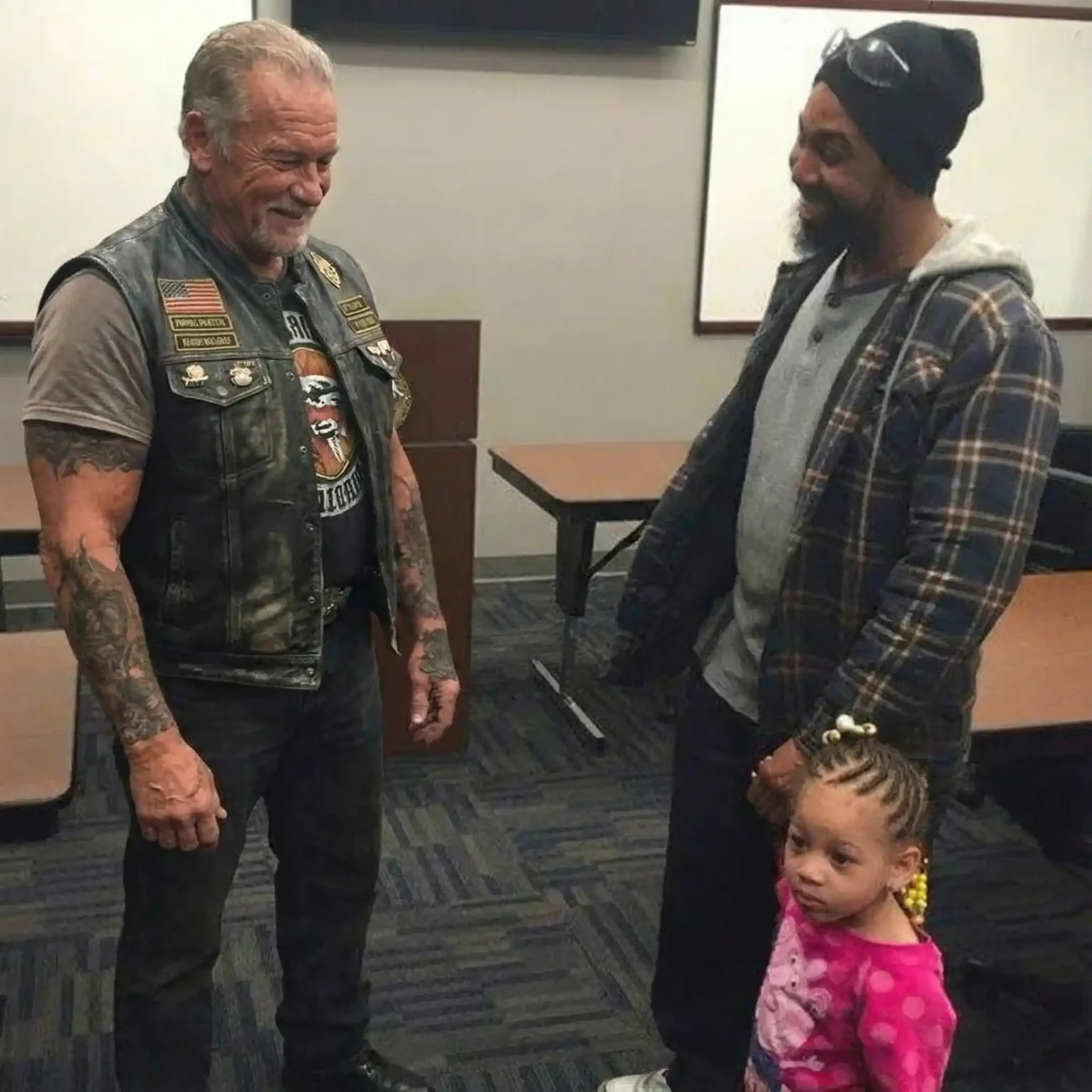
A nurse stepped out of one of the rooms looking exhausted. She saw me standing there in my leather vest, tattoos showing, patches on my chest.
“Can I help you?” she asked.
“Sorry,” I said. “Wrong floor.”
She nodded, then paused and studied me for a second.
“You look like somebody who doesn’t give up easy,” she said.
I frowned. “Excuse me?”
She glanced back toward the room behind her.
“That baby in there,” she said. “Room 412. She’s been crying for two hours. Nothing works. She just cries like she knows nobody’s coming for her.”
I don’t know why I asked.
But I did.
“Can I try?”
The nurse looked at me like I was out of my mind.
Then she said, “Wash your hands first.”
Maya was tiny. Barely five pounds. She had tubes, wires, and monitors attached to her. Her little face was red from crying so hard.
The nurse carefully placed her in my arms and showed me how to support her head.
“Her name is Maya,” she said. “She doesn’t have a family. She’s a ward of the state.”
I held her against my chest and started humming. Nothing special. No real song. Just a low rumble from somewhere deep in my chest.
And just like that, she stopped crying.
After a minute, she went quiet.
After another minute, her little hand wrapped around my finger.
The nurse stared at us.
“I’ll be damned,” she said.
I sat there in that rocking chair for forty minutes, just holding her.
When I finally handed her back, Maya started crying again.
The nurse looked at me and said, “You can come back tomorrow, if you want.”
So I did.
And the day after that.
And the day after that too.
For two full weeks, I came back every day.
On the tenth day, a woman in a suit came into the room while I was holding Maya.
She introduced herself as Beth from Child Protective Services.
“The nurses told me about you,” she said. “Why do you keep coming?”
I looked down at Maya sleeping against my chest.
“Because she needs somebody.”
Beth sat across from me.
“Maya is medically complex,” she said. “She’ll need surgery. She’ll need special care. She’s likely going to be placed in institutional care.”
I looked up at her.
“You mean you’re giving up on her.”
Beth didn’t flinch.
“We don’t have another placement option,” she said. “Nobody is willing to take her.”
I looked back down at Maya.
“I will,” I said.
That one sentence changed my entire life.
Beth tried to talk me out of it.
She listed every reason it was a bad idea.
My age. My health. My lifestyle. The cost. The risks. The fact that Maya would need years of medical care and therapy. The fact that she might never be easy.
I listened to every word.
Then I said, “She deserves better than growing up in an institution. If nobody else is willing to give her a home, I am.”
Beth stared at me for a long time.
Then she nodded once.
“I’ll start the paperwork.”
The next three months were a blur.
Background checks. Home inspections. Medical evaluations. Parenting classes. Financial reviews.
I learned more in ninety days than I’d learned in the previous ten years.
I took classes on caring for children with Down syndrome. Learned about developmental delays, feeding issues, therapy plans, and long-term care.
I learned how to use a feeding tube.
I learned medication schedules.
I learned infant CPR three different times because I was so scared I’d forget it when it mattered.
They inspected my house four times. Checked my smoke detectors, my cabinets, my water heater temperature, my electrical outlets, and my bank account.
They asked me if I understood that this was permanent.
I told them yes.
They asked me if I understood that she might outlive me.
I told them yes.
They asked me who would care for her if something happened to me.
I had names. Legal documents. A will. Insurance. Plans.
I was ready.
What I wasn’t ready for was telling people.
My daughter Lisa called as soon as she heard what I was doing.
She lives in Oregon with her husband and two boys. We talk once a month if we’re lucky.
“Dad,” she said, “please tell me you’re not serious.”
“I’m serious.”
“You’re sixty-eight years old,” she said. “You still ask me how to open photo messages on your phone. How are you going to raise a special-needs baby?”
“I’ll learn.”
“This isn’t like rescuing a dog.”
“I know that.”
“This is a lifetime commitment.”
“I know exactly what it is, Lisa.”
There was a long pause.
Then she said, “Is this because you’re lonely?”
That one hit me.
But I kept my voice steady.
“This isn’t about me being lonely. This is about a baby who needs a home.”
“There are younger couples,” she said. “People better prepared for this. People with experience.”
“Twelve families saw her file,” I told her. “Twelve. Every one of them said no. She was headed for a group home.”
Lisa was quiet again.
Then, softer this time, she said, “I just don’t want you to get hurt. And I don’t want her to get hurt either. What happens if something happens to you?”
“I’ve handled that.”
“With who?”
“With people I trust.”
She let out a long breath.
“You’re really doing this.”
“Yes.”
Another silence.
Then she said, “Then I guess I’m about to become a big sister.”
That was the first time I smiled during the whole conversation.
“I guess you are.”
My club had mixed reactions.
A couple of the guys thought I’d lost my mind.
Some made jokes about me being an old man with diapers and formula.
A few of them asked if I was having some kind of late-life crisis.
But most of them understood.
Danny, our club president, came over the day before Maya’s placement with three of the brothers. They helped me turn my spare room into a nursery.
We assembled the crib, hung shelves, painted the walls pale yellow, and installed a baby monitor I had no clue how to use until Tommy figured it out for me.
At one point, Danny set down his paintbrush and looked at me.
“You know what you’re getting into?”
“Not even a little.”
He laughed.
“You’ll be eighty by the time she’s in middle school.”
“If I’m lucky.”
He looked at me for a long moment.
“Why, Jack? Really. Why are you doing this?”
I leaned against the wall and thought about it.
“My wife Sarah and I tried to have more children for ten years,” I said. “We had Lisa. Then nothing. Miscarriages. Treatments. Loss after loss. We wanted a bigger family. It just never happened.”
Danny nodded. He knew.
“When Sarah died three years ago, I thought that was it for me. I figured I’d just ride out whatever time I had left. Fix bikes. Go on runs. Sit in an empty house and wait to die.”
“That’s bleak,” he said.
“It’s honest.”
I looked toward the little crib in the corner.
“Then I held Maya, and something in me shifted. I don’t know how else to explain it. It felt like I was supposed to find her. Like maybe all the doors that closed before were closing because this one was waiting.”
Danny was quiet for a second.
“You really believe that?”
“I don’t know if I believe it,” I said. “But I know it feels true.”
He stepped forward and put a hand on my shoulder.
“Then we’ve got your back.”
Maya came home on a Tuesday in September.
Beth brought her in a car seat that looked twice her size. She spent an hour going over everything one last time.
Medications.
Feeding schedule.
Emergency symptoms.
Warning signs for heart failure.
When to call the doctor.
When to call 911.
At the end, she looked at me and said, “You can still change your mind.”
I looked at Maya.
Then back at Beth.
“I’m not changing my mind.”
Beth handed me the car seat.
“Then she’s yours.”
I looked down at that tiny little girl staring up at me with those huge dark eyes.
“Hey, baby girl,” I said. “Welcome home.”
When Beth left, the house got very quiet.
Too quiet.
Just me and Maya.
I set the car seat down on the floor, knelt beside it, and unbuckled her carefully.
She was so small it scared me.
So fragile I was afraid I’d do something wrong without even knowing I was doing it.
“Okay,” I said out loud. “We can do this.”
She made a tiny little sound, like she was answering me.
I carried her through the house and introduced her to everything.
“This is the kitchen. This is where your bottles get made. That’s the living room. That’s my recliner. Someday that’ll probably be your recliner.”
I took her into the nursery.
“This is your room,” I told her. “Uncle Danny and the boys helped paint it. You like yellow?”
She yawned.
“I’m taking that as a yes.”
Then I sat down in the rocking chair, held her against my chest, and hummed the same way I had in the hospital.
She fought sleep for a while.
Then finally gave in.
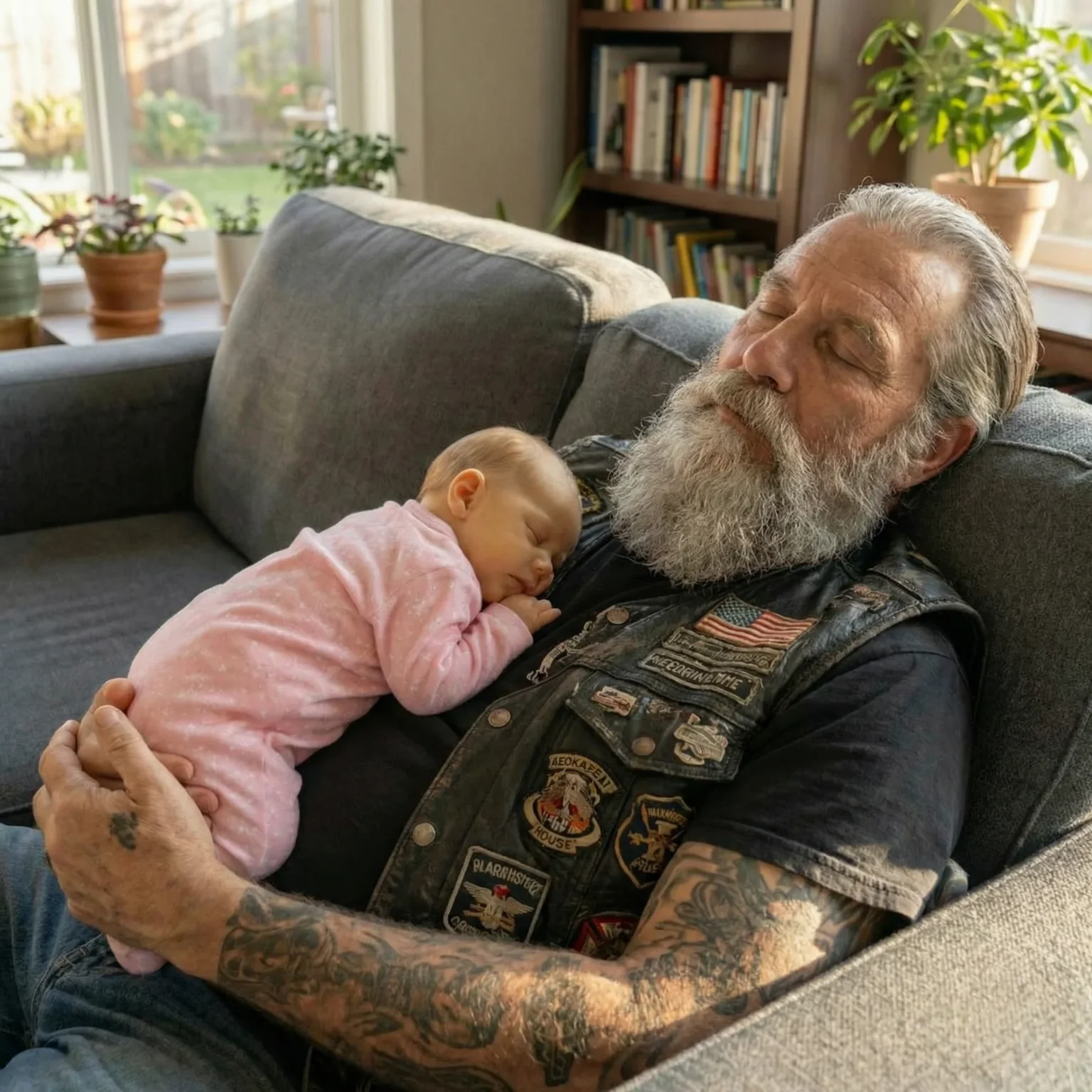
Her little hand curled against my shirt and she fell asleep on me.
I sat there for almost two hours, afraid to move.
Just watching her breathe.
Just trying to understand that this was real.
That at sixty-eight years old, I was finally somebody’s father.
The first week nearly killed me.
Maya woke up every two hours.
She needed bottles, diaper changes, medications, temperature checks, and constant watching.
I slept in chunks so small they barely counted.
I forgot to eat lunch more than once. Burned through the frozen meals people dropped off. Wore the same jeans for three days because I couldn’t remember the last time I’d done laundry.
On the fifth day, Danny showed up, took one look at me, and said, “You look like roadkill.”
“Appreciate that.”
“When’s the last time you slept?”
I stared at him.
“What month is it?”
He laughed, took Maya from my arms, and pointed toward the hallway.
“Go lie down. Two hours. I’ve got her.”
“You know how to handle—”
“Jack, I raised three kids. Go.”
I slept for three straight hours and woke up in a panic, convinced something was wrong.
I came running into the living room.
Danny was asleep on the couch with Maya on his chest.
Both of them looked perfectly content.
“She took a bottle an hour ago,” he muttered without opening his eyes. “Diaper’s clean. She’s good.”
I sank into my recliner and rubbed my face.
“I don’t know if I can do this.”
Danny finally opened his eyes and looked at me.
“Yes, you can.”
“I’m exhausted.”
“That means you’re a parent.”
“This is just the beginning. She’s got surgery next month. Years of therapy after that. What if I’m too old? What if I can’t keep up?”
Danny sat up a little.
“Jack. You rode through a firefight in Vietnam. You buried your wife and somehow kept breathing. You stayed sober when half the world expected you to fall apart. You can handle one tiny baby.”
“It’s different.”
“Why?”
Because the truth came out before I could stop it.
“Because I can’t let her down.”
Danny looked at me for a long time.
Then he glanced down at Maya.
“She trusts you,” he said. “That’s all you need to know.”
Week two got easier.
Not easy.
Just easier.
I started learning her rhythms.
The difference between hungry crying and tired crying.
How to burp her without making her angry.
How to hold the bottle just right.
How to get her back to sleep after medicine.
The brothers started rotating through more often.
Bringing food. Doing laundry. Holding her so I could shower or eat.
Tommy, one of the younger guys in the club, came by every couple of days. He had a toddler at home and taught me more in one week than any of the parenting classes had.
“You’re doing fine,” he told me one afternoon.
“I am absolutely not.”
He laughed.
“We’re all improvising. That’s parenting.”
Lisa started calling more often too.
Every few days.
Checking in.
Asking questions.
Then one night she said, “I’m coming next month.”
“You don’t have to.”
“I know,” she said. “I want to meet my sister.”
That word hit me harder than I expected.
Sister.
Maya had family.
Maya’s first cardiology appointment came during week three.
Dr. Patel examined her, listened to her heart, reviewed her scans, then sat down across from me.
“Her heart function is stable for now,” he said. “But she’ll need surgery soon. The defect is serious.”
“How soon?”
“Within the next month. Sooner if she starts declining.”
I swallowed hard.
“What are the odds?”
Dr. Patel was quiet for a second.
“It’s open-heart surgery on a four-month-old infant. There’s always risk. But without it, she won’t live past a year.”
I felt the air leave my chest.
“And with surgery?”
“About a seventy percent survival rate.”
Seventy percent.
I’d faced worse odds in war.
But never for someone this small.
Never for someone I loved like this.
I buckled her into her car seat afterward, sat behind the wheel of my truck, and just stared ahead for ten minutes.
Then I looked at her through the mirror and said, “You’re going to make it, baby girl. You hear me? You’re going to make it.”
That night the club held a meeting.
Danny stood up and said, “Jack’s baby has surgery next month. Recovery’s going to be rough. He’s going to need help.”
And just like that, the room went into motion.
Meal train.
Hospital rotation.
House maintenance.
Rides to appointments.
Fundraiser for medical costs.
Every man in that room volunteered something.
Danny looked at me and said, “You’re not doing this alone.”
I wanted to say something back.
Couldn’t.
Just nodded.
The three weeks before surgery crawled by.
Every day I memorized Maya a little more.
The way she looked right before she smiled.
The sound of her sleepy sigh.
The way she gripped my finger like her whole life depended on it.
I took hundreds of pictures.
Maya sleeping.
Maya stretching.
Maya in her crib.
Maya in my arms.
Maya with the brothers.
Just in case.
Lisa came two days before the surgery.
The second she saw Maya, she started crying.
“She’s so small.”
“I know.”
“And you really did it,” she said. “You really became her dad.”
“Yeah,” I said. “I did.”
She held Maya for over an hour.
Told her about Oregon. Told her about her nephews. Told her about the mother she’d never meet.
“Sarah would’ve loved her,” Lisa said quietly.
I nodded.
“She really would have.”
The night before surgery, I sat in the rocking chair at two in the morning with Maya asleep against my chest.
I couldn’t put her down.
“You have to get through this,” I whispered. “Do you hear me? You have to. Because I don’t know how to live in a world where you don’t.”
She shifted in her sleep and wrapped her hand around my finger.
“I know I’m old. I know I’m not what anybody would have picked. But I love you. And I’m not going anywhere.”
Surgery day was the longest day of my life.
They took Maya back at seven in the morning.
Said it would take four to six hours.
I sat in that waiting room with Lisa and Danny and couldn’t do a single thing except stare at the doors.
At hour three, a nurse came out and said things were going well.
At hour five, I started pacing.
At hour six, Dr. Patel came through the doors.
He was smiling.
“She did great,” he said. “The surgery was successful.”
My knees nearly gave out.
“She’s okay?”
“She’s okay.”
I sat down hard.
Lisa was crying beside me. Danny’s hand was heavy on my shoulder.
“When can I see her?”
“About an hour.”
When they finally let me into recovery, Maya was surrounded by machines and tubes and monitors, but her chest was rising and falling.
She was breathing.
I sat beside her bed and took her hand in mine.
“You did it, baby girl,” I whispered. “You did it.”
For just a second, her eyes opened.
She looked right at me.
Then they closed again.
But she knew me.
I know she did.
Recovery took six weeks.
Six long weeks of medications, setbacks, alarms, oxygen dips, and more fear than I knew one person could hold.
But Maya fought.
Every single day, she fought.
The brothers rotated through the hospital with food, coffee, blankets, and bad jokes. Lisa stayed for two weeks before she had to fly home, but she called every single day after that.
By week four, Maya was out of the PICU.
By week six, Dr. Patel told us we could take her home.
Bringing her home the second time felt different.
The first time I had been terrified because I didn’t know what I was doing.
This time I was still terrified.
But I also knew something important.
I could do hard things for her.
I would do hard things for her.
Because she was mine.
And I was hers.
It’s been four months since the surgery.
Maya is nine months old now.
She’s gaining weight.
Smiling all the time.
Getting stronger.
She has physical therapy, occupational therapy, and speech support even though she’s still too little to talk.
I take her to every appointment.
Do every exercise.
Celebrate every tiny victory.
Last week she rolled over by herself for the first time.
I called Danny immediately.
He came over and we celebrated like she’d won a championship.
“That’s my girl,” I told her. “That’s my tough little girl.”
She smiled at me like I was the only person in the world.
People still ask me why I did it.
Why a sixty-eight-year-old biker would adopt a medically fragile baby that nobody else wanted.
At first, I told people it was because someone had to.
Because she needed a home.
Because she deserved better than an institution.
And all of that is true.
But it’s not the whole truth.
The whole truth is this:
Maya saved me too.
Before her, I was just existing.
An old man in an empty house, waiting for the days to run out.
Then one tiny baby wrapped her hand around my finger in a hospital room and gave me a reason to keep going.
Now I wake up with purpose.
Now I matter to someone.
Now somebody lights up when I walk into the room.
Somebody needs me.
Somebody knows I’m her dad.
Is it hard?
Every day.
Am I tired?
Constantly.
Am I scared of losing her?
More than I know how to say.
But I am also happier than I have been in years.
Maya isn’t the baby nobody wanted anymore.
She’s mine.
And I’m the luckiest old biker alive.