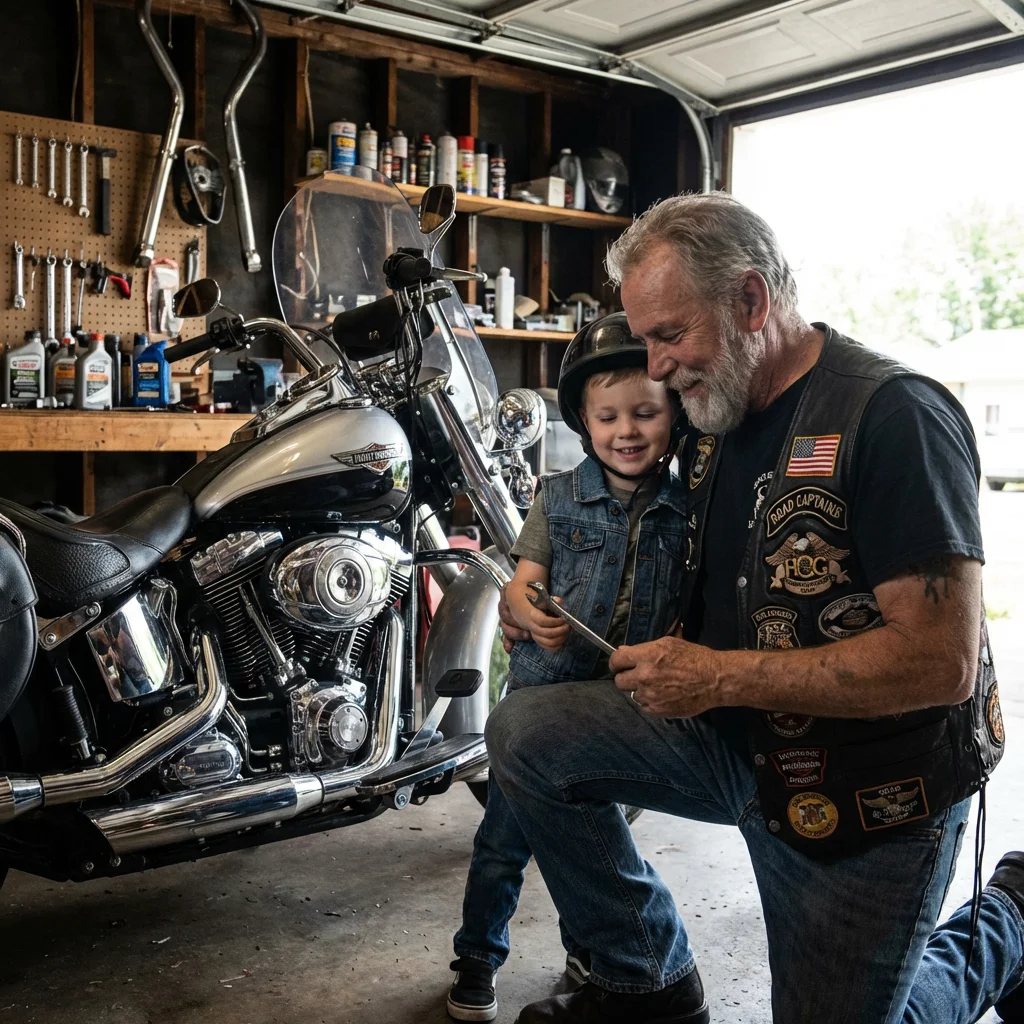
I’m a biker.
I’ve ridden through a tornado in Oklahoma without blinking. I’ve faced down four men in a parking lot with a chain in my hand. I’ve held my best friend’s hand while he died on the side of the highway.
Fear has never been a word I used for myself.
Then last Sunday, my five-year-old grandson crawled into my lap, pressed his head against my chest, and whispered something so softly I almost didn’t hear it.
“Grandpa,” he said, “it hurts.”
I looked down at him immediately.
“What hurts, buddy?”
He didn’t answer with words. He just lifted his hand and touched his chest.
There were no bruises. No cuts. No scrapes. Nothing I could see. I checked him over carefully.
“Your chest hurts?” I asked. “Like a tummy ache?”
He shook his head.
“No. Inside. It hurts inside.”
I figured maybe he meant his stomach. I made him some soup. Got him some juice. He ate a little. He seemed fine for a while.
Then he asked me something that knocked the breath out of me.
“Grandpa,” he said, “why doesn’t Daddy love me?”
My son—Eli’s father—walked out three years ago.
Just disappeared.
No note. No phone call. No explanation.
He looked me in the eye at Thanksgiving dinner, said he was going to get cigarettes, and never came back.
He left his wife.
He left his son.
He left all of us.
Eli was only two then. Too young to understand. Too young to ask the questions that would come later.
But he’s five now.
And at five years old, he notices things.
He sees the other kids at school getting picked up by their dads. He sees fathers carrying backpacks, showing up at school events, kneeling down to hug their sons at pickup.
He sees what he doesn’t have.
And now he’s old enough to feel the absence.
“He loves you,” I told him.
The words felt like a lie the moment they left my mouth.
“Then why doesn’t he come home?” Eli asked.
I swallowed hard.
“Sometimes grown-ups make bad choices, buddy. It’s not your fault.”
He looked down.
“Jake’s dad comes every day,” he said. “He picks him up and carries him.”
“I know.”
“My chest hurts when I see that. Is that normal?”
My grandson.
Five years old.
Asking me if heartbreak is normal.
I have fought men twice my size. I have buried brothers. I have walked away from crashes that should have killed me.
But sitting in that chair with Eli’s head on my chest, listening to him describe the pain of being abandoned by his father, I was more afraid than I have ever been in my life.
Because I didn’t know how to fix it.
You can fight a man.
You can survive a wreck.
You can ride through a storm.
But how do you heal something inside a five-year-old boy’s chest that was broken by the one person who was supposed to protect it?
I held him tighter. Told him I loved him. Told him I would always be there.
But his hand stayed on his chest, like he was trying to hold something together that felt like it was falling apart.
And I realized something that night.
The scariest thing in the world is not danger.
It’s not pain.
It’s not death.
It’s watching someone you love hurt and not knowing how to make it stop.
That night, after Eli fell asleep on the couch with his head in my lap, I sat in the dark and thought about my son.
Kyle.
I named him after my father.
I raised him the best I knew how. I wasn’t perfect. I spent too many years on the road. Missed too many things I should have been there for. But I showed up more often than I didn’t. I worked hard. I stayed.
Kyle was a good kid once.
Smart. Funny. He had his mother’s eyes and my stubborn streak. When he was seventeen, he told me he wanted to be nothing like me. Didn’t want the bike. Didn’t want the leather. Didn’t want my life.
It hurt, but I let him go his own way.
He went to college. Got a business degree. Met Sarah at a campus job fair. Got married young—twenty-three. On the morning of his wedding, I had to show him how to tie a tie because nobody had ever taught him.
Then Eli was born.
And when I saw Kyle holding that baby, I thought maybe he had found the thing that would steady him. Maybe fatherhood would anchor him in a way nothing else had.
I was wrong.
At first, the changes were small.
Working late.
Missing dinners.
Weekend trips that stretched longer and longer.
Sarah called me crying more than once. Said Kyle had become distant. Said it was like he was already halfway gone.
Then came Thanksgiving.
Three years ago.
Kyle was sitting at my table eating turkey, laughing at something on his phone. Eli was in the highchair throwing mashed potatoes. Sarah was trying to hold the day together like she always did.
Then Kyle stood up, said he was going to get cigarettes, and walked out the front door.
We never saw him again.
I tried to find him.
I called every number I had. Checked every city I could think of. Filed a missing persons report that didn’t go anywhere because he wasn’t missing.
He had just left.
Deliberately.
Six months later, Sarah got divorce papers in the mail. Postmarked from Nevada. No return address. No note. No explanation. Just signatures and legal forms.
She signed them. What else could she do?
Part of me wanted to hate Kyle.
Part of me still does.
But hating your own son is a poison. It eats you from the inside.
What I could never forgive—what I still struggle to forgive—was what he did to Eli.
Not leaving Sarah.
Not leaving me.
Leaving his little boy.
Because children always think it’s their fault.
Always.
The morning after Eli told me his chest hurt, I drove him to school.
He sat quietly in the back seat, staring out the window.
When I walked him to the door, his teacher, Mrs. Delgado, stopped me in the hallway.
“Mr. Garrett,” she said, “can I talk to you for a minute?”
Eli went to his cubby while she pulled me aside.
“I’ve been meaning to call Eli’s mother,” she said. “He’s been having a hard time the last few weeks.”
My stomach tightened.
“What kind of hard time?”
“We did a project about families,” she said. “The kids drew pictures of their family members. Eli drew everyone—his mom, you, even your dog. But where his father should have been, he drew an empty space. Just a blank spot. When I asked him about it, he said, ‘That’s where my dad goes, but he’s not there.’”
Something inside me broke.
“The other children noticed,” she continued. “A few of them asked where his dad was. Eli didn’t answer. Since then, he’s been withdrawing. Sitting alone. Not playing as much.”
I looked through the classroom window.
There he was.
My grandson.
Sitting alone at a tiny table.
His hand resting on his chest.
“He told me this weekend that it hurts here,” I said, touching my own chest.
Mrs. Delgado’s face softened.
“He’s grieving,” she said. “Children don’t always have the words for grief. Sometimes it becomes physical. Sometimes it turns into stomach aches, headaches… or chest pain.”
“What do I do?” I asked.
“Love him. Be consistent. Show up. If it continues, a child counselor might help. But the most important thing is that he has someone he can count on. Someone who won’t disappear.”
I looked at Eli again.
“I’m not going anywhere,” I said.
That week, I made a decision.
I called Sarah and asked if I could pick Eli up from school every day.
She sounded surprised.
“Every day?”
“Every day,” I said. “I’ll get him after school. Bring him to my place. Feed him dinner. You pick him up when you’re done with work.”
“Dad, you don’t have to do that.”
“I know. I want to.”
She got quiet for a second.
Then she said, “He talks about you all the time. You’re his favorite person.”
“Then let me be there.”
On Tuesday afternoon at 3:15, I pulled into the school parking lot on my bike.
Full leather.
Vest.
Boots.
Patches.
I looked exactly like what I was—a sixty-one-year-old biker surrounded by minivans and SUVs.
Some parents stared. A couple of mothers pulled their kids a little closer.
I’m used to that.
Doesn’t bother me anymore.
I stood by the fence and waited.
Then the doors opened and the children came pouring out.
Backpacks bouncing. Lunch boxes swinging. Parents calling names.
I saw Eli come through the door with his backpack hanging crooked on his shoulders. He was looking down, walking slow.
Then he looked up.
And he saw me.
His entire face changed.
Not just a smile.
Something deeper than that.
Something bright.
“GRANDPA!”
He ran.
Full speed.
He hit me like a freight train, and I caught him easily. Lifted him into the air. His arms wrapped around my neck so tight I could barely breathe.
“You came,” he said.
“I told you I would.”
He pulled back just enough to look at me.
“Jake’s dad picks him up every day.”
“Well,” I said, “now your grandpa picks you up every day.”
“Every day?”
“Every single day.”
“Promise?”
“Promise.”
He hugged me again, and I could feel his little heart beating against my chest—fast and hopeful.
A kid passing by tugged at his mother’s sleeve and pointed.
“Mommy, that man has a motorcycle.”
Eli turned proudly and said, “That’s my grandpa. He’s a biker.”
The way he said it.
Not embarrassed.
Not ashamed.
Proud.
I had bought him a little blue helmet with dinosaur stickers on it the day before. I set it on his head, buckled it, and helped him climb on behind me.
“Hold on tight,” I said.
“I always hold on tight, Grandpa.”
We rode out of that school parking lot past every SUV and minivan. Eli was laughing behind me. The other kids were staring. Some of them were pointing.
And for the first time in weeks, he wasn’t holding his chest.
He was holding onto me.
I picked him up every day after that.
And then the next week.
And the week after that.
We built a routine.
School pickup at 3:15.
Ride to my place.
Snack.
Homework.
Then whatever he wanted.
Feeding the chickens.
Playing in the yard.
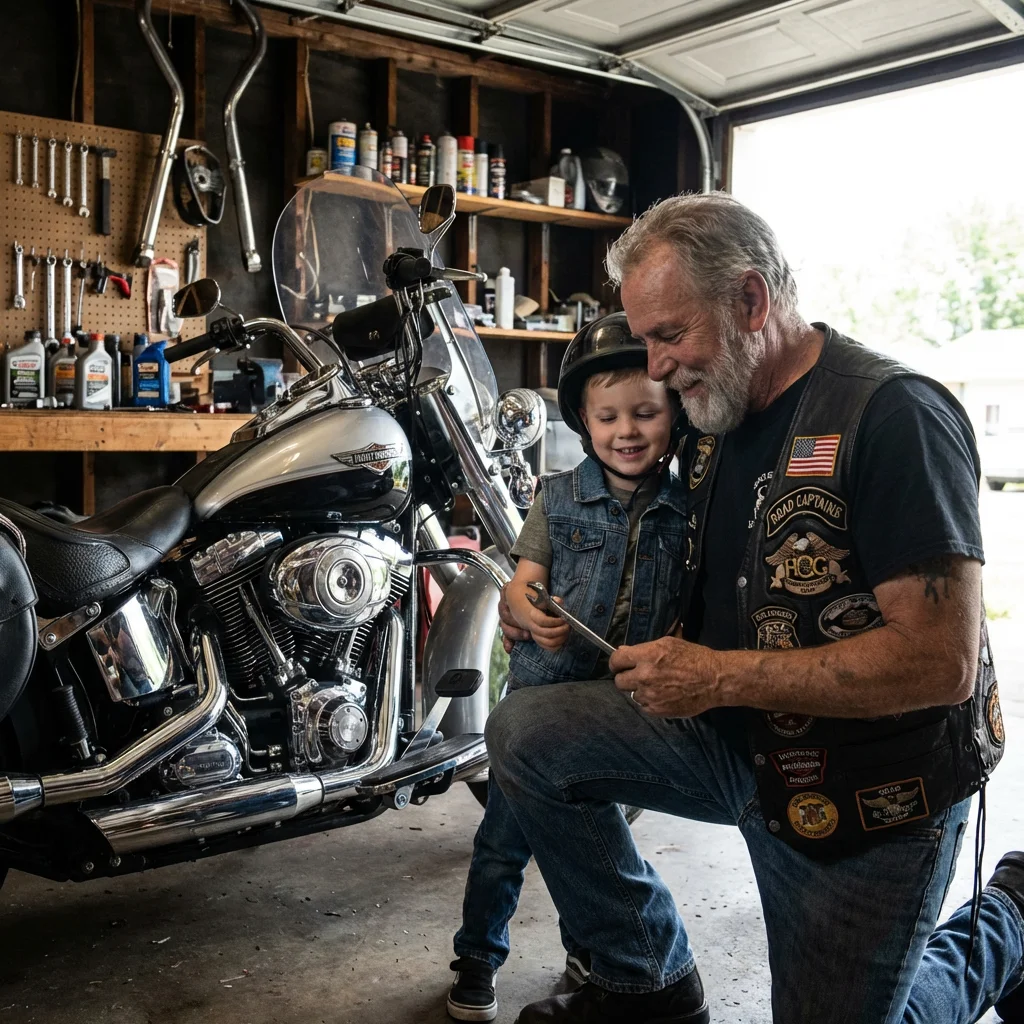
Helping me in the garage while I worked on the bike.
He’d hand me tools and ask endless questions.
“What’s that one do?”
“That’s a socket wrench.”
“What’s it for?”
“Tightening bolts.”
“Can I try?”
“Sure. Hold it like this.”
His hands were tiny. He could barely grip the wrench, but he tried with everything he had.
“Got it!” he’d say, grinning.
“Good job, buddy. You’re a natural.”
Some evenings we just sat on the porch with the sun going down, him curled into my lap, neither of us saying much.
He still asked about Kyle sometimes.
Not as often.
But the questions came.
“Do you think Daddy thinks about me?”
“I think he does,” I said.
“Do you think he’s coming back?”
I could have lied.
But children know when you lie.
Always.
“I don’t know, buddy,” I told him. “I hope so. But no matter what happens, I want you to know something. You have people who love you. Your mom loves you. I love you. You’re not alone. You will never be alone.”
He was quiet for a while.
“But it’s not the same.”
“No,” I said. “It’s not.”
“I have you.”
“Yeah. You have me.”
He looked up at me then and asked, “Is that enough?”
That question nearly destroyed me.
I pulled him closer.
“I’m going to do everything I can to make it enough, buddy. Everything I can.”
He put his hand on his chest.
Then he moved it to mine, like he was comparing the sound of our hearts.
“It hurts less now,” he said.
“Good.”
“It still hurts a little.”
“I know. It may hurt for a while. But I’ll be here for all of it.”
Three months later, Mrs. Delgado stopped me again at school pickup.
“I wanted to show you something,” she said. “We did the family drawing project again.”
She handed me the paper.
Eli had drawn his mom.
The dog.
The chickens.
And right in the center, bigger than everyone else, he had drawn a figure in a black vest on a motorcycle. Gray beard. Big shoulders.
Next to it, in crooked kindergarten letters, he had written:
GRANDPA
No empty space.
No blank spot.
Just Grandpa.
Right in the center.
“He showed it to the whole class,” Mrs. Delgado said. “Told everyone his grandpa picks him up every day on a motorcycle. Said his grandpa is the toughest guy in the world.”
I stood there staring at that picture.
“He’s doing better,” she said. “He’s laughing again. Playing again. Whatever you’re doing, keep doing it.”
I took a picture of that drawing.
It’s still the background on my phone.
I know I’m not Eli’s father.
I can’t replace what Kyle took from him when he walked away. There is a wound in that little boy that may never fully disappear.
But I can show up.
Every day.
3:15.
Rain or shine.
Bike or truck.
I can be the one he sees when the school doors open.
The one he runs to.
The one who lifts him up and says, “I told you I would.”
I can teach him to use a wrench.
To feed chickens.
To watch sunsets.
To ride.
I can teach him that men don’t leave.
That real men stay.
Especially when staying is hard.
My son broke something in Eli that I cannot repair.
But I can build something strong around the broken place.
Something steady.
Something safe.
Something he can hold onto when his chest starts hurting.
Last week, Eli was sitting on my bike in the garage, pretending to ride it and making engine sounds while I cleaned parts at the workbench.
“Grandpa?”
“Yeah, bud?”
“My chest doesn’t hurt today.”
I set the rag down and looked at him.
“No?”
He shook his head.
“No. It feels warm. Like when you hug me. But it feels like that even when you’re not hugging me.”
I had to swallow before I could speak.
“What do you think that is?”
He thought about it for a long moment, his little face serious.
Then he said, “I think it’s love. I think love and hurt feel the same but different. And right now it’s the love one.”
I turned away so he wouldn’t see my face.
Sixty-one years old.
Combat veteran.
Biker.
And a five-year-old boy had just brought me to my knees with ten words.
“Yeah, buddy,” I said finally. “I think that’s exactly what it is.”
Then he went back to making engine noises.
I went back to cleaning parts.
The garage was warm. Sunlight was coming through the window.
And for that one moment, everything was okay.
Not fixed.
Not perfect.
But okay.