My stepmother locked me inside a burning house when I was seven years old because she wanted my daddy’s insurance money.
A biker broke down my bedroom door and carried me out through the flames.
What I didn’t know until fifteen years later was that after saving me, he went back inside for my stepmother—and she stabbed him for it.
The fire started in the kitchen.
I woke up coughing, my room full of smoke and the sharp smell of something burning. My bedroom was upstairs at the end of the hall. At first I didn’t understand what was happening. I just knew something was wrong.
I ran to my door and tried to open it.
It wouldn’t move.
I twisted the knob harder. Pulled with both hands. Nothing.
Then I realized why.
It was locked.
From the outside.
I started screaming for my daddy.
He worked third shift at the factory and wouldn’t be home until morning.
Then I screamed for my stepmother, Linda.
She had married my daddy two years earlier, after my real mama died.
Nobody answered.
I beat on the door until my hands hurt. The smoke got thicker by the second. Orange light was starting to flicker under the crack beneath the door. The hallway outside was on fire.
I was only seven years old. I didn’t understand arson or murder or insurance fraud.
I only understood that I was trapped and scared and no one was coming.
I crawled to the window and tried to force it open, but it had been painted shut. I shoved and pushed and cried and begged, but it wouldn’t budge.
The room was filling with smoke fast. I got down on the floor, pressing my face near the crack under the door where the air was a little cleaner.
That was when I heard the motorcycle.
Then I heard footsteps.
Heavy boots pounding up the stairs.
Someone rattled my doorknob, realized it was locked, and then I heard the most beautiful sound I have ever heard in my life.
Wood splintering.
The door breaking open.
A man burst through the smoke.
He was huge. Dressed in leather. A bandana covered the lower half of his face. His eyes found me instantly.
“I got you, baby,” he said. “I got you.”
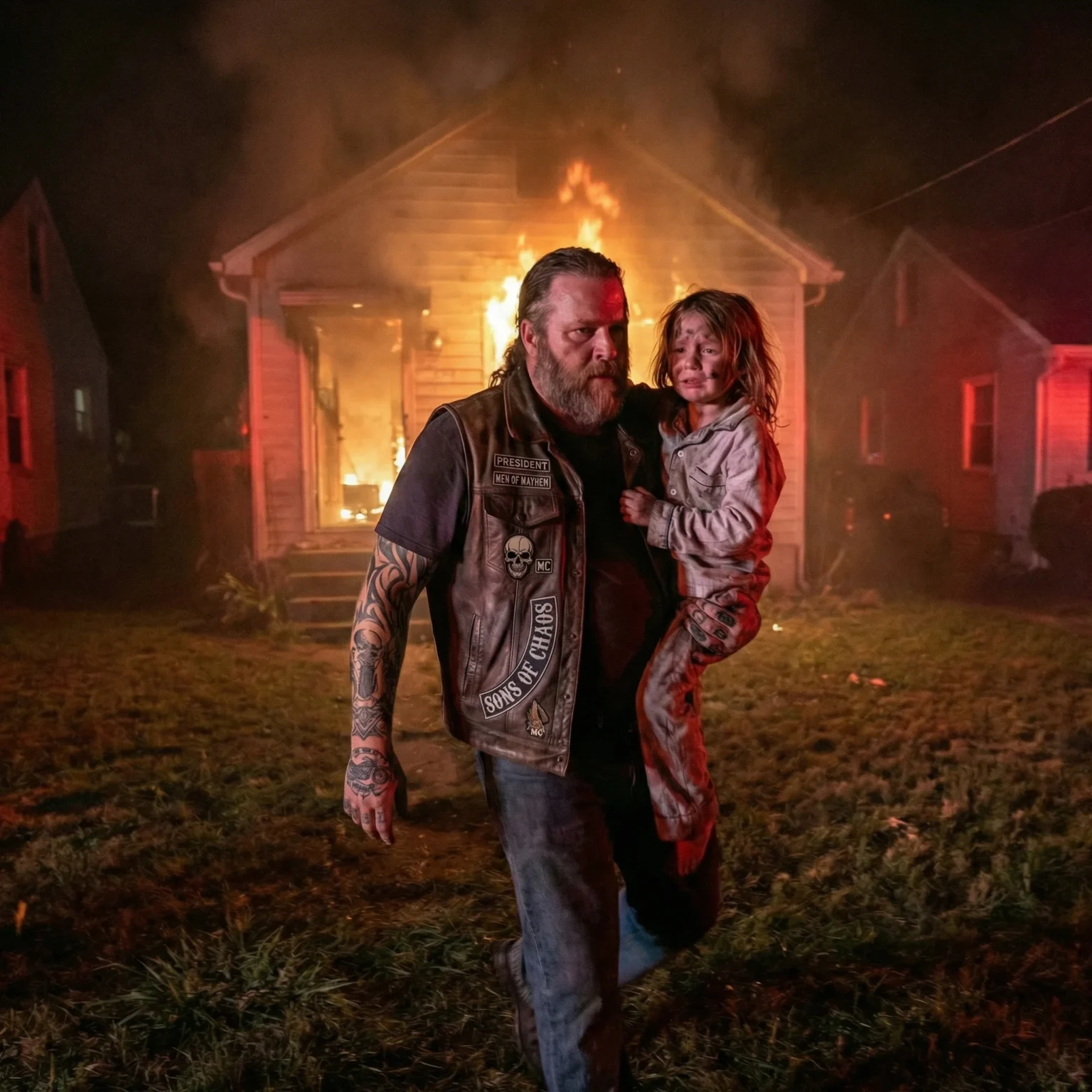
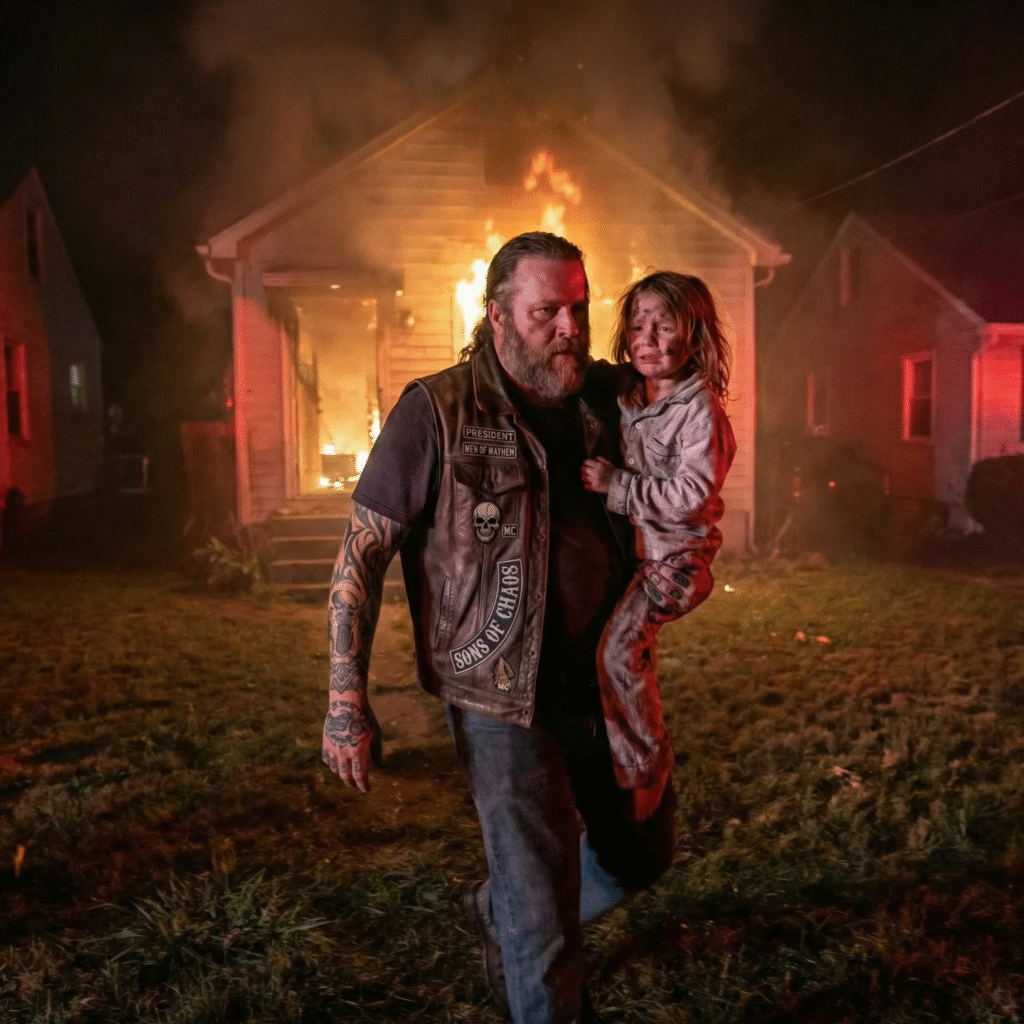
He scooped me up in his arms and carried me through the burning hallway, down the stairs, and out the front door into the yard.
The cold night air hit my face. I remember grass under my legs when he set me down. I remember him pulling the bandana away from his mouth.
He had kind eyes.
A gray beard.
A face I would never forget.
“You’re okay now,” he told me. “You’re safe.”
I was crying so hard I could barely speak.
“My stepmother,” I said. “Linda. She’s still inside.”
Something changed in his face.
“Where?”
“I don’t know,” I sobbed. “Maybe downstairs.”
He turned and looked at the house.
The entire first floor was engulfed. Flames were climbing toward the second. Smoke poured from every broken window.
He looked back at me.
“Stay here,” he said. “Don’t move.”
Then he ran back into the fire.
I sat in the yard wrapped in someone else’s coat and watched the house burn.
Neighbors were coming outside. Someone was on the phone with 911. Another person was kneeling beside me, trying to keep me calm.
Five minutes passed.
The biker never came back out.
Then the fire trucks arrived. Sirens. Lights. Shouting. Water spraying everywhere.
Part of the roof collapsed.
I started screaming again.
The man who saved me was still inside.
And it was because of me.
Because I had told him Linda was in there.
Then I saw movement at the side of the house.
Firefighters were running toward someone.
They carried a body out through the smoke.
It was him.
The biker.
Burned.
Bleeding.
Coughing like his lungs were full of fire.
But alive.
They laid him on the ground and started working on him. I tried to run to him, but someone grabbed me and held me back.
That was when I heard one of the firefighters say something I didn’t understand until much later.
“He went back in for the woman. Found her in the kitchen. She fought him. Stabbed him with a knife.”
I looked around.
Linda was sitting in the back of an ambulance.
She wasn’t crying.
She wasn’t burned.
She wasn’t hysterical.
She was just sitting there, staring at me with a face as empty as stone.
The paramedics took me to the hospital for smoke inhalation and burns on my hands from pounding on the door.
They kept me overnight for observation.
My daddy came straight from work, still wearing his factory uniform. His face was white when he walked into my room.
He came straight to my bed and took me in his arms.
“Baby girl,” he whispered. “What happened?”
“There was a fire,” I told him. “And I was locked in my room. A man on a motorcycle saved me.”
My daddy pulled back.
“Locked in?”
“The door wouldn’t open. It was locked from the outside.”
His whole face changed.
“From the outside?”
I nodded. “I tried and tried. I couldn’t get out. I was so scared, Daddy.”
He held me while I cried. Then he asked the nurse where Linda was.
They told him she had been treated for minor smoke inhalation and released. She was in the waiting room.
My daddy walked out to talk to her.
I couldn’t hear the whole conversation, but I heard his voice.
Loud.
Angry.
When he came back in, his jaw was tight.
“She said she fell asleep while cooking,” he told me. “She said the fire spread too fast and she panicked.”
“She locked my door,” I said.
He looked at me for a long moment.
“She says she didn’t.”
“I know she did.”
“She said maybe you locked it by accident.”
I shook my head hard. “I couldn’t. The lock is on the outside.”
My daddy went very still.
Then he nodded once.
“I know, baby. I know.”
The next day, a fire investigator came to talk to me. He was kind and patient. Asked me to walk him through everything I remembered.
I told him about waking up, about the smoke, about trying to open my door, about the biker breaking it down.
When I finished, he said, “Your bedroom door was locked from the outside. We found the bolt still engaged. There is no way you locked yourself in.”
I looked up at him.
“Where is the man who saved me?”
“He’s still here in the hospital,” the investigator said. “Different floor. He’s pretty badly hurt.”
“Can I see him?”
The investigator looked at my daddy.
My daddy nodded.
They wheeled me upstairs to Room 412.
The biker was in bed, wrapped in bandages. Both arms were burned. His side was bandaged too, where Linda had stabbed him.
But when he saw me, he smiled.
“Hey there, brave girl,” he said.
“You came back,” I said. “You’re alive.”
He gave a little crooked grin.
“Takes more than a fire to finish me off.”
I started crying again.
“I’m sorry. I told you she was inside. That’s why you went back.”
He shook his head.
“Not your fault. You didn’t know.”
“She stabbed you.”
“Yeah,” he said. “That part caught me by surprise.”
My daddy stepped forward.
“I’m Michael. Jenny’s father. You saved my daughter’s life.”
The biker nodded.
“Marcus.”
“You went back in for my wife.”
“I did.”
“She stabbed you.”
“Sure did.”
My daddy looked at him hard.
“Why would she do that?”
Marcus glanced at me, then back at my daddy.
“I think that’s a question the police need to answer.”
The police came later that afternoon.
They talked to Marcus.
They talked to me.
They talked to the fire investigator.
Then they went to question Linda.
At first, she stuck to her story.
Said it was a cooking accident. Said she’d fallen asleep. Said she ran outside in a panic and forgot I was upstairs. Said when Marcus grabbed her in the smoke, she thought he was an intruder and fought back.
It sounded calm.
Reasonable.
Believable.
Except the fire investigator found three separate points of origin.
Gasoline in the kitchen.
Gasoline in the living room.
Gasoline at the bottom of the stairs.
This wasn’t an accident.
It was arson.
And my bedroom door had been locked from the outside.
They arrested Linda three days later.
My daddy and I were staying with my aunt by then. Linda had been living in a hotel, paid for by the insurance company while they processed the claim.
When the police came for her, she didn’t cry.
Didn’t scream.
Didn’t protest.
She just went with them.
At the station, she finally told the truth.
She had married my daddy for money.
Not because he was rich.
Because he had enough.
The house was paid off.
He had a hundred-thousand-dollar life insurance policy through work.
If I died in the fire, my daddy would be broken. Vulnerable. Easier to manipulate.
Linda planned to comfort him, manage the insurance money, and eventually get everything else too.
And if that didn’t work?
Maybe one day my daddy would have an “accident” too.
She had planned the whole thing.
She waited two years so no one would be suspicious.
Then she set the fire while my daddy was at work, locked me in my room, and expected me to die from smoke inhalation before anyone noticed.
After lighting the fire in three places, she walked outside and called the insurance company.
Not 911.
The insurance company.
She thought she had timed it perfectly. Two in the morning. Quiet street. No witnesses. By the time anyone saw the flames, it would be too late.
But Marcus happened to ride past.
And Marcus was not the kind of man who rides past a burning house and keeps going.
When he went back inside for Linda, she panicked.
She was supposed to be the grieving survivor.
The poor wife.
The eventual widow.
Not the murderer.
So she stabbed him.
Tried to stop him from getting her out.
Maybe hoped they would both die and take the truth with them.
But Marcus was tougher than she had counted on.
The prosecutor later called it one of the coldest cases he had ever seen.
Attempted murder of a child.
Attempted murder of a rescuer.
Arson.
Insurance fraud.
Premeditation.
Linda got thirty years.
No parole.
Marcus recovered.
His burns healed.
The stab wound healed.
He was left with scars, but when I asked about them later, he just shrugged.
“They’re reminders,” he said.
“Reminders of what?”
“That sometimes you run into burning buildings,” he said. “And sometimes the person you’re trying to save turns out to be the one who started the fire. But you go in anyway, because it’s the right thing to do.”
Before he left the hospital, he gave me a stuffed bear.
“You be good, Jenny,” he said. “Take care of your daddy.”
“Will I ever see you again?”
He smiled.
“Maybe. If you need me.”
My daddy tried to pay him. Tried to cover his medical bills. Marcus refused both.
Said his club had already taken care of everything.
But he did write his phone number down for my daddy.
“If you ever need anything,” he said, “you call me. Day or night. You’re family now.”
Then he rode out of our lives.
And for fifteen years, I never saw him again.
My daddy and I moved to a new town and started over.
We didn’t talk much about Linda. We didn’t talk much about the fire either. We just kept moving.
I went to school.
Graduated.
Went to college.
Became a social worker.
I wanted to help kids who had been hurt by the very people who were supposed to protect them.
Kids like me.
On my twenty-second birthday, I decided it was finally time to find Marcus and thank him properly.
I was old enough now to understand what he had done.
What he had risked.
What he had given me.
I found his motorcycle club online and sent a message asking if anyone knew a man named Marcus who had saved a little girl from a fire fifteen years earlier.
Someone answered within an hour.
They gave me an address.
Said Marcus would want to hear from me.
I drove three hours to a small motorcycle repair shop in Pennsylvania.
There were bikes parked outside. Music playing inside. The whole place smelled like oil, metal, and old leather.
I walked in nervous.
Didn’t know if he would remember me.
A man looked up from the bike he was working on.
He was older now. More gray in his beard. More lines in his face.
But the eyes were the same.
“Can I help you?” he asked.
“Marcus?”
“Yeah?”
“I’m Jenny. You saved me from a fire when I was seven.”
He stared at me for a second.
Then his face broke open into the biggest smile.
“Little Jenny,” he said. “Look at you.”
He wiped his hands on a rag and came around the workbench and hugged me like I belonged there.
I hugged him back and cried before I could stop myself.
“I wanted to thank you,” I said. “For real this time. I was too little back then to understand. But I understand now. You didn’t just save me. You risked your own life. She stabbed you and you still got her out.”
Marcus shook his head.
“I just did what needed doing.”
“No,” I said. “You did what a hero would do.”
He made a face like he didn’t like that word.
“I’m not a hero. I’m just a guy who couldn’t ride past a burning house.”
“You went back in.”
“I thought she was a victim.”
“But you still went.”
He gave me a small nod.
“How’s your daddy?”
“He was good,” I said softly. “He remarried five years after the fire. Good woman. She really loved him.”
Marcus smiled. “That’s good.”
I handed him an envelope.
“My daddy wanted you to have this.”
Inside was a check for five thousand dollars.
Marcus tried to hand it back immediately.
“I can’t take this.”
“You have to. My daddy saved for fifteen years because he wanted to thank you properly. He said it wasn’t enough, but it was what he had.”
“I didn’t do it for money.”
“We know. That’s exactly why we want you to have it.”
He looked at the check for a long moment.
Then at me.
His eyes were wet.
“Tell your daddy thank you,” he said. “And tell him he raised a good woman.”
I smiled through tears.
“He only got to raise me because of you.”
We talked for two hours that day.
He introduced me to his club brothers. They all knew my story. They all laughed and said Marcus was crazy for going back in.
Then they got serious and said they would have done the same.
Before I left, Marcus walked me out to my car.
“You said you’re a social worker now?”
“Yeah. I work with kids in foster care. Kids who’ve been abused. Neglected. I help them find safe homes.”
He nodded slowly.
“That’s good work.”
“I do it because of you,” I told him. “Because you showed me strangers can be heroes. Because you showed me that sometimes the person who saves you is someone you’ve never met before.”
He shook his head.
“You’re doing more good than I ever did.”
“I’m doing good because you let me live long enough to do it.”
He pulled me into another hug.
“You ever need anything,” he said, “you call me. Flat tire, bad date, trouble at work, somebody bothering you—doesn’t matter. You call.”
“I will.”
As I got in my car, I rolled the window down.
“Marcus?”
“Yeah?”
“Why did you stop that night? Really?”
He looked away for a second.
Then back at me.
“My daughter would have been about your age,” he said. “If she’d lived.”
That was all he said.
But it was enough.
I understood then.
I wasn’t just a little girl he had saved.
I was also the daughter he had lost.
The second chance he never got.
I visit Marcus twice a year now.
I bring coffee. Tell him about the kids I’m helping. Tell him about the cases that keep me up at night and the small victories that make it worth it.
He always listens.
Always asks good questions.
Always tells me the work matters.
Last year, he walked me down the aisle at my wedding.
My daddy had died two years before from cancer, and there was no one else I wanted beside me.
As we walked, Marcus leaned over and said, “Your daddy would be proud.”
I smiled through tears.
“He always said you were the reason he got to walk me to kindergarten. And the first day of high school. And graduation. He said you gave him everything.”
Marcus shook his head.
“I just gave him his daughter back.”
“That was everything.”
At the altar, Marcus shook my husband’s hand.
“You take care of her,” he said. “She’s special.”
My husband smiled.
“I know. I will.”
Marcus sat in the front row, cried during the vows, and danced with me at the reception.
“You picked a good one,” he told me.
“I learned from good men,” I said. “My daddy taught me what love looks like. And so did you.”
He laughed softly.
“I just broke down a door.”
“No,” I said. “You broke down a door when no one else would. You ran into a burning house when everyone else was running out. That’s not ‘just’ anything.”
He didn’t argue with me that time.
He just held me a little tighter while we danced.
People ask me sometimes how I turned out okay.
How I’m not consumed by trauma.
How I can work with abused children after what happened to me.
I tell them the truth.
I’m okay because someone stopped.
Someone heard me screaming and came for me.
Someone broke down the door.
Someone said, “I got you.”
That changes a person.
It changes everything.
Linda got out of prison last year after serving twenty-five years.
She sent me a letter. Said she had found God. Said she was sorry. Said she wanted to make amends.
I never answered.
Marcus asked if I wanted him to handle it.
I told him no.
But I appreciated that he offered.
I appreciated knowing that if I ever needed him, he would still show up.
That’s what men like Marcus do.
They don’t just save you once.
They keep being the kind of person who would do it again.
He’s seventy now.
Still rides.
Still works on bikes.
Still shows up when someone needs help.
He has a dozen stories like mine—people he helped, lives he changed, doors he broke down, both literally and figuratively.
But he says mine is the one he carries closest.
Says I reminded him why he rides.
Why he stops.
Why he goes toward the fire when everyone else is running away.
I tell him he’s the reason I became a social worker.
The reason I fight for children who can’t fight for themselves.
He says that makes us even.
But we are not even.
We never will be.
Because he gave me my life.
And every good thing I’ve done since that night exists because he heard a little girl screaming behind a locked door and said:
“I got you, baby.”
That debt can never be repaid.
But it can be honored.
I can live the life he saved.
I can help others the way he helped me.
I can be the person who shows up when someone is trapped and terrified and thinks nobody is coming.
I can break down doors.
Just like Marcus taught me.