I’ve been a biker and a mechanic for over thirty years. I can usually tell what’s wrong with an engine just by the sound it makes. Turns out I’m not nearly as good at reading people. Because it took me three months to understand why a fourteen-year-old boy kept showing up at my shop.
His name is Caleb.
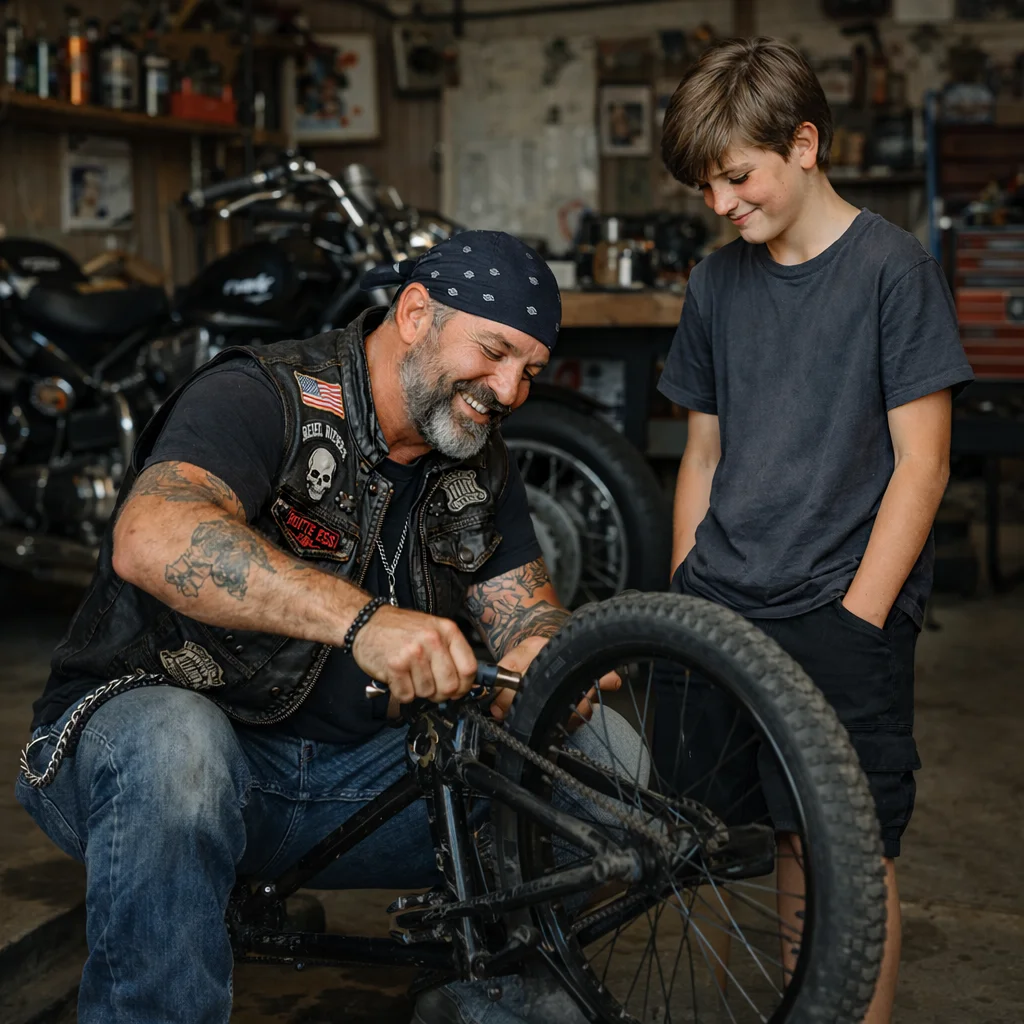
He first walked into my garage one afternoon in June, pushing a rusty BMX bike with a broken chain. I fixed it in about ten minutes and didn’t charge him anything. He thanked me quietly and left.
A week later he came back.
This time he said his handlebars were loose. They weren’t.
The week after that he said his brakes were squeaking. They weren’t.
The week after that he told me his tire was flat. It wasn’t.
Every Tuesday. Same time. Same kid. Same made-up problem.
At first I wondered if he might be scouting the shop for someone else. Maybe some older kid had sent him to look around for tools to steal. But Caleb never touched anything. He never wandered where he wasn’t supposed to. He would just sit on an old milk crate in the corner and watch me work.
Sometimes he would ask questions.
“What’s that part called?”
“How does a transmission work?”
“Why do Harleys sound like that?”
I answered every question. He would nod, think about it for a moment, and then sit quietly again.
By the fourth week, I stopped pretending to fix his bike. When he walked in, I’d just say, “Hey Caleb,” grab him a soda from the fridge, and let him sit.
He always stayed until six in the evening. Never later. Then he’d thank me and disappear until the next Tuesday.
My wife thought it was strange.
“Why does that kid keep coming to your shop?” she asked.
“Probably likes motorcycles,” I told her.
But then October came.
One Tuesday Caleb walked in without his bike. His left eye was swollen almost completely shut. Yellow and purple like it had been that way for at least two days.
“What happened to you?” I asked.
“Nothing.”
“That’s not nothing.”
“I fell.”
“Off what?”
“My bike.”
“Caleb,” I said gently, “you don’t have your bike.”
He sat down on the milk crate, pulled his hood up, and wrapped his arms around himself.
For the first time in four months he didn’t ask any questions. He didn’t drink his soda. He didn’t watch me work.
He just sat there shaking.
And suddenly everything made sense.
Those Tuesdays. The exact same time every week. Leaving right at six. The fake problems with the bike.
He hadn’t been coming to see a mechanic.
He had been looking for somewhere safe to hide.
I shut off the air compressor and pulled a stool over next to him. Not too close. Just close enough.
“Caleb,” I said softly, “I need you to tell me the truth.”
“I’m fine.”
“You’re not fine. You’ve got a black eye and you’re shaking in my garage.”
“Please don’t make me leave.”
Those five words hit me harder than anything else.
Please don’t make me leave.
“Nobody’s making you leave,” I told him. “You can sit here until the sun goes down. But I need to know who did that to your face.”
He didn’t answer. Just pulled his hood tighter around his head.
So I tried something else.
“You hungry?”
He looked up slightly.
“Yeah.”
I called my wife and asked her to bring some food. She didn’t ask any questions. After twenty years of marriage she knows when something is wrong just by the sound of my voice.
While we waited, I went back to work. I gave him space. Sometimes silence is what people need when they’re deciding whether they can trust you.
My wife arrived with two sandwiches, chips, and a thermos of soup. She took one look at Caleb and I saw her expression change immediately. She set the food beside him and gently touched his shoulder before walking over to me.
“How long?” she whispered.
“I don’t know,” I said. “He just showed up like this.”
“We need to call someone.”
“I know. But if I push too hard he’ll run.”
She nodded. She understood. She left quietly, but I knew she was going home to start looking up phone numbers and resources.
Caleb ate both sandwiches. The soup. All the chips.
Like he hadn’t eaten in days.
“When’s the last time you had a meal?” I asked.
“Sunday, I think.”
It was Tuesday.
“Caleb,” I said carefully, “is someone at home hurting you?”
His jaw tightened and he stared at the floor.
“You can’t help,” he said quietly.
“Try me.”
“Nobody can help. I told my teacher last year. She called CPS. They came to the house and asked questions. He acted normal while they were there. They left and said everything was fine.”
“Who’s ‘he’?”
“My mom’s boyfriend. Rick.”
He said the name like it tasted bitter.
“Rick hits you?” I asked.
Caleb slowly lowered his hood and turned his head. Behind his ear were small round marks.
Cigarette burns.
“He does other stuff too,” Caleb said quietly. “When my mom’s at work. She works nights at the hospital. Tuesday through Saturday. That’s why I come here on Tuesdays. She leaves at three and he starts drinking around three-thirty.”
Suddenly everything made sense.
Three o’clock. His mom leaves for work.
Three-thirty. Rick starts drinking.
By 3:45 Caleb is riding his bike to my shop.
He stays until six, when Rick usually passes out.
For four months this kid had been running a survival routine.
And my garage had become his safe place.
That night I couldn’t sleep.
The next morning I called an old friend of mine named Frank, a retired police officer who now worked as a private investigator. I asked him to look into Rick.
By that afternoon he called me back.
Rick Donovan. Forty-one years old.
Two domestic violence charges in another state. Both dropped after the victims recanted. One expired restraining order. A pattern of moving from place to place.
“This guy is a predator,” Frank told me. “He moves in with women who have kids. The pattern is textbook.”
The next step was the school counselor. She told me if we could document the injuries, CPS would be forced to act.
So I waited for Tuesday.
When Tuesday finally came, Caleb arrived late. Nearly five o’clock.
He was moving slowly like every step hurt. He was wearing a jacket that was far too big for him.
“Hey Caleb,” I said casually.
“Hey.”
“You’re late today.”
“Had to walk. Rick threw my bike in the creek.”
“Why?”
“Because I left a dish in the sink.”
A dish. In the sink.
I took a deep breath.
“Caleb,” I said, “I want to help you get out of that house. Really help you.”
“You can’t.”
“I can. But I need you to trust me.”
After a long silence he slowly took off the oversized jacket.
His arm was covered in bruises. Finger marks from someone grabbing him hard.
He lifted his shirt. More bruises across his ribs.
Then he turned around.
Belt marks across his back.
I took photos of everything.
Then I made some calls.
The school counselor contacted CPS. The police were notified.
And I called a few biker friends.
Within an hour fourteen motorcycles were parked outside my shop.
The police arrested Rick that night.
Caleb came home with my wife and me.
That night my wife made spaghetti. Caleb ate three full plates.
I showed him the guest room and the bed.
“The door has a lock,” I told him. “If you want to use it.”
He looked at the door for a moment.
“I don’t think I need it,” he said quietly.
“You don’t.”
He slept for fourteen hours straight.
It’s been eight months now.
Caleb still lives with us as our foster son.
He works at the shop after school and he’s already better with engines than most grown men I know.
Last Tuesday he looked up from an engine we were rebuilding.
“Hey Ray?” he said.
“Yeah?”
“You know why I chose your shop?”
“Why?”
“Because the first day I came in you fixed my bike and didn’t ask me anything. You just treated me like I was normal.”
He paused.
“No one ever did that before.”
I had to turn away for a moment so he wouldn’t see my eyes.
“You’re not broken, Caleb,” I told him.
“You never were.”
And now he finally knows that too.