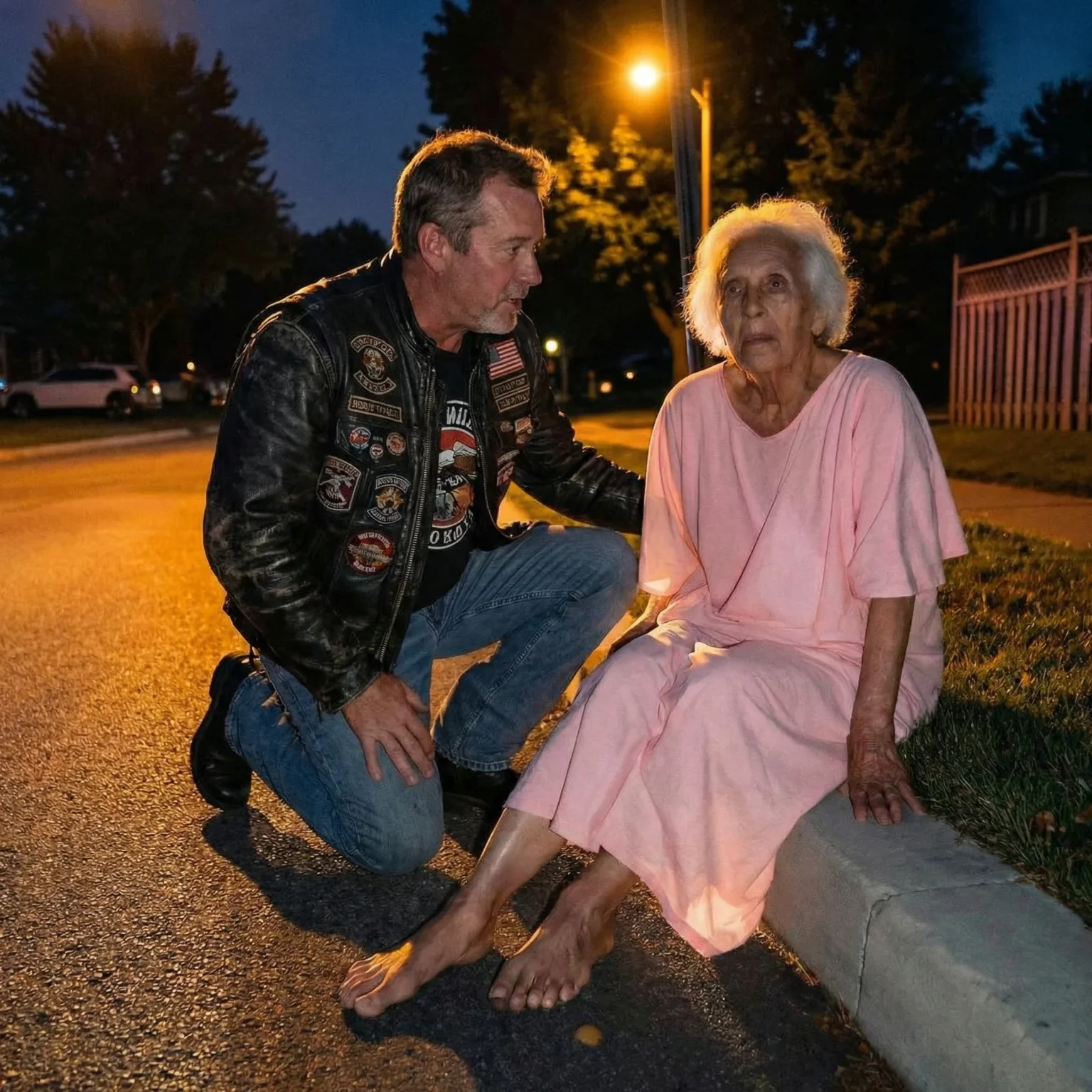
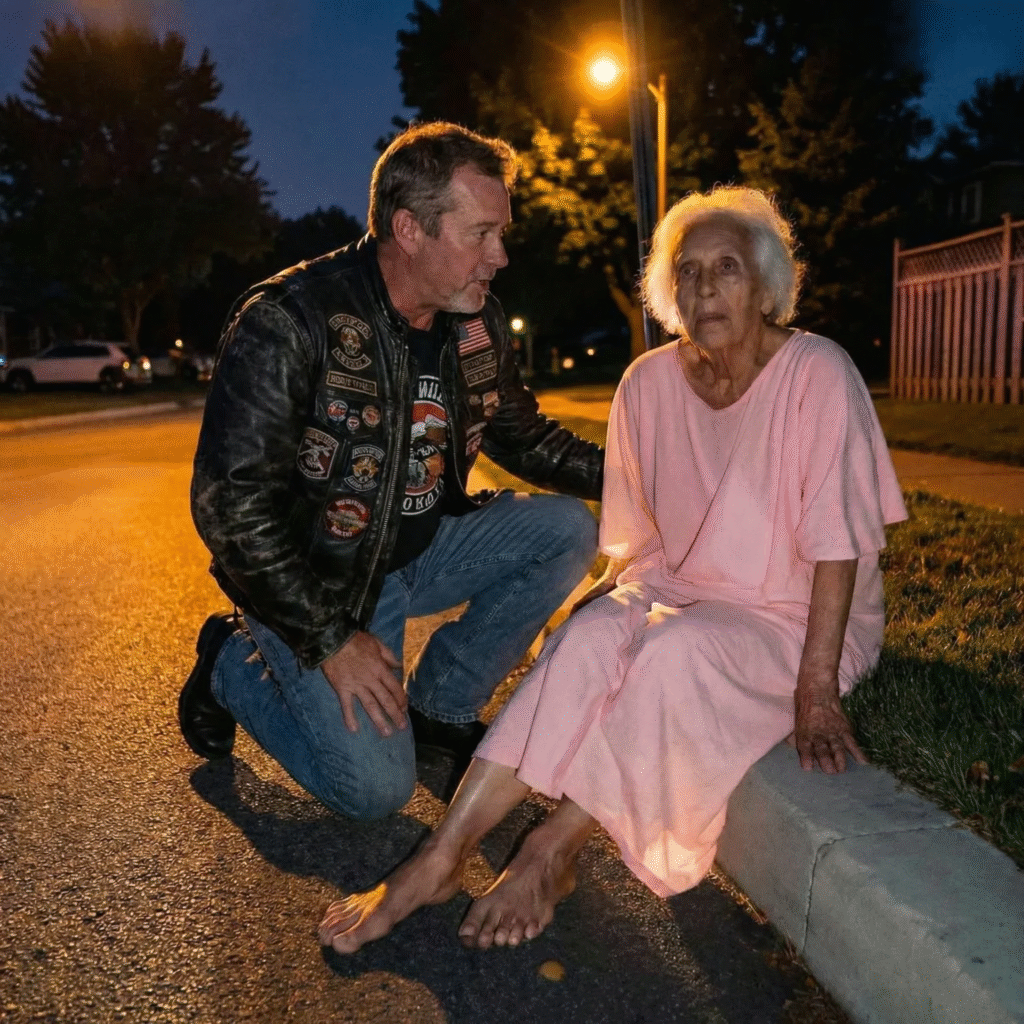
I found an elderly woman sitting on a curb outside a gas station just after midnight, crying so hard she could barely speak. When I asked if she needed help, she grabbed my arm and begged me not to take her back.
She looked to be around seventy-five. Tiny. Frail. Dressed in nothing but a thin nightgown, with no shoes on her feet.
It was forty degrees outside.
She was shaking so badly I could hear her teeth chattering.
I had stopped for gas on my way home from a club meeting. The station was one of those twenty-four-hour places just off the highway, the kind that stays half-lit and mostly empty after dark. There was no one outside except the clerk behind the counter and this old woman curled up on the curb.
At first I almost missed her.
She had her arms wrapped around herself, rocking slightly, trying to stay warm.
“Ma’am?” I said carefully. “Are you okay?”
She looked up at me, and even in the poor lighting I could see the bruising on her face. Fresh bruises. Purple and yellow blooming around her cheekbone.
Her eyes were red from crying.
“Please,” she whispered. “Please don’t make me go back.”
“Go back where?”
“Sunny Brook,” she said. “The nursing home. Please. I can’t go back there.”
I crouched beside her. “What happened to your face?”
She lifted one trembling hand and touched the bruise as though she had forgotten it was even there.
“I fell,” she said.
That answer hit me like it always does.
I’ve heard it too many times.
In the Army. In emergency rooms. In parking lots. In homes where people whisper the truth with their eyes but not with their mouths.
“I fell” usually means someone hurt me and I’m afraid to say it.
“Did someone hit you?” I asked.
Her eyes filled with tears again.
She didn’t answer.
She didn’t have to.
“How did you get here?”
“I walked,” she said. “I think. I’m not sure. I just knew I had to get away.”
Sunny Brook was about three miles from that gas station.
That meant this woman had walked three miles in the cold, barefoot, in a nightgown, with a bruised face and nobody to protect her.
The clerk came outside then, wiping his hands on his apron.
“She’s been sitting there almost an hour,” he said. “I was about to call the police.”
“Don’t,” I told him. “Not yet.”
Then I took off my leather jacket and wrapped it around her shoulders.
“What’s your name?” I asked.
“Dorothy,” she said. “Dorothy Walsh.”
“I’m Mike,” I told her. “And I’m going to help you. But I need to know what happened.”
She stared at me for a moment, trying to decide whether I was safe.
Then she slowly pushed up the sleeve of her nightgown.
There were bruises on her wrist.
Clear finger marks.
Someone had grabbed her hard enough to leave a pattern.
“There’s an aide at the home,” she said quietly. “Marcus. He gets angry when people don’t do what he says. He grabbed me. Shook me. Tonight he pushed me. I hit the dresser.”
She touched the bruise on her cheek.
“I told the head nurse,” she continued. “She said I must have been confused. Said Marcus is wonderful with the residents.”
Her lips trembled.
“So I ran.”
I pulled out my phone.
Not to call the police.
I called someone who knew exactly what to do in situations like this.
Dorothy caught my hand before I could dial.
“Please,” she said again. “Please don’t take me back there.”
I looked her straight in the eye.
“I’m not taking you back,” I said. “I promise.”
The person I called was Linda Ramirez.
Two years earlier, when my own mother had been in a care facility, Linda had helped us document neglect and get her transferred somewhere safe. She ran a nonprofit that dealt with nursing home abuse cases. If anyone knew how to help Dorothy, it was her.
She picked up on the second ring.
“Mike? It’s midnight.”
“I know. I need help. I’ve got a woman here. Dorothy Walsh. She says she escaped from Sunny Brook Care Center. She says an aide named Marcus has been hurting her. She’s bruised, terrified, and freezing.”
Linda didn’t waste a second.
“Where are you?”
“Highway 7 gas station.”
“Stay there,” she said. “I’m on my way. Do not let anyone take her anywhere. I’ll be there in thirty.”
She made it in twenty-five.
Linda stepped out of her old Honda carrying a duffel bag and one look at Dorothy told her everything she needed to know.
She knelt beside her and said softly, “Dorothy, my name is Linda. I help people who are being hurt in care homes. Can I ask you a few questions?”
Dorothy nodded.
Linda carefully photographed the bruises on her face and wrist. Then she started asking calm, precise questions.
“How long has Marcus worked there?”
“About six months.”
“How long has he been hurting you?”
“A few weeks. At first it was rough handling. Pulling too hard. Grabbing too hard when helping me walk. Then it got worse.”
“Has he hurt anyone else?”
Dorothy hesitated. Then nodded.
“Mrs. Patterson,” she said. “Room fourteen. He twisted her arm when she wouldn’t take her pills.”
She swallowed hard.
“And Mr. Lee. He’s scared of Marcus too. Won’t even look at him.”
Linda wrote everything down.
“Did you report it?”
“I told Nurse Sullivan. She said I was confused. Said Marcus is one of their best aides.”
“Did you tell your family?”
“My daughter. Sarah. She visits once a month. I told her last time.”
Linda paused.
“What did she say?”
Dorothy looked away.
“She said maybe my memory was playing tricks on me. That maybe I should give Marcus the benefit of the doubt.”
Linda’s jaw tightened.
“Your memory sounds plenty clear to me,” she said.
Then she looked at me.
“We need to get her somewhere safe tonight. Tomorrow we start building the case.”
“Where can she go?” I asked.
“I know someone. Ruth. She does emergency foster placement for elderly adults in crisis.”
Dorothy panicked at the idea immediately.
“Another stranger? Another strange place?”
Linda reached for her hand.
“Ruth is safe,” she said gently. “You’ll have your own room. You’ll be warm. You’ll have food. And Marcus won’t be able to reach you.”
Dorothy’s face crumpled.
“I just want to go somewhere I don’t have to be afraid.”
“Then that’s where we’re taking you,” Linda said.
Ruth lived in a small house on a quiet street about twenty miles away.
She opened the door in a robe and slippers, like she had been waiting for us all night.
“Come in, honey,” she said to Dorothy. “Let’s get you warm.”
She had tea already made. Blankets folded on the sofa. A small bedroom ready with clean sheets and a lamp glowing softly beside the bed.
She treated Dorothy like she was something precious.
Not a burden.
Not a problem.
A person.
Dorothy started crying the minute Ruth showed her the room.
“It’s been so long,” she whispered, “since anyone was kind to me.”
Ruth touched her shoulder.
“You’re safe now,” she said. “That’s all you need to worry about tonight.”
Linda and I stood in Ruth’s driveway around two in the morning talking through what came next.
“Tomorrow I call Adult Protective Services,” Linda said. “Then the state health department. Then the police. But they’re going to push back.”
“Because of her memory?”
Linda nodded.
“She has early-stage memory issues. Not dementia, but enough for people to dismiss her. The facility will say she’s confused. They’ll say the bruises came from falls. They’ll say Marcus is being targeted unfairly.”
“She knows exactly what happened.”
“I know that,” Linda said. “But knowing the truth and proving it are two different things.”
She crossed her arms.
“If Marcus is hurting Dorothy, he’s hurting others. We find them, we document it, and we build a case they can’t bury.”
“I’m in,” I said.
She gave me a long look.
“You understand this could get ugly?”
“Dorothy walked three miles barefoot in forty-degree weather to get away from that place. Yeah. I’m in.”
The next morning, Linda and I walked into Sunny Brook Care Center like we belonged there.
Linda had a clipboard. I wore clean jeans and a button-up instead of my cut, trying not to look like a guy who might set the whole building on fire if someone admitted what had happened.
The receptionist asked who we were there to see.
“Mrs. Patterson in Room 14,” Linda said smoothly. “Her grandson asked us to check on her.”
We signed in under fake names.
No one looked twice.
Room 14 was down a quiet hallway that smelled like industrial cleaner, canned vegetables, and old loneliness.
Mrs. Patterson was lying in bed staring at the ceiling.
She looked tiny.
Smaller than a person should look.
“Mrs. Patterson?” Linda said softly. “My name is Linda. I’m a friend of Dorothy Walsh.”
Her eyes shifted toward us.
“Dorothy is safe,” Linda said. “She told me you might need help too.”
The woman tensed immediately.
“I don’t know any Dorothy.”
“It’s okay,” Linda said. “We’re not from the facility. We’re here because we think someone has been hurting residents.”
Mrs. Patterson’s face changed.
Fear.
Instant and unmistakable.
“Has Marcus hurt you?” Linda asked.
“I fell,” she said too quickly.
Linda sat down beside her.
“Mrs. Patterson, Dorothy told me what he did. I need you to tell me if he hurt you too.”
The woman pulled her arms beneath the blanket.
“I don’t want to talk about it.”
“Nobody will believe me,” she whispered. “My son barely visits. The nurses already think I’m difficult. Marcus said if I complained, he’d make sure I regretted it.”
“Did he threaten you?”
Tears slid down her face.
“Please leave,” she said. “If he finds out you were here, he’ll know I talked.”
Linda wrote down her number and left it on the bedside table.
“If anything happens,” she said, “you call me. Day or night.”
As we stepped out into the hallway, a voice called from across from us.
“You looking for people Marcus hurt?”
We turned.
An older man stood in his doorway, leaning on a walker. Thin. Sharp-eyed. Angry.
“I’m Henry Lee,” he said. “Room 13. Marcus broke my finger three weeks ago.”
He held up his hand.
The finger had healed crooked.
“Bent it backward till it snapped,” Henry said. “Said it was an accident. Said I caught it in the wheelchair.”
“Did anyone report it?” Linda asked.
“My daughter did. Administrator said there was no sign of abuse. Said I probably hurt it myself and forgot.”
He stared at us hard.
“Would you like the truth? This place protects him. They all do.”
That was the crack we needed.
Over the next two weeks, Linda and I documented eight residents Marcus had hurt.
Eight.
Bruises. Broken fingers. Dislocated shoulders. Fearful statements whispered behind closed doors.
He targeted the same kind of people every time: residents with memory problems, weak family support, or voices nobody respected.
People easy to dismiss.
People easy to silence.
At first, the complaints went nowhere.
Adult Protective Services took notes.
The state opened a file.
The facility denied everything.
Marcus was described as “one of their strongest staff members.”
Then he made the mistake that ended him.
He assaulted a resident in front of another staff member.
A young nursing assistant named Jessica had suspected something was wrong for weeks. She had seen the fear in the residents but hadn’t known how to prove it.
When Marcus twisted Mrs. Patterson’s arm hard enough to make her cry out, Jessica pulled out her phone and recorded it.
That video changed everything.
The police arrested Marcus.
The state launched a full investigation into Sunny Brook.
The administrator was suspended.
Suddenly families who had ignored their parents’ complaints started paying attention.
The trial took eight months.
Marcus’s lawyer tried every trick in the book. Said the residents were confused. Vindictive. Unreliable. Claimed bruises came from falls, fractures came from frailty, and every accusation was a misunderstanding.
But Jessica’s video was undeniable.
And when Dorothy took the stand, she was stronger than anyone expected.
“He hurt me because he thought no one would believe me,” she said. “Because I was old. Because my memory isn’t perfect. Because he thought that made me powerless.”
She looked straight at the jury.
“My memory is good enough to remember every time he laid hands on me.”
Marcus was convicted on all counts.
He got twelve years.
Sunny Brook was fined heavily, placed under state supervision, and forced to overhaul its staffing and reporting procedures.
But the real victory wasn’t in the verdict.
It was in the people.
Dorothy never went back.
Her daughter, shaken by how badly she had failed her mother, moved Dorothy into her own home. They’re still rebuilding trust. Slowly. Carefully.
Mrs. Patterson transferred to another facility with better oversight. Her son visits twice a week now, trying to make up for everything he missed.
Henry Lee stayed at Sunny Brook.
Says somebody needs to keep watch.
Says the place won’t go bad again on his shift.
I still think about that night sometimes.
Dorothy sitting on that curb. Barefoot. Bruised. Terrified. Begging me not to send her back.
She had already asked for help.
Asked nurses.
Asked family.
Asked the people responsible for protecting her.
And every one of them had explained away her fear.
Told her she was mistaken.
Told her she was confused.
That’s the part that stays with me.
Not just what Marcus did.
But how easy it was for him to do it.
How many people saw the signs and looked away.
How many times Dorothy told the truth and no one believed her because she was old, frightened, and inconvenient.
Now I visit her sometimes.
She lives in a little house with her daughter and keeps flowers in the yard.
She smiles more now.
Eats better.
Sleeps better.
Still has nightmares sometimes, but not as many.
The last time I saw her, she handed me a framed photograph.
It was a picture of her from fifty years ago.
Young. Beautiful. Smiling. Full of life.
“I want you to have this,” she said.
“So you remember.”
“Remember what?”
“That we’re still people,” she said. “Not just old bodies in rooms. Not just burdens. Not just problems. We had lives. We still matter.”
Then she squeezed my hand.
“And thank you for stopping. Thank you for listening. Thank you for believing me.”
I told her the truth.
“You saved your own life, Dorothy. You walked three miles to get away.”
She smiled.
“Maybe,” she said. “But you’re the one who made sure I didn’t have to go back.”
I keep that photo in my saddlebag now.
It reminds me to pay attention.
To stop when something feels wrong.
To listen when people say they’re scared.
To believe them even when everyone else doesn’t.
Because dignity shouldn’t depend on age.
Safety shouldn’t depend on whether someone thinks your memory is good enough.
And old women crying on curbs at midnight are not invisible.
Especially them.
Dorothy taught me that.
And I’ll never forget it.