
I was sitting in booth four at Moretti’s. Corner spot. I go there every Thursday with my wife. Have for six years. Good food, decent prices, and Frank Moretti knows our names.
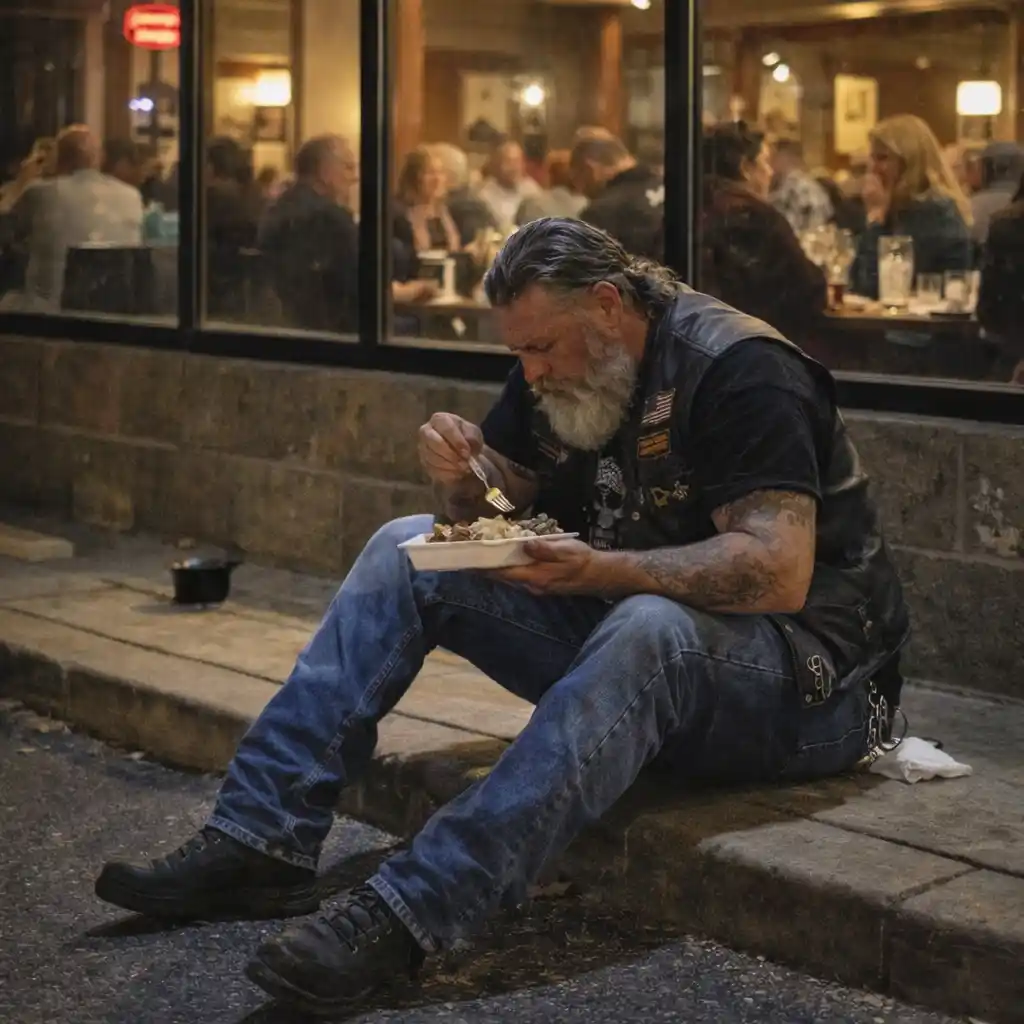
The biker came in around 7:30. Alone. Big guy, maybe sixty. Leather vest with patches. Bandana. Gray beard down to his chest. Road dust on his boots.
He sat down at a table near the window. Picked up a menu. Didn’t bother anyone.
Frank came out of the kitchen. Saw the biker. Stopped cold.
He walked over to the table. Didn’t bring water. Didn’t bring silverware.
“We have a dress code here,” Frank said. Loud enough for everyone to hear.
The biker looked up. “Excuse me?”
“Dress code. No leather. No biker gear. You’ll need to leave.”
There is no dress code at Moretti’s. I’ve eaten there in gym shorts. Frank made it up on the spot.
The biker was calm. “I just want a meal, man. I’ve been riding all day.”
“Then you can eat on the patio.”
“It’s forty degrees outside.”
“Then try somewhere else.”
The restaurant went silent. Every fork stopped. Twenty-three people watching this happen.
The biker looked around the room. Made eye contact with me. I looked down at my plate.
He scanned every table. Every single person either looked down or turned away.
Not one person spoke up.
The biker nodded slowly. Like he was used to it.
He stood up. Pushed his chair in. Walked outside.
And he sat at the patio table. Alone. In the cold. Because Frank Moretti decided he didn’t deserve to eat with the rest of us.
My wife grabbed my arm. “That’s not right,” she whispered.
“I know,” I said.
But I didn’t get up. Just sat there eating my chicken parmesan while a man sat outside in forty-degree weather because of what he was wearing.
The waitress brought him food through the patio door. He ate alone, breath fogging in the night air, while the rest of us pretended he didn’t exist.
I’ve thought about that moment every day since. About the way he looked at me. About the way I looked away.
Because three days later, I found out who that biker was.
And what I learned made me sick to my stomach.
His name was Dale Jeffords.
My neighbor Hank told me on Sunday morning. We were in our driveways, doing the usual weekend small talk. I mentioned what happened at Moretti’s. Said it had been bothering me.
Hank’s face changed.
“Big guy? Gray beard? Patches on his vest?”
“Yeah. You know him?”
“That’s Dale Jeffords. He’s part of the Guardian Riders.”
The name didn’t mean anything to me. Hank could tell.
“They’re a volunteer biker group,” Hank said. “They escort abused kids to court. Sit with them during testimony. Stand outside the courtroom so the kids feel safe. They’ve been doing it for years.”
My coffee suddenly tasted like nothing.
“He was in town for the Dawson case,” Hank continued. “You hear about that? The seven-year-old girl whose stepfather was charged with abuse? Dale’s been assigned to her for three months. Drives two hours each way to be there when she needs him.”
I had heard about the Dawson case. The whole town had. A little girl named Lily who’d been through hell. Her court date was the Friday after I watched Dale eat in the cold.
“He rode in Thursday night,” Hank said. “So he’d be here first thing Friday morning for Lily. Probably just wanted dinner before he found a place to sleep.”
I set my coffee down on the hood of my truck.
“You okay?” Hank asked.
“No. Not really.”
I went inside and sat at my kitchen table for a long time.
Then I opened my laptop and searched for Dale Jeffords.
What I found made everything worse.
Dale Jeffords was 62 years old. Marine Corps veteran. Two tours in Afghanistan. Purple Heart recipient. Retired after twenty years of service.
After the military, he’d become a long-haul trucker. Did that for a decade. Then his wife got sick. Cancer. He quit trucking to take care of her. She died fourteen months later.
That was four years ago.
After she died, Dale didn’t know what to do with himself. He was alone. His two sons had moved out of state. He had a house, a motorcycle, and nothing else.
Then he found the Guardian Riders.
A friend told him about the group. Volunteer bikers who provide support to abused and neglected children. They show up at court hearings. They stand guard outside kids’ homes when the abuser is released on bail. They let children know that someone big and strong is on their side.
Dale started volunteering. Then he started organizing. Within two years, he was running the entire state chapter.
His Facebook page was mostly private, but the Guardian Riders page was public. There were photos. Dale at courthouses. Dale at fundraisers. Dale surrounded by kids who were smiling because for the first time in their lives, they felt safe.
One photo stopped me cold.
Dale sitting on his motorcycle with a little girl on his lap. She was wearing a tiny leather vest the group had made for her. She was grinning. Her front teeth were missing.
The caption read: “Lily’s first smile in months. This is why we ride.”
That was the same Lily. The Dawson case. The girl he’d driven two hours to protect.
And the night before he was supposed to stand next to her in court, he’d walked into Moretti’s for a warm meal. And we’d made him eat in the cold like he was less than human.
I closed my laptop. Went to the bathroom. Splashed water on my face.
The man in the mirror looked like a coward. Because he was one.
I couldn’t let it go. The more I learned, the worse I felt.
I found an article in a regional newspaper from two years ago. The headline was “Local Biker Group Provides Shield for Vulnerable Children.”
Dale was quoted. “These kids have been hurt by adults they trusted. They’re scared of everything. We show up so they know that not every big person is going to hurt them. We’re their wall.”
Their wall. He used that word. Wall.
And we made him sit outside.
I found another article. A mother of an abused child wrote a letter to the editor about Dale specifically.
“My daughter wouldn’t leave the house for three months after what her father did to her. She was terrified of men. All men. Then Dale showed up on his motorcycle. He sat on our porch and talked to her through the screen door for an hour. Didn’t push. Didn’t force anything. Just talked. By the end of the week, she was sitting next to him on the porch steps. By the end of the month, she was laughing again. Dale Jeffords gave me my daughter back.”
I read that paragraph four times.
Then I thought about how he’d looked at me in the restaurant. Not with anger. Not with resentment. Just with hope. Hope that one person might say something.
And I’d looked at my plate.
Monday morning, I drove to Moretti’s before the lunch rush. Frank was in the kitchen doing prep.
“Hey, early bird,” he said when he saw me. “We don’t open for another hour.”
“I’m not here to eat, Frank.”
He wiped his hands on his apron. “What’s up?”
“That biker you made eat outside last Thursday.”
Frank’s expression hardened. “What about him?”
“That was wrong.”
“My restaurant, my rules.”
“You don’t have a dress code. You never have. You just didn’t want him in here because he looked like a biker.”
“I have the right to refuse service to anyone.”
“Sure. You have the right. But that doesn’t make it right.”
Frank crossed his arms. “Listen, those guys come in here, they scare my customers. They drive away business. I’m running a restaurant, not a charity.”
“He scared nobody. He sat down and opened a menu. That’s it.”
“And I handled it. What’s your problem?”
“My problem is that man is a Marine veteran. Purple Heart. He volunteers with a group that protects abused children. He was in town to escort a seven-year-old girl to court the next morning. And you made him eat in forty-degree weather because of his clothes.”
Frank’s jaw tightened. He didn’t speak for a moment.
“How was I supposed to know that?” he finally said.
“You weren’t. That’s the point. You shouldn’t need to know someone’s life story to treat them with basic decency.”
“I didn’t do anything illegal.”
“No, you didn’t. But you did something cruel. And I sat there and watched. And that makes me just as bad.”
Frank looked away. I could see it working behind his eyes. The justification fighting the guilt.
“I’ve got prep to do,” he said.
“Yeah. I know.”
I turned and left. I didn’t feel better. Confronting Frank hadn’t fixed anything. It was three days too late and I knew it.
Finding Dale took some work. The Guardian Riders had a website with a contact form. I sent a message explaining who I was. Said I’d been at Moretti’s that night. Said I wanted to apologize.
A woman named Pam called me back. She was the group’s coordinator.
“Dale doesn’t hold grudges,” she said. “It happens more than you’d think. Restaurants, hotels, gas stations. People see the leather and the beard and they assume the worst.”
“That doesn’t make it okay.”
“No. It doesn’t. But Dale’s been dealing with it for years. He says the kids are what matter. Everything else is noise.”
“I still want to talk to him.”
She gave me his number. I called that afternoon.
Dale answered on the third ring. His voice was deep and calm.
“This is Dale.”
“Mr. Jeffords, my name is Greg Hamill. I was at Moretti’s restaurant last Thursday night. I was one of the people who sat there and did nothing while they made you eat outside.”
Long pause.
“I remember you,” he said. “Booth four. You and your wife.”
He remembered. Of course he did.
“I called to apologize. What happened was wrong and I should have spoken up.”
“I appreciate that.”
“I learned about what you do. The Guardian Riders. Lily. All of it. And knowing that you were there to help a child and we treated you like that. I can’t stop thinking about it.”
Dale was quiet for a moment.
“Can I tell you something, Greg?”
“Of course.”
“What happened at that restaurant hurt. I won’t pretend it didn’t. I’m sixty-two years old. I’ve been spit on, turned away, followed by security, and called every name you can think of. It still hurts every time.”
“I’m sorry.”
“But here’s the thing. Friday morning, I stood in that courtroom next to Lily Dawson. She’s seven years old. She weighs forty-five pounds. She had to sit in front of a judge and talk about the worst things that ever happened to her. And when she got scared, she reached for my hand.”
His voice caught. Just for a second.
“That little girl doesn’t care what I look like. She doesn’t care about my vest or my beard or my boots. She sees someone who shows up. Someone who doesn’t leave. That’s all she needs.”
I didn’t say anything. Couldn’t.
“What happened at the restaurant wasn’t okay. But it didn’t stop me from being there for Lily. Nothing stops me from being there for these kids. Not weather, not restaurant owners, not twenty-three people who look the other way.”
“I should have said something,” I said.
“Yeah. You should have. But you’re saying it now. That counts for something.”
“Does it?”
“It does to me. Most people wouldn’t call. Most people would just feel bad for a week and then forget about it. You called. That tells me something about who you are.”
“I’m not sure I like what it tells me.”
Dale laughed. Low and warm. “Nobody does, at first. But the question isn’t who you were last Thursday. The question is who you’re going to be next Thursday.”
I went back to Moretti’s the following Thursday. Same booth. Same time.
My wife was with me. She knew what I was going to do. She squeezed my hand under the table.
Frank came over to take our order. Same as always.
“The usual?” he asked.
“Actually, Frank, I invited someone to join us tonight. Hope that’s okay.”
“Sure. Who?”
The front door opened. Dale walked in. Leather vest. Bandana. Boots. Same as before.
Frank saw him and stiffened.
I stood up. “Frank, this is Dale Jeffords. He’s a Marine Corps veteran. Purple Heart. He’s also a volunteer with the Guardian Riders. They protect abused children. Dale, this is Frank Moretti.”
The restaurant was watching. Every table. Just like last time.
But this time was different.
Dale extended his hand. “Nice to meet you, Frank.”
Frank looked at Dale’s hand. Looked at me. Looked around the restaurant.
The silence stretched. I could hear the kitchen fan humming.
Then Frank took Dale’s hand and shook it.
“Welcome to Moretti’s,” he said. Quiet. Almost a whisper.
Dale sat down at our booth. Frank brought him water. Silverware. A menu.
Nobody clapped. Nobody made a speech. It wasn’t a movie.
But something shifted. Something small and quiet and important.
The waitress came over. She was the same one who’d served Dale through the patio door the week before. She recognized him. Her face flushed red.
“What can I get you?” she asked.
“What’s good here?” Dale asked.
“The chicken parmesan,” I said. “Trust me.”
Dale ordered the chicken parmesan. We ate together. Talked about motorcycles and kids and the weather and nothing important.
When the check came, Frank brought it over himself. He set it down, then paused.
“The meal’s on the house,” he said to Dale. “And I owe you an apology. What I did last week was wrong.”
Dale looked at him steadily. “I appreciate that, Frank.”
“I judged you by what you looked like. That wasn’t fair.”
“No. It wasn’t.”
“I’m sorry.”
Dale nodded. “Apology accepted.”
Frank walked away. I saw him stop in the kitchen doorway and stand there for a moment with his hand on the frame. Just standing there.
Dale and I stayed in touch after that.
He told me more about the Guardian Riders. About the kids they’d helped. About Lily, who was doing better. Her stepfather was convicted. She was living with her grandmother now. Starting to heal.
“She still calls me sometimes,” Dale said. “Just to say hi. Just to hear my voice. She says it makes her feel safe.”
A sixty-two-year-old biker with a gray beard and road dust on his boots. Making a seven-year-old feel safe.
I asked Dale how he kept going. How he dealt with the judgment, the rejection, the people like Frank. Like me.
“Because the kids need me to keep going,” he said. “And because every time someone treats me like less than human, it reminds me why I do this. These kids get treated like they don’t matter every single day. They get told they’re nothing. They get hurt by people who are supposed to love them. If I can handle a little cold weather and some dirty looks, the least I can do is show up for them.”
I joined the Guardian Riders two months later.
My wife thinks I’m crazy. My boss thinks I’ve lost it. My neighbors don’t know what to make of the leather vest in my closet.
But I think about that Thursday night at Moretti’s. Twenty-three people. Twenty-three chances for someone to speak up. And every single one of us failed.
I don’t want to be that person anymore. The one who looks down at his plate. The one who says “it’s not my business.” The one who lets a good man eat in the cold because standing up feels uncomfortable.
Dale told me something on my first ride with the group. We were heading to a courthouse to support a nine-year-old boy who was testifying against his father.
“You know why we ride in groups?” he asked.
“Safety?”
“Visibility. One biker, people ignore. Twenty bikers, people notice. That’s the whole point. Be impossible to ignore. Be so loud and so present that nobody can look down at their plate and pretend we’re not there.”
I think about that every time I put on my vest.
Twenty-three people watched Dale Jeffords eat in the cold. I was one of them. And I said nothing.
I’ll never say nothing again
rewrite