My daughter Lily is nine years old. She has Down syndrome. She is the happiest child you could ever meet. She loves butterflies, music, and waving at strangers.
Most strangers do not wave back.
We moved to this town last year after my divorce. Every morning, Lily and I walk four blocks to her school. The last block has a crosswalk with no traffic light—just faded white paint on the road and a sign telling drivers to yield to pedestrians.
Nobody ever does.
Lily walks slowly. She cannot help it. What takes most people ten seconds takes her nearly a full minute.
Drivers honk.
They rev their engines.
One man even screamed at us to hurry up.
Lily cried for twenty minutes after that.
From then on, every morning became a struggle. We would reach the crosswalk, and she would freeze.
“Scary,” she would whisper. “Cars scary, Mama.”
I called the city and asked for a crossing guard. They told me they would look into it.
That was six months ago.
Nothing changed.
Then one Tuesday morning in March, Lily and I were standing at the crosswalk again. She was frozen in fear, and cars kept rushing past without slowing down.
That was when I heard the motorcycle.
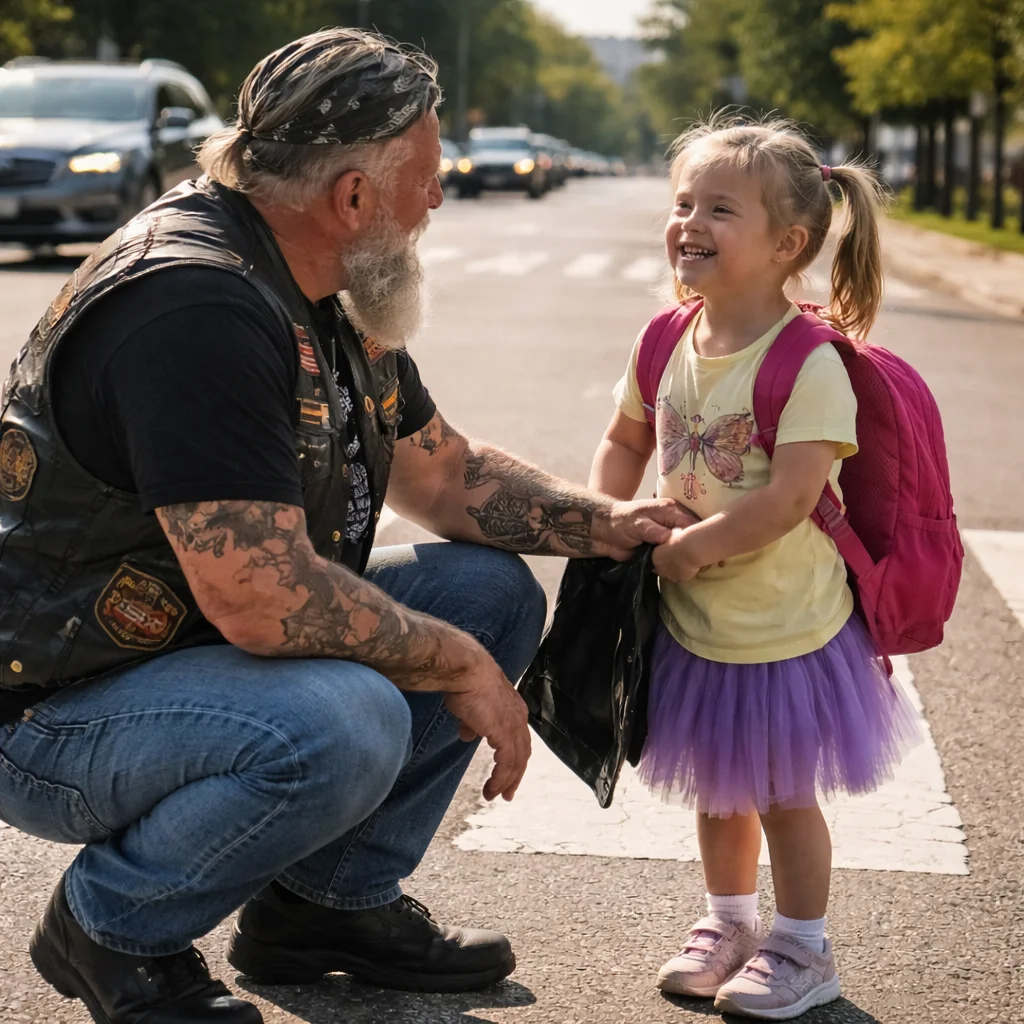
He came up behind us on a black Harley so loud it seemed to shake the street. He was a large man with a leather vest, a beard, and the kind of presence people notice immediately.
He looked at Lily.
Then he looked at the crosswalk.
Then he looked at the drivers who would not stop.
Without saying a word, he rode his motorcycle into the middle of the street, turned it sideways, and blocked both lanes.
Every car stopped.
Instantly.
Dead still.
Then he looked back at us, gave a small nod, and said, “Go ahead.”
Lily stared at him.
Then she looked at the empty street.
No cars.
No horns.
No angry drivers.
Just silence. Just safety.
She took one step.
Then another.
When she got halfway across, she stopped, turned toward the biker, and waved.
He waved back.
We made it to the other side. He moved his bike. Traffic resumed. Then he rode away without another word.
I thought that was the end of it.
A beautiful moment with a kind stranger.
But the next morning, he was there again.
Same spot.
Same bike.
Waiting.
Lily noticed him before I did.
She tugged on my hand and pointed excitedly.
“Motorcycle man, Mama.”
He was parked on the shoulder just before the crosswalk, engine off, sitting there as though he had been waiting for us.
When we got close, Lily did something that surprised me.
My daughter, who was terrified of loud cars and strange men, walked straight up to him.
He leaned down and took off his sunglasses. His eyes were warm and gentle.
“Hey there,” he said. “You remember me?”
Lily nodded. “You stopped the cars.”
“That’s right,” he said. “And I’m going to stop them again today. And tomorrow. And every day after that. Nobody is going to honk at you while I’m here. Okay?”
Lily looked at me.
Then back at him.
“Promise?” she asked.
“Promise.”
She held out her pinky.
That giant man in leather, with tattoos running up both arms, hooked his pinky around my daughter’s little finger.
“Pinky promise,” Lily said.
“Pinky promise,” he replied.
Then he started the motorcycle, rode into the street, and blocked traffic again.
And Lily crossed.
No hesitation.
No freezing.
No tears.
When we reached the other side, she blew him a kiss.
He pretended to catch it and tucked it into his vest pocket.
That became our routine.
His name was Ray Dalton. I learned that on the third day.
By then, I had started bringing an extra cup of coffee. It seemed like the least I could do for the man who showed up every morning at 7:45 to stop traffic for my daughter.
He took it black.
No sugar.
“You don’t have to do this,” I told him one morning.
“I know.”
“We’re strangers.”
“Not anymore,” he said.
He was not a talkative man. At least not at first.
I asked questions, and he answered in short pieces. He was retired. He lived on the south end of town. He rode every day. No, he did not mind getting up early. He was awake anyway.
Lily started calling him Mr. Ray.
He called her Miss Lily.
Every morning, she would walk up to him, and they would do their pinky promise. Then he would block traffic, and she would cross the street like she owned it.
Within a week, Lily was no longer afraid of the crosswalk.
Within two weeks, she started looking forward to it.
“Mr. Ray day!” she would announce every morning when she woke up.
As far as she was concerned, every day was Mr. Ray day now.
She began making things for him—drawings of motorcycles, butterflies, and stick figures holding hands. One morning she gave him a butterfly sticker for his gas tank.
He stuck it on his Harley right in front of her.
A big black motorcycle with a pink butterfly sticker.
Not everyone appreciated what Ray was doing.
By the second week, drivers had started noticing the pattern. Most of them adjusted. Some found a different route. Others simply left earlier.
But not all of them.
One morning, a man in a pickup truck laid on his horn the entire time Lily was crossing. She flinched, but she kept walking. Ray did not react. He just stood beside his bike with his arms crossed, unmoving.
When Lily safely reached the other side, the truck driver rolled down his window and shouted, “You can’t block a public road like this, you idiot!”
Ray walked over slowly. The driver’s expression changed the closer he got.
“That little girl needs sixty seconds to cross,” Ray said calmly. “You can give her sixty seconds.”
“I’ll call the cops!”
“Go ahead,” Ray said. “I’ll be here tomorrow too.”
The man sped away.
He did call the police.
The next morning, Officer Martinez arrived. He was young, polite, and clearly curious. He sat in his patrol car and watched while Ray parked his bike in the road, blocked traffic, and let Lily cross. She blew him a kiss. He caught it.
Then Officer Martinez got out and approached Ray.
“Mr. Dalton?”
“Morning, officer.”
“I got a complaint about you blocking traffic.”
“I figured.”
“Technically,” the officer said, “what you’re doing is obstructing a roadway.”
“Technically,” Ray replied, “that sign says drivers should yield to pedestrians. Nobody yields. So I help them.”
Officer Martinez looked at the crosswalk. Then the sign. Then the road.
Finally, he sighed.
“I’ve been asking the city for a light here for two years,” he said. “Budget keeps getting cut.”
“So until they figure it out,” Ray said, “I’ll be here.”
The officer stood there for a moment.
Then he nodded once.
“Have a good morning, Mr. Dalton.”
And he left.
He never came back about it.
It was during the fifth week that Ray finally told me the truth about why he did it.
Lily had already crossed and was waving goodbye from the school entrance. I stood beside Ray with my coffee, and he stood by his bike holding his.
“Can I ask you something personal?” I said.
“You can ask.”
“Why do you do this?” I asked. “And don’t tell me it’s because nobody else will. I want the real answer.”
Ray took a long drink of coffee and looked down the road.
Then he said, very quietly, “I had a daughter.”
Had.
That one word made my stomach drop.
“Her name was Grace,” he said. “She had Down syndrome too.”
I didn’t interrupt.
“She was the best thing that ever happened to me. Happiest kid in the world. Loved everyone. Waved at strangers the way Lily does.”
He set his coffee on the seat of his bike.
“Grace had a heart condition. Sometimes that comes with Down syndrome. The doctors said she might need surgery when she got older. We thought we had time.”
His jaw tightened. He looked away.
“She was ten. We were at the park. She was on the swings. She called out, ‘Daddy, watch this.’ She pumped her legs higher and higher, laughing the whole time.”
He paused.
Then his voice grew rough.
“Her heart just stopped. Right there on the swing. By the time the ambulance came, she was gone.”
I felt tears in my eyes immediately.
He kept talking.
“My wife died three years later. Said she couldn’t live without Grace. Didn’t mean it literally, but I think her body just gave up. Heart attack in her sleep.”
By then I was openly crying.
Ray looked at me and said, “You don’t have to cry every time I tell you something.”
“Yes I do,” I said.
He almost smiled.
He told me he had stopped riding after Grace died. Stopped doing almost everything. Spent two years sitting alone in his house, waiting for life to finish with him.
Then one morning, he woke up and heard Grace’s voice in his dream.
“Daddy, go ride.”
So he did.
He got on his bike for the first time in two years and rode all day.
“And somewhere out on the highway,” he said, “I felt her. Like she was riding with me. Like her arms were around me.”
He looked at Lily’s school entrance, where she had disappeared inside.
“That first morning I saw Lily standing at that crosswalk, shaking and scared, I saw every kid like Grace who needed someone to stop the cars.”
“Grace didn’t need that?” I asked.
Ray smiled softly.
“Grace was afraid of nothing. She would have waved at traffic and laughed when they honked.”
That was the first real smile I ever saw on his face.
“Lily needs me to stop the cars,” he said. “So I figure that’s Grace telling me where I’m supposed to be.”
After that, things started changing.
Not just at the crosswalk.
Everywhere.
Lily became more confident. She started waving at people in stores again. She raised her hand in class more often. She sang louder at home. Her therapist even noticed the difference and told me Lily’s confidence had improved across the board.
“What changed?” the therapist asked.
“She has a friend,” I said.
Even the crosswalk began to change.
Drivers started recognizing us. Some waved to Lily. One delivery truck driver began slowing down and stopping on his own. A school bus driver once pulled over, got out, and stood beside Ray while Lily crossed, saying nothing at all.
Whatever Ray had started, it was spreading.
Then one morning, Ray was not there.
Lily and I reached the crosswalk at 7:45.
No black Harley.
No Ray.
“Where’s Mr. Ray?” Lily asked.
“Maybe he’s running late,” I said.
We waited.
Five minutes.
Ten.
Nothing.
Cars kept rushing by.
Lily’s hand tightened around mine.
“He promised,” she whispered, and her voice started to shake.
At eight o’clock, I knew he was not coming. We had to cross or she would be late. I stepped into the street, raised my hand, and finally got traffic to stop long enough for us to make it across.
But Lily didn’t wave.
Didn’t blow a kiss.
She just walked with her head down.
Ray was gone the next day too.
And the next.
On the third day, I asked Officer Martinez if he knew anything.
He made some calls.
Ray was in the hospital.
Heart trouble.
The same thing that had taken Grace.
I went to see him that Thursday. He was in Room 412. He looked smaller in a hospital bed—smaller without the Harley, the leather, and the road.
“You weren’t supposed to find out,” he said.
“Lily cried every morning.”
That hit him hard.
“Tell her I’m sorry,” he said. “Tell her I didn’t break the promise. I just need a tune-up.”
“Tell her yourself,” I said. “She’s in the waiting room.”
His eyes widened.
“You brought her?”
“She wouldn’t stop asking about you.”
I went and got Lily. She walked into the room slowly, taking in the machines, the beeping monitor, and the tubes.
“Mr. Ray?”
“Hey, Miss Lily.”
Before I could stop her, she climbed right up onto the bed beside him, curled against him, and rested her head on his chest.
“Your heart is beeping,” she said, listening to the monitor.
“That means it’s working,” he told her.
“Does it hurt?”
“Not anymore.”
Then she pulled a drawing from her backpack. It showed a motorcycle, a big figure, a little figure, and a pink butterfly on the gas tank.
“I made this so your heart gets better,” she said.
Ray took the drawing, stared at it for a long time, and then whispered, “It’s already working.”
He taped it to the wall beside his bed. The nurse later told me he would not let anyone move it.
Ray was in the hospital for eight days.
The first morning without him, I parked my own car sideways in the street and blocked traffic so Lily could cross.
The next morning, the delivery driver did it.
On the third morning, Officer Martinez stood in the crosswalk directing cars.
On the fourth morning, three parents from Lily’s school showed up holding a hand-painted sign that said LILY’S CROSSING.
By the fifth morning, there were twelve people.
Someone had posted the story online—the biker who stopped traffic every day for a little girl with Down syndrome, and how he was in the hospital now.
People came.
Parents.
Retirees.
Teenagers.
Strangers.
Every morning, someone stood in Ray’s place.
And every morning, Lily blew a kiss across the street, and whoever was there pretended to catch it.
Ray came back on a Wednesday.
The doctor had given him new medication and strict instructions to rest. No riding for two weeks.
He rode to the crosswalk the very next morning.
When Lily saw the black Harley parked on the shoulder, she screamed, “MR. RAY!”
Then she ran.
As fast as she could.
Ray crouched down and caught her in his arms.
“You came back,” she said.
“I promised.”
“You were gone.”
“I know.”
“Don’t leave again.”
“I won’t.”
She pulled back and looked into his face.
“Your heart is okay now?”
He smiled.
“My heart is perfect now.”
Then she held out her pinky.
He hooked his around it.
“Pinky promise,” she said.
“Pinky promise.”
Only then did she notice the crowd standing nearby—the delivery driver, Officer Martinez, several parents, and a few teenagers, all gathered with their handmade sign.
“Who are they?” she asked.
“The people who helped while Mr. Ray was gone,” I told her.
Ray looked at them, one by one. These strangers who had taken his place, shown up for Lily, and kept his promise while he couldn’t.
The delivery driver came over and shook his hand.
“Glad you’re okay, brother.”
Officer Martinez stepped forward next.
“Good to see you back, Mr. Dalton.”
One of the teenagers grinned and said, “You’re kind of a legend now.”
Ray laughed.
A real laugh.
“I’m not a legend,” he said. “I’m just a guy with a motorcycle and a free morning.”
Six weeks later, the city installed a traffic light at that crosswalk.
The local news had picked up the story. Parents started a petition. The city council finally had to act.
They even held a little ceremony.
The mayor gave a speech about safety and community and looking out for one another. Ray stood in the back, trying to avoid attention.
Lily dragged him to the front.
“This is Mr. Ray!” she announced proudly. “He stopped the cars!”
Everyone applauded. Ray looked like he wanted to disappear.
After the ceremony, I found him standing beside his bike.
“You don’t need me anymore,” he said. “You’ve got a real light now.”
“Lily will always need you,” I said.
He looked at the new traffic light glowing red, yellow, and green.
“Grace would’ve liked this,” he said quietly.
“She’d be proud of you.”
He shook his head.
“She’d be proud of Lily.”
It has been three months since the traffic light went up.
Ray still comes every morning.
He doesn’t block traffic anymore. He doesn’t need to.
He just parks on the shoulder and waits.
Lily walks up to him. They do their pinky promise. She crosses with the light. Then she turns around, blows him a kiss, and he pretends to catch it and tuck it into his vest pocket.
Every morning.
Without fail.
Now some of the other parents stop to talk to him. People bring him coffee. The delivery driver honks and waves. Teenagers fist-bump him as they walk by.
Ray comes to our house for dinner on Sundays. Lily makes him wear a paper crown covered in butterfly stickers, and he keeps it on the whole meal without complaint.
One day, he showed me a picture of Grace.
She had Lily’s smile.
The same bright eyes.
The same light.
“She sent me to that crosswalk,” he said.
And I believe him.
Last week, Lily asked me something at bedtime.
“Mama, is Mr. Ray family?”
I thought about it.
About this man who showed up one morning and never stopped showing up. Who blocked traffic, caught kisses, and kept every promise he made. Who saw a piece of his daughter in mine and chose love instead of grief.
“Yes, baby,” I said. “He’s family.”
Lily smiled, pulled the blanket up to her chin, and closed her eyes.
“Good,” she said. “Because I already told him he was.”